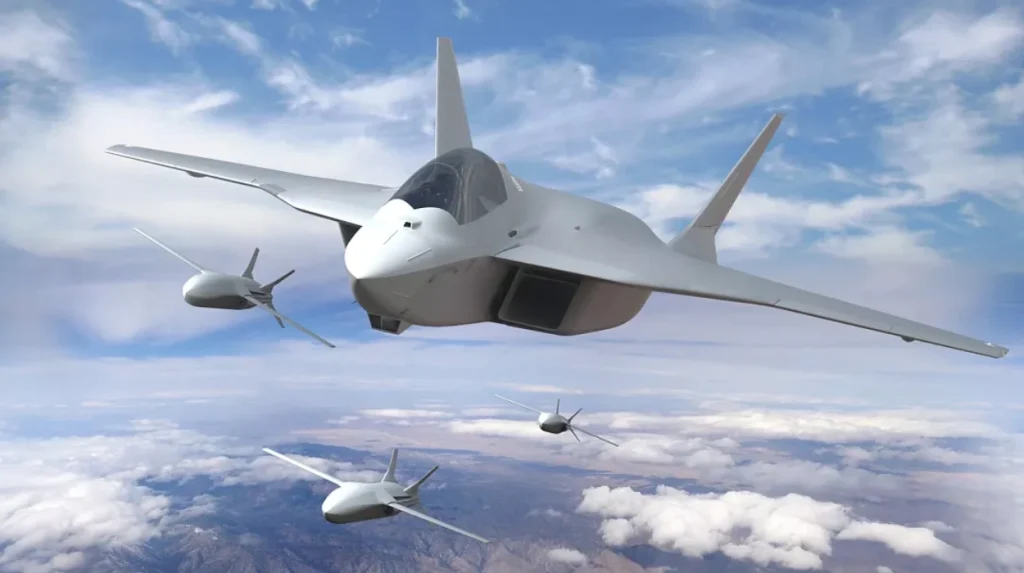
German Chancellor Friedrich Merz has confirmed that Germany and France are back in talks regarding the future of the Future Combat Air System (FCAS), which is the flagship project of next-generation fighter jets in Europe. At the center of this debate is the question of whether the FCAS should develop a common fighter jet or whether it should diverge into two different designs under a common system.
The renewed discussions come after more than a year of paralysis in a project valued at approximately €100 billion, widely seen as central to Europe’s long-term air power and strategic autonomy. Speaking in Berlin alongside Lithuania’s prime minister, Merz acknowledged that Germany is engaged in “intensive talks with France” over whether joint aircraft development remains viable.
A €100 Billion Program Stalled by Politics and Industry
Launched in 2017 by France and Germany, with Spain joining in 2019, FCAS was envisioned as a comprehensive “system of systems” combining a sixth-generation fighter jet, unmanned “remote carriers” (drones), and a networked combat cloud powered by artificial intelligence. The system is intended to replace France’s Rafale and Germany and Spain’s Eurofighter fleets from around 2040.
Yet despite its strategic ambition, FCAS has been repeatedly delayed by industrial rivalry, governance disputes, and diverging national priorities. Progress effectively stalled in 2024 amid disagreements over workshare, intellectual property, and leadership roles between Dassault Aviation and Airbus Defence and Space.
The program’s latest uncertainty reflects a broader problem in European defense cooperation: grand political visions colliding with entrenched national industrial interests.
Two Jets, One System? A Symptom of Deeper Fragmentation
Among the proposals that are currently being seriously considered is the separation of the fighter jet from the overall FCAS structure, enabling France and Germany to work on different jets but continue to work together on drones, sensors, and the combat cloud. As Euractiv reported, this proposal has been well-received as a means of unblocking the impasse.
Airbus Defence and Space CEO Michael Schöllhorn expressed support for the plan on January 29, saying that the development of two fighters is a “good solution.” However, some observers have pointed out that a two-jet solution may end up undermining the very purpose of the FCAS program, which could become little more than a coordinated effort.
Instead of addressing the problem of fragmentation, a two-jet solution may end up institutionalizing the problem, making it more expensive and difficult to implement.
France vs Germany: Strategic Cultures Collide
One of the main sources of tension is the different military doctrines. The French government is adamant that the future fighter needs to be able to support its nuclear deterrent and operate from aircraft carriers, which puts a number of strict constraints on size and design. The German government, which does not have nuclear weapons or aircraft carriers, is more focused on land-based multirole capabilities and interoperability with NATO.
These are not mere technical details but rather define the whole aircraft system. It has been politically and industrially difficult to try to find a compromise between the two, which has strengthened the case for divergence.
Industrial Rivalry and the Dassault–Airbus Power Struggle
But beyond the strategic considerations, the FCAS program has also become a turf war between the two aerospace leaders in Europe. Dassault has always been adamant about being the lead contractor for the new fighter plane, given its experience with the Rafale. Airbus, on the other hand, has represented the interests of Germany and Spain, and has been pressing for a more balanced leadership arrangement.
Such differences are not just about the companies. They also represent the broader national interests of Europe regarding issues of technological sovereignty, export policies, and industrial competitiveness. The leadership of the fighter program will determine the future of combat aviation in Europe for generations to come.
Spain Caught in the Middle
Spain, the third partner in the FCAS, has been effectively relegated to the sidelines in the public spat but is financially and politically committed. A rift between Paris and Berlin could put Madrid in a position of being forced to choose between a reduced role, an alignment with one of the partners, or being left on the periphery of the future European air combat environment.
This adds a further layer of instability to a project that is already struggling with coherence.
Strategic Consequences for European Defense Autonomy
The FCAS standoff also has wider implications than just fighter aircraft. The FCAS project is frequently mentioned as a cornerstone of European strategic autonomy, particularly in light of the United States’ acceleration of its Next Generation Air Dominance (NGAD) program and China’s development of its sixth-generation designs.
Delays could potentially leave Europe reliant on non-European designs well into the 2040s, which would undermine the notion of defense sovereignty. Simultaneous projects, such as the Global Combat Air Programme (GCAP) led by the UK, Italy, and Japan, are actually progressing at a faster pace, and there are doubts about whether FCAS can remain competitive.
Merz’s Optimism vs Structural Reality
However, Chancellor Merz has been trying to appear confident, saying that
“there will definitely be joint systems”
and that a decision can be expected within weeks. But such promises have been made before, only to be superseded by political drift and industry resistance.
Without a firm political agreement at the highest level, one that will compel industry to fall in line rather than simply accommodate division, the FCAS project could come to symbolize Europe’s failure to turn ambition into capability.
The question of one plane or two is more than a matter of design—it is a referendum on European cooperation in defense. A divided fighter program may keep the FCAS project alive on paper, but it could undermine efficiency, drive up costs, and weaken integration.
If Europe cannot reconcile strategic cultures and industrial egos within a €100 billion flagship program, the credibility of future multinational defense projects will be severely undermined. FCAS now stands as a test case: either a breakthrough in European defense integration, or a cautionary tale of managed fragmentation.