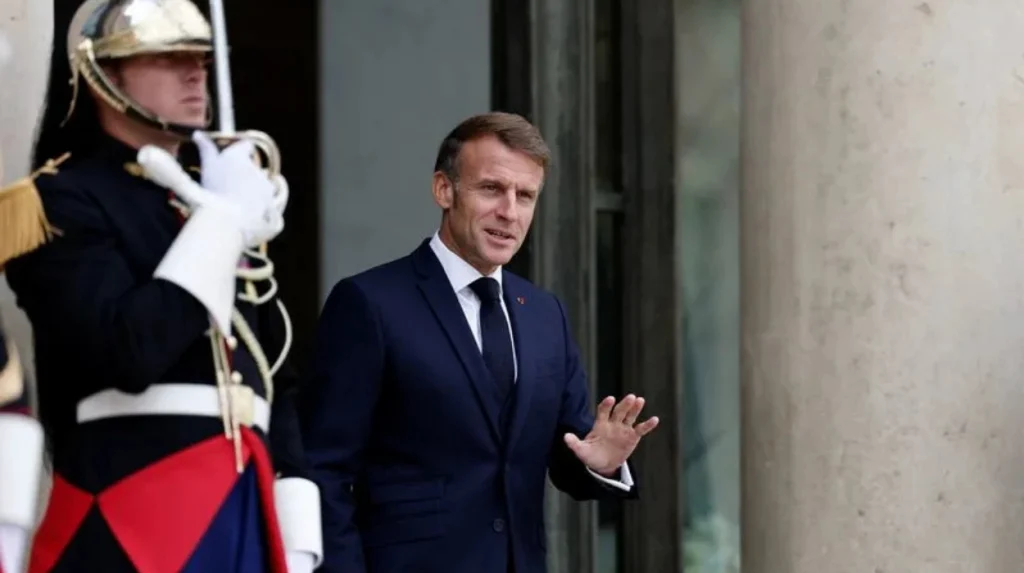
The presidency of Emmanuel Macron is beginning 2025 with an economic burden and France is going through one of the most complicated crises of recent decades. The French economy which was previously billed as an exemplar of economic strength in the European Union has lost steam due to the continued inflation, low investment and mounting dissatisfaction among the citizenry. The Banque de France had reduced its GDP growth projection to 0.7 per cent by 2025, which represents the aggregate impact of increasing debt, policy paralysis and dwindling business confidence.
Fitch and Standard and Poor credit rating agencies have reduced the sovereign rating of France, with a wake-up call of fiscally deteriorating and politically unstable. This negative rating raises the cost of borrowing, which adds more pressures to the finances of the populace and diminishes fiscal flexibility. This increase in interest rates coupled with a deceleration of growth drives France to the risk of a sustained economic stagnation.
Political volatility and governance strain
France has seen five prime ministers since the re-election of Macron in 2022, which is a record in terms of frequency in the Fifth Republic. The newest, Sebastien Lecornu, struggles with an uphill task of managing a fractured parliament with no apparent majority. Constant confrontations between centrist, far-left and far-right blocs have paralyzed major fiscal and labor reforms. This atmosphere compromises continuity of governance and confidence by the people which contributes to the perception of an executive that has been weakened by political fracturing.
France’s fiscal trajectory and investor confidence
The fiscal situation of France remains poor as the level of public debt is more than 113 percent of GDP with a budget deficit of more than 5.8 percent. These figures put the country far above the target of Europe Union stability and growth pact 3%. Although the government of Macron explains increased expenditures as the necessity to support social protection and green investment, the critics claim that the strategy does not imply any viable medium-term consolidation strategies.
The European commission has already taken the issue of France failing to adhere to the fiscal regulations and this has indicated that corrective measures may be taken. The level of investor confidence is still weak and the 10-year bond yields in France have risen to 3.34 that borders on limiting the fiscal policies.
The failure of fiscal reform consensus
Political divisions have acted as a hitch towards trying to reorganize the expenditure and enhance efficiency in the taxation system. The left-wing movements promote the idea of progressive taxation and welfare-states to deal with the inequality, whereas the conservative groups insist on the reduction of spending and restricting migration. Macron with his centrist coalition, which is between these extremes, finds it difficult to remain coherent in legislation. This continued stalemate does not allow structural fiscal correction, which is fueling the anxiety of there being structural deficits over the next five years and beyond.
The widening gap in French society
The social scene of France is characterized by growing resentment against inequality and poor pay. Household purchasing power is still declining due to the cost of living crisis caused by energy price shocks and the high food inflation. The rate of unemployment is still high especially among the youth and low-skilled workers with small and medium enterprises increasingly encountering the danger of bankruptcy following the tightening of credit requirements.
The mass protests, similar to the 2019 movement of Yellow Vests, have resurfaced in the major cities. The participants protest against what they perceive as favoritism towards corporate interest groups and foreign investors and enforce more redistributive policies.
Regional disparities and populist resurgence
Social polarization is enhanced by the economic disparity between metropolitan centers and rural France. Unemployment and underinvestment in services has made its way to populations of the peripheral regions, which in turn have been resorting to populist discourses. The National Rally led by Marine Le Pen is taking advantage of this mood and is increasing its electoral foothold in the run-up to the 2027 elections.
The president of the rich Macron is still described as such as most people believe that his reforms especially in taxation and labor flexibility will favor the rich in the country. This is believed to undermine the credibility of centrist politics in the changing French environment, a fact which analysts fear.
Political fatigue and reform paralysis
The collapse of carrying out the flagship pension reform represents the weakness of the political power of Macron. First introduced as a measure necessary to make the financial system sustainable, the proposal has sparked mass protests and union strikes. By the end of 2024 the government indefinitely suspended the reform, marking defeat due to social pressure. This flip-flop estranged some of the central supporters as well as increasing political criticism on the right and left.
Failure to implement the pension overhaul has lowered the credibility of France in the European fiscal debate, in which structural reforms are regarded as the stepping stone to long-term stability. The fact that Macron has an approval rating of about 14 percent by the end of 2025 highlights how the people are disenchanted with his leadership and the ideology of centrist that Macron embodies.
Decline of “Macronism” as a governing vision
The initial agenda of Macron that involved the integration of pro-business modernization with social inclusion has corroded under economic necessities and political resistance. His attempt to balance market liberalisation and welfare protection has failed mostly to please both ends of the political axis. The vacuum created has only increased the rate of polarization as ideologically oriented movements gain strength and the traditional center of France is weakened.
In the European Union, Macron has less power, which makes it more difficult to affect the fiscal coordination, defense policy and management of migration of France. The allies now see Paris as a vacillating ally instead of a changer of direction as the domestic constraints of its leadership model.
France’s uncertain trajectory in 2025 and beyond
The long term consequence of the policies of Emmanuel Macron brings out the complex interaction between ambition, governance and economic reality. A combination of social welfare demands and fiscal discipline in his administration is not sitting well, and the result has not been happy on both economic and social stability measures. This is the state of tension that characterizes the present situation of France, a country full of riches but with a heavy weight, a country full of reforms but incapacitated.
In the future, France will be at a crossroad. In case the economic stagnation continues and social unrest, the popularity of populist options can redefine its political future. However, with fiscal reforms doing well again and social dialogue returning to its level, France may still re-emerge as a dominant force in Europe.
Even in 2025, the equilibrium between reform and legitimacy will continue to be the test of fire that France takes. Not only will the result of the election be a determinant of the future of the Macron presidency, it will also have an impact on the greater experiment of economic accountability and social fairness being tested in Europe.