The humanitarian crisis that has been developing in Gaza by 2025 has emerged as the prime issue that international diplomacy focuses its attention on. One of the most public statements thus far against the proposed full military invasion of the Gaza Strip by Israel has come in the form of a warning issued by French foreign minister Jean-Noel Barrot, which argued that such an action would not only be doomed to fail in its stated aim of disbanding the Hamas terrorist group, but would also only serve to make an already devastating humanitarian situation all the worse. His comments are made on the heels of world concern about the consequences of 22 months of active hostilities and blockade leading to devastation of the Gaza infrastructure and the displacement of about 85 percent of the population.
The condemnation by Barrot further contributes to the pressure being mounted on Israel to rethink its military campaign especially when the international community has failed to initiate a sustainable ceasefire and significant humanitarian assistance. The French position echoes the growing unease on the part of Western allies about the policy being pursued which will not only dampen regional stability, but will not contribute meaningfully to either strategic or humanitarian aims.
Humanitarian indicators show irreversible damage
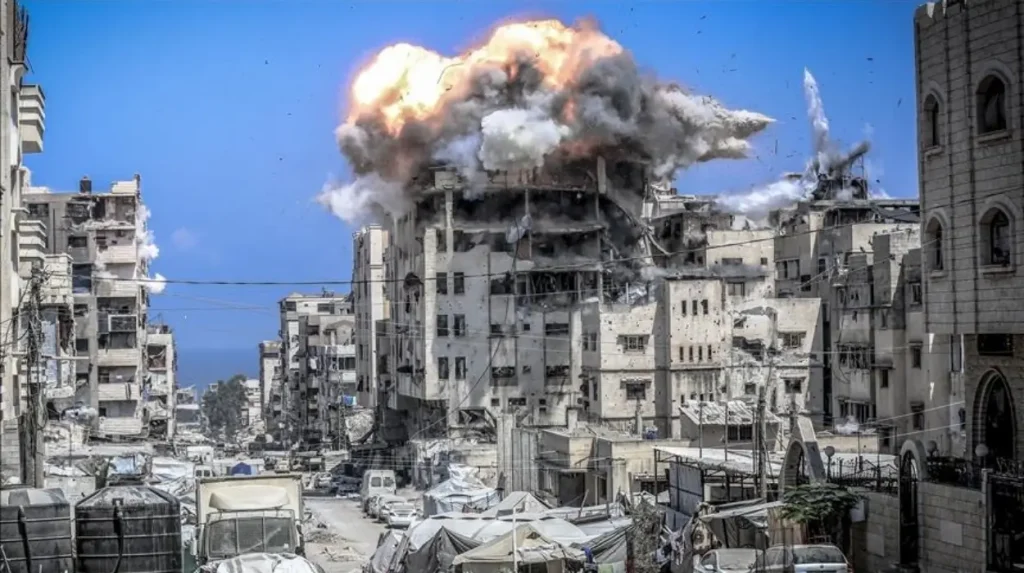
It has been at a toll of magnitudes on the civilian population in Gaza like never before. More than 58,000 Palestinians, including almost a third of the children, have been killed since the escalation of October 2023. In August 2025, according to the Gaza Ministry of Health and UN agencies, there were 139,000 injuries of which a large number are permanently disabled due to poor medical services.
Displacement is unprecedented and 1.9 million people (approximately 90 percent of the population of Gaza) are displaced with many forced out of their homes again and again. Safe areas have constricted to less than 12 per cent of the land and Israeli harsh orders have led to mass violently dispersed movements of citizens with little access to water, shelter facilities, and medical help. The cumulative impact has been the near-collapse of Gaza’s social structure.
Collapsing health system and famine risk
Healthcare delivery is now virtually non-functional. With over 500 aid workers killed—including UN and Red Crescent personnel—and critical medical infrastructure destroyed, the few remaining hospitals operate under extreme conditions. Shortages of surgical supplies, antibiotics, and electricity have rendered them unable to treat even basic trauma cases.
The famine crisis is equally acute. As of July 2025, the Integrated Food Security Phase Classification system places over half a million Gazans at IPC Phase 5—defined as catastrophic food insecurity. Dozens of children have died from starvation, and more than 20,000 under the age of five have been diagnosed with acute malnutrition. Israel’s restrictions on aid convoys and fuel entry have left tons of supplies stuck at checkpoints, within sight but out of reach of dying civilians.
France’s evolving diplomatic response
Jean-Noël Barrot’s position against the Gaza takeover underscores France’s broader concerns regarding the trajectory of Israeli military strategy. In late July speaking from Paris, Barrot added that a full scale occupation could only increase suffering and spoil every attempt towards sustainable peace or hostage recovery. He also stressed there is no obvious post-conflict governance strategy to the operation that is potentially leading to lifelong occupation and seclusion of Israel by the international community.
It is the sentiment shared in the European Union foreign policy circles whose key principle requires the Israeli actions to be aligned with international law, the emphasis on the protection of civilians and not taking acts that lead to the destabilization of an already volatile conflict. French resistance is also based on previous EU statements that are demanding a higher level of responsibility in actions contributing to deaths of civilians as well as impediment of humanitarian access.
Operational humanitarian efforts
In addition to diplomatic positioning, France has also initiated several humanitarian operations that would evacuate the wounded civilians and medical workers as well as nationals of other countries. With the agreement of the Egyptian government, French militaries have operated their aircraft that ferry the vulnerable to healthcare centers in Cairo and Paris.
Moreover, France is an international negotiator on hostages, especially to work with Qatar and the United States. French diplomats have objected to Israeli refusals to issue visas to the head of UN aid in Gaza and to IDF attacks that have severed aid routes and field hospitals time and again. All these measures represent an effort on the French side to find a way amid the balance between political pressure and practical humanitarian intervention.
Regional consequences and Israeli political calculations
France does not stand alone in cautioning against a large-scale ground operation. British and German leaders have echoed those warnings, with British leader Lord Richard Dannatt cautioning that the greatly escalated fighting in the crowded urban environs of such population centers as Gaza City could pose a threat to the lives of surviving hostages and result in further war crimes charges. Agencies at the United Nations and the International Committee of the Red Cross have cautioned that the infrastructure of Gaza could not bear any more increase in military escalation.
UN Secretary-General António Guterres described the situation as “a humanitarian catastrophe of epic proportions,” urging all parties to “uphold the principles of distinction, proportionality, and necessity under international humanitarian law.” Despite this, Israeli leadership continues to maintain that the operation is essential for the total dismantling of Hamas.
Internal divisions within Israel
Inside Israel, the decision to approve a prolonged ground campaign has sparked domestic tension. Families of hostages have protested in front of the Knesset, expressing fears that an invasion will lead to their loved ones’ deaths. Security officials have expressed their doubts that the action may attract regional players such as Hezbollah and disrupt the silent diplomatic channels with Saudi Arabia.
The security cabinet decided on this plan with the full knowledge of these risks, and the plan will take years to complete, probably going into 2026. Heavy urban combat is predicted to be a part of the operation so the analysts predict that over a year of instability and tens of thousands of extra civilian deaths will be the result unless the trend is changed.
Gaza takeover raises questions about post-war governance
Lack of a well laid out strategy on what would follow after the conflict has proved to be a bone of contention among international stakeholders. Israeli authorities have proposed a temporary military government and after that the local Palestinian government under foreign supervision but the details are blurred and not convincing to the foreign community. Failure to have a feasible political plan makes the long-term objectives of the operation to lack credibility and further complicates the humanitarian concerns.
The fear that such Israeli military presence may be permanent or a disunited local rule would augur further conflict as well as civil unrest and the subsequent loss of any little political capital left on a two-state solution. With over 70% of Gaza’s infrastructure rendered nonfunctional, reconstruction would require billions in international aid, yet current donor states remain unwilling to commit while active military operations continue.
Global voices urge adherence to international law
This person has recently spoken on the complexities of the Gaza crisis, emphasizing international humanitarian law and the urgent need for balanced solutions protecting civilians and hostages alike:
BREAKING:
— Megatron (@Megatron_ron) July 28, 2025
🇫🇷🇮🇱 Israel’s ‘indefinite’ war in Gaza has NO JUSTIFICATION, two-state solution is must – French FM
"Gaza today is a charnel house where the corpses are looking famished and the spirits are becoming desperate.
Speaking on urgent need to recognize Palestine and reach… pic.twitter.com/ZmCFszVjjC
The emphasis on legal obligations and neutral humanitarian access reflects a growing consensus among international analysts that the future stability of the region hinges not only on military outcomes but also on the moral and legal frameworks that govern them.
As violations of international law mount—from attacks on medical facilities to forced evacuations and aid blockades—the reputational cost to Israel continues to grow. Legal scholars and human rights monitors warn that continued operations without accountability mechanisms may expose both Israeli and Hamas actors to prosecution by the International Criminal Court, further complicating diplomatic efforts.
The crossroads of violence, diplomacy, and humanitarian urgency
The Gaza crisis in the year 2025 is now at a turning point. The military takeover that leaders in Israel claim is essential to the security of the nation is finding more opposition not only by its foes but also by its most strategic associates such as France. The observations made by Jean-Noel Barrot are not rhetorical only as they summarize the expressed doubts about the way of the conflict development, its influence on civilians, and the sustainability of the peacebuilding processes.
France is playing a leading role in a general realization around the world of the frustrating inability of military solutions to resolve humanitarian emergencies. It is unclear whether these warnings will be followed up by a change in policy but the importance of safeguarding human life and the accepted international standards which underpins them has seldom been more pressing. What Israel and Hamas, as well as the international community do next will not only reveal the destiny of Gaza, but also the validity concerning the world reaction to one of the most catastrophic conflicts of the decade.