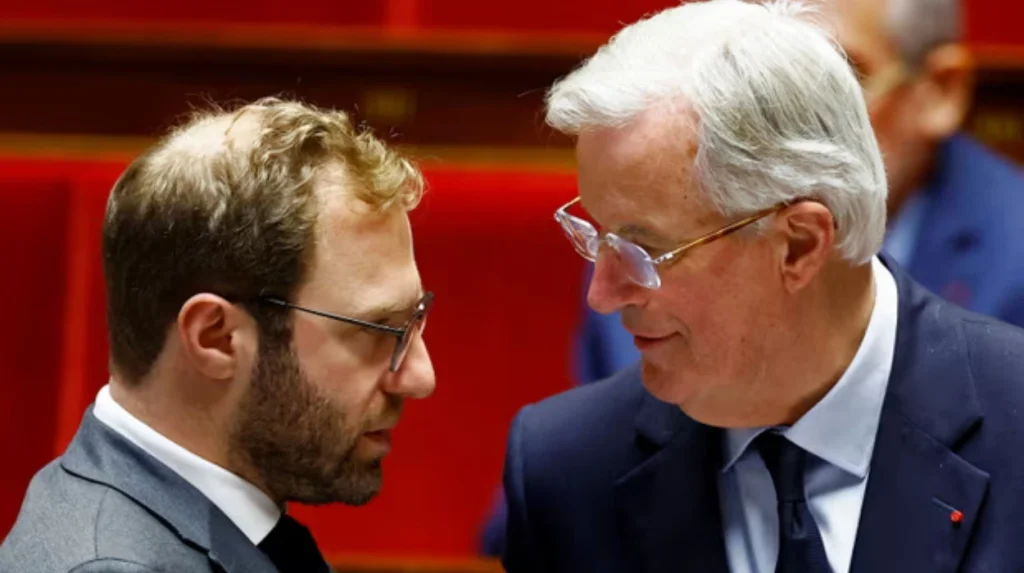
France’s minority government is on the verge of dissolving due to opposition ire over a proposed austerity budget, putting the country at risk of experiencing new political unrest. French sovereign borrowing rates have increased significantly, hitting the largest premium over German bonds since the height of the eurozone debt crisis in 2012, reflecting rising financial market trepidation. The French far-right leader Marine Le Pen has threatened to overthrow the government because of Prime Minister Michel Barnier’s plans for a budget that includes €60 billion (£50 billion) in tax increases and expenditure cutbacks despite not having a majority in parliament. Barnier dropped proposals to hike an electricity tariff on Thursday, marking a significant compromise. Jordan Bardella, the president of the far-right National Rally, declared a “victory” over the step, but he cautioned that “other red lines remain.”
Political instability in France
The biggest difference between French and German sovereign borrowing prices since 2012 grew to 90 basis points on Wednesday. The Paris stock market saw a decline in shares as well. For the first time on Thursday, the yield, or interest rate, on 10-year French government bonds momentarily surpassed those of Greece due to market apprehension that the fall of the government may lead to a new round of political unrest. Antoine Armand, the finance minister, stated that the government was willing to make some budgetary concessions later on Thursday, which caused the yield on French bonds to marginally decline again. Following Emmanuel Macron’s snap elections this summer, the EU and financial markets are putting pressure on the new minority government to stabilize the public finances after it warned that this year’s budget deficit the difference between spending and tax revenue—would surpass 6% of GDP. Barnier revealed tax increases last month, including the reinstatement of a fee on power usage that had been suspended during the energy crisis, along with cuts to welfare, health, pensions, and local governments.
EU’s growing concerns
According to the proposal, borrowing might be reduced to 5% of GDP the next year, but it could still approach 7% in the absence of that action. The EU’s stability and growth agreement, which aims to guarantee that member states pursue “sound public finances” and coordinate their tax and spending plans, would more than treble the 3% cap. An “excessive deficit” monitoring mechanism has been imposed on France by Brussels. Investors worry that France may continue to pursue unsustainable ambitions, even if Belgium, Italy, and Poland are among the other countries in a similar situation. Since the government stepped in to protect people and companies and lower economic activity reduced tax revenues, borrowing increased dramatically during the COVID-19 epidemic and Russia’s war in Ukraine, which caused a worldwide inflation shock. The stability of state finances, however, has been weakened by tax cuts that Macron implemented as part of his reforming ambition to bring more free-market dynamism to the French economy, according to economists.
Impact on the French economy
“Unfunded tax cuts under Macron are the main cause of the current precarious fiscal situation,”
stated Léo Barincou, a senior economist at the consultancy firm Oxford Economics. French Prime Minister Michel Barnier’s administration appears to have a dismal future, as his attempts to pass the 2025 budget through a divided parliament are more likely to result in the dissolution of his tenuous coalition. If far-right and leftist opponents launch a no-confidence motion that Barnier is sure to lose, his administration may fall before Christmas, and possibly even by next week, according to a dozen individuals from a variety of political backgrounds. The sources claimed that even if Barnier lived, he would only do so by giving in to pressure to reduce expenditure, which would further erode the nation’s already precarious public finances and stifle investor interest. To prevent France from experiencing its second political crisis in as many months, Barnier’s team is constantly negotiating with Marine Le Pen’s far-right National Rally (RN), which supports his cabinet, and other parties.
French government’s response
The core of France’s political woes is the budget bill. By raising taxes and cutting expenditure by 60 billion euros ($62.85 billion), it aims to control France’s rapidly growing public deficit. However, it has turned out to be Barnier’s right-wing government’s kryptonite. The law is presently being discussed in the Senate after being rejected by the sharply split lower chamber, which was made nearly unmanageable by Macron’s disastrous decision to call a quick election that resulted in a hung parliament.