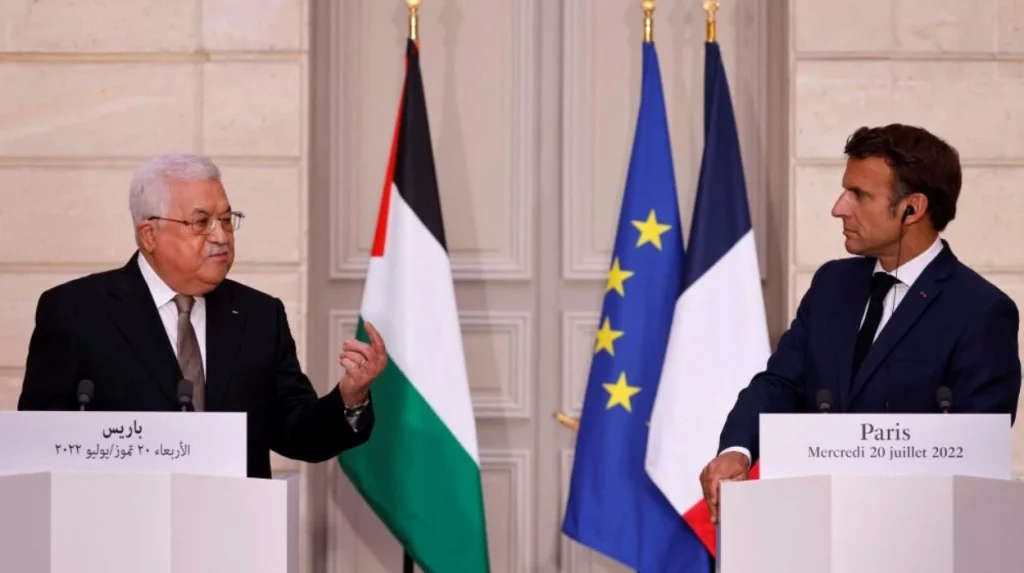
The decision of French President Emmanuel Macron to officially acknowledge Palestine as an independent state during the United Nations general assembly is a historic move in the field of diplomacy. This was a dramatic departure from the long-traditionally reserved nature of France that had been trying to maintain a dialogue with Israel and the Palestinian Authority. The statement, which was issued in the form of commitment to the two-state solution, was an attempt by France to reestablish its popularity as a mediator in the international arena, based on international law.
According to Macron, the recognition of the state of Palestine is a necessity that would restore the balance and the hope of peace. His message came when there was increasing regional unrest such as the Gaza deteriorating and settlements growing in the west bank. The recognition was broadly viewed as a turning point in the strategy, as the effort to jumpstart frozen talks with a symbolic but politically significant move.
The action highlighted France, being frustrated with years of diplomatic inability and increased distrust of the old mediation models. With the recognition being formalized at the UN, Paris sought to show leadership in Europe, and re-energize the course towards peace on a multilateral and law-based process.
Impact On French Credibility As A Mediator
The fact that France recognizes Palestine can never be the same in the understanding of its neutrality in the Israeli Palestine war. France had traditionally had a delicate balancing act in favor of Palestinian self-determination and security promises to Israel. This balance which is crucial to its mediator position is now being questioned. Paris has the problem of demonstrating the fact that recognition was not a political intervention but the way to enhance dialogue based on legitimacy and law.
On one hand, the move was celebrated by the Palestinian authorities and most Arab countries as a long overdue move towards justice, but on the other hand the move was condemned by the Israeli officials as a unilateral and counterproductive move. This contention casts doubts on the fact that France is in a position to act as a reliable broker that can make both sides sit down.
Diplomatic Leverage Through Recognition
However, according to the analysts, the recognition could increase the diplomatic leverage of France. By taking the position of international requirements of Palestinian state, Paris may influence the Arab League and the Organization of Islamic Cooperation that both imply greater involvement of the international community. The fact that France is long known to practice diplomatic refinement and be involved in peacekeeping efforts may also divide the force of the prejudiced apprehensions.
The French policymakers have opined that moral credibility may act as strategic capital they can use to give Paris more legitimate advocacy of renewed negotiations in the Arab world and still be a major European interlocutor with Israel.
Shifts In Alliances And Regional Diplomatic Dynamics
The fame of France has fueled new orientations in the Middle East. Gulf region Arab states have come out in great support of the position of Paris. Both the UAE and Saudi Arabia in 2025 pointed out that the stance of France is indicative of the international opinion regarding the right to Palestinian self-determination. This has led to further integration of France in the areas of energy, defense, and infrastructure, and partly this marks a convergence between strategic and moral diplomacy.
On the other hand, the action will lead to the potential worsening of relations with Israel, which said that France has put direct negotiations and unilateral efforts in jeopardy. Although the diplomatic tensions have not been turned into a rupture, the mistrust of Israeli against French mediation can remain and it is difficult to facilitate the peace process in future.
European And Transatlantic Repercussions
On the European front, the move by France supports the request by the EU to have a common stand on Palestine. Some member states have since shown their willingness to lead in the footsteps of Paris such as Ireland and Spain. This trend may transform the EU foreign policy where it will no longer be the spectators of the peace process but rather participate in it actively.
In the transatlantic circles the recognition, however, creates friction. The United States has been very conservative and has been focusing on regional normalization between Israel and the Arab countries. The acknowledgment of France, then, helps highlight a new drift in the approach to Western diplomacy between the international acclaim of Europe and the practicality of the U.S. involvement in foreign affairs.
Influence On EU And International Mediation Efforts
The move by France is a fresh boost to the overall European Union agenda on peace and stability in the Middle East. In 2025, the EU stepped up coordination with France to increase humanitarian aid and governance support in Palestinian territories. Brussels also started considering a new joint venture to re-establish the Quartet framework possibly by including the Arab League representation in order to make it inclusive.
This new European activism can enhance the diplomatic voice of the continent in the region, which was dominated previously by the U.S. led initiatives. It is also consistent with the post-Ukraine foreign policy change of the EU, which claims to be more strategic and to be guided by diplomacy, based on the international norms.
Broader Multilateral Implications
The international institutions are also echoed in the recognition of France. At the United Nations, the action has brought back the debate concerning full membership of Palestine. The move by France was received positively by the UN Secretary-General who called it a move towards renewed commitment to peace. Concurrently, it has sparked controversies at the Security Council regarding the feasibility of the two-state solution in the face of continued turmoil.
Beyond the UN, France has been more collaborative with regional bodies like the Arab League and the African Union, which have signed its accreditation as an example of positive interaction. Such alliances are an indicator of the willingness of France to develop a new multilateral agreement that will support Palestinian statehood not just in the Western diplomatic community but also in other quarters.
Prospects For Peace And The Future Of Mediation
The fact that France recognized Palestine is not merely a symbolic gesture but a strategic reset of Middle East politics in 2025. This is because Paris aims at rejuvenating a sinking peace process through renewed dialogue and multilateral coordination by making international law and moral legitimacy the central focus of the P5+1 peace process. However, there is a risk involved in this strategy. It violates the traditional diplomatic norms and puts the right of France to credibility with Israel, its European allies, and the United States into question.
In view of the fact that the region is experiencing chronic instability and switching of international alliances, the biggest question posed is whether symbolic recognition will translate into tangible diplomatic breakthroughs. The gamble of France lies in the assumption that credibility is not based on non partisanism but principled involvement. Whether or not such a belief will lead to sustainable peace or more polarization will be the determinant of not only the future of France in the Middle East, but also the future of the whole of Europe in mediating conflicts around the world.
The result of this latest diplomatic course could be the deciding factor between 2025 being a center of a more aggressive, values-based new European role in the Middle East or an occasion to recall the boundaries of recognition without reconciliation.