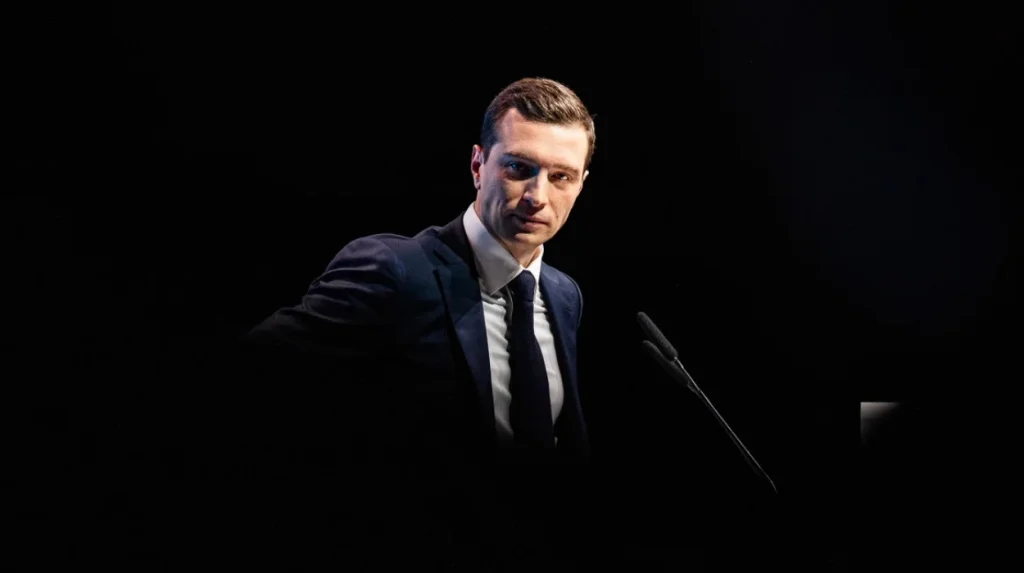
A generation ago, it seemed unimaginable: the head of France’s far-right party – an organisation notoriously established by Nazis – was welcomed to address an Israeli antisemitism conference. Recently, Jordan Bardella, the head of France’s National Rally party, is set to take the stage in Jerusalem. This marks a victory that is both symbolic and political for the far-right legislator as Israel looks to establish new alliances globally.
This marks a remarkable shift in political conventions. Far-right leaders throughout Europe, eager for mainstream acceptance, are aligning with Israel to vilify Muslims who support the Palestinian cause. Israeli Prime Minister Benjamin Netanyahu, whose party has long viewed itself as a natural ally of global right-wing movements, is endorsing a movement that has historically been rejected by Jews.
This is particularly surprising given that antisemitism is a fundamental belief among many right-wing extremists, who have perpetrated some of the deadliest attacks on Jews in the West recently years.
Political shapeshifter
The increasing acceptance of the European far right parallels Israel’s rightward shift.
Netanyahu currently leads with Itamar Ben Gvir, a minister formerly deemed too extreme for Israeli military service, who also has a conviction for endorsing a terror organisation.
According to Daniel Shek, a retired Israeli diplomat who was the ambassador to France from 2006 to 2010, the choice to invite someone like Bardella to speak in Jerusalem has been “in the works for some time.”
Amichai Chikli, Israel’s minister for diaspora affairs and organiser of the conference, has been advocating the notion that far-right parties in Europe and beyond are Israel’s natural allies, Shek commented.
“Thus, their history and ideological foundations are seen as long as they support the Israeli government and oppose Muslims.”
Shek further noted,
“For the current government, Muslims and the extreme left are the only true antisemites.”
The Anti-Defamation League, which tracks a soaring number of white supremacist incidents, says that geographic location is a far more important indicator of antisemitic views than religion.
The choice to invite Bardella and representatives from far-right parties sparked enough controversy that Israeli President Isaac Herzog opted out of hosting the conference’s opening night focused on antisemitism.
Netanyahu, frequently positioning himself as the global defender of Jews, has asserted that he will “never permit the horrors of history to repeat – we will never surrender to antisemitism or terrorism.”
Shek’s opinions are not shared by all former Israeli diplomats. Avi Pazner, who served as ambassador to France in the 1990s, noted that the National Rally has “evolved.”
“I recognize the wickedness of Jean Marie Le Pen – the infamous antisemite. However, I now perceive that his party has undergone a significant transformation,”
Pazner remarked.
“In our tradition, when a person shows genuine remorse, we should welcome them instead of turning them away.”
During his time leading European affairs at Israel’s foreign ministry, Shek recalled consistently fending off efforts from Marine Le Pen – Jean-Marie’s daughter and Bardella’s predecessor – to visit Israel.
“It was a persistent challenge,”
he noted.
Ultimately, he stated that the Israeli government needs to heed the views of the majority of French Jews, who, while yearning for law and order, harbor doubts about the far-right.
“I have always believed we should follow the insights of local Jewish communities,”
he expressed.
“To bypass them is nothing short of a betrayal.”
Regardless of Bardella’s thoughts, Shek expressed, the idea of the party formerly led by Jean Marie Le Pen attending a conference in Jerusalem is overwhelming. “He is not a private person. He represents a party and a movement that has very deep roots in antisemitism and Holocaust denial.”