Since 2017, the democratic course of France has been characterized by a significantly negative trend, a decrease in political confidence, a decrease in voter turnout, and continued violations of civil rights. In an annual evaluation, the International Federation of Human Rights (FIDH) pointed to a significant deterioration of democratic infrastructure in the institution, that civil society is increasingly limited in its participation and expression.
This decline is not abstract. According to the 2025 Political Trust Barometer, just 28% of the French people think democracy is functioning successfully, a drastic decline since the middle of the 2010s and the first drop in a decade. This loss of faith is a reflection of the national sentiment at the time of the Gilets jaunes protests of 2018 but is now seemingly more deeply rooted in terms of demographics and ideological boundaries.
The advocates of the leftist, nationalist, and far-right political candidates all of them show less confidence. Only 21 percent of the base of Jean-Luc Melenchon is satisfied with the democratic functioning. This figure declines to 17 percent among the supporters of Marine Le Pen and to 10 percent of the supporters of Eric Zemmour. The disappointment spreads to the institutions too-74% of the interviewees report a level of little or no trust in the political system and trust in the presidency, the office of the Prime Minister and the National Assembly remains at a low level.
Structural Causes Underpinning Democratic Erosion
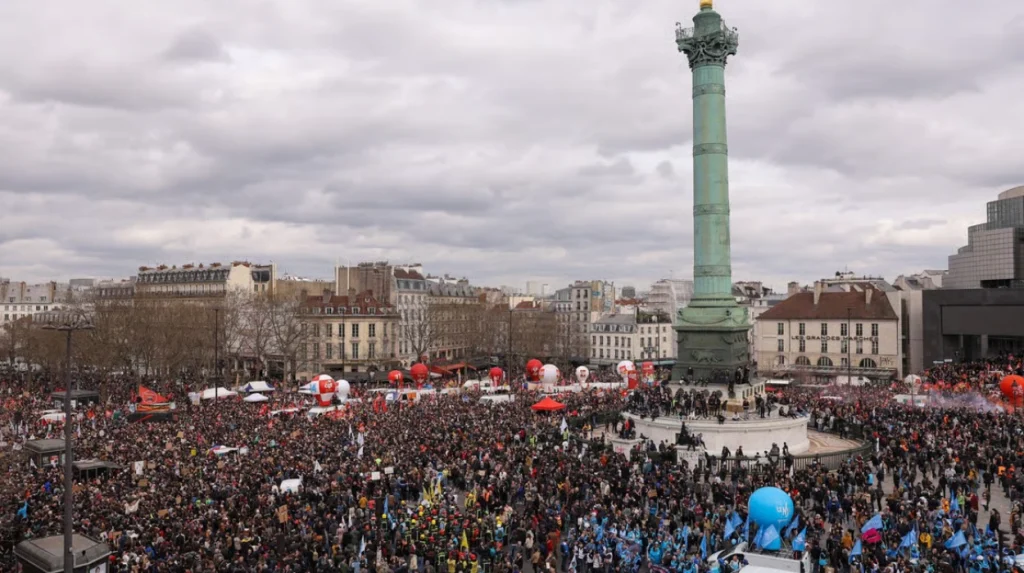
Backsliding of democracy in France is strongly related to the legal, institutional, and cultural processes which have been further intensified since the year 2017. One of the key reasons is the growing reliance on the French Constitution Article 49.3 that allows the executive to enact the legislation without parliamentary support. The governments of President Emmanuel Macron have used this provision more than 20 times, including the recent 2023 battle over pension reform that sparked mass actions and unrest in the streets.
Although legal, common use of Article 49.3 has been seen by most to be a circumvention of the democratic principle, undermining the credibility of the legislature and casting doubts on the centralization of executive authority. The fact that these decisions do not pass through open parliamentary discussion just increases the perception of the people that the political elites are acting outside democratic control.
It is also voter apathy, which is an indicator of democratic illness. The 2024 legislative elections saw abstinence levels that had never been documented before and, more importantly, youth voter turnout was even lower at a rate in excess of 70 percent in certain age groups. This loss cannot be explained by a lack of concern; it is active disengagement based on being disappointed in party systems, political effectiveness, and the irrelevance of the institution-based mechanisms in addressing practical problems.
To make these problems worse is a limitation of civil liberties. The democratic infrastructure in France has been put at a strain due to increased surveillance legislation, increased restrictions on public gatherings, and administrative measures against protest groups. Although the reasons behind such measures have been usually justified in the terms of national security or anti-terrorism, it has caused concern among international watchdogs. Since 2019, Freedom House has decreased the civil liberties rating of France, claiming that there have been recurrent violations of the right to assemble and freedom of association.
Societal Implications And Political Trust Crisis
The effects of this decline in democracy trickle into the social world. Institutional trust is fading away by the region and social classes. As per the reaction of the IFOP mid-2025, most of the people, 54 percent, are of the view that there is nothing to be proud of in the present situation of the French democracy. This is a story of disillusionment that contrasts with the other democracies in the region, such as Germany and Italy, in which the political trust, albeit strained, is nevertheless more stable.
Another frightening development is the apparent increase in the tacit approval of dictatorial options. Almost half of those polled in 2025 indicated that they would accept a less democratic, but more effective, system of governance, indicating that procedural legitimacy is being undermined to perceived effectiveness. This is an omen of rising popular willingness to sacrifice checks to democratic procedures in favor of more immediate action in policy, at the price of civil rights.
The Gilets jaunes movement in 2018 was a trigger towards public anger but failed to cause lasting institutional change. Rather, it showed that there was no effective mediation of citizens and the state. The example of frequent strikes in 2023 and 2024 such as in transportation, energy, and education sectors are symptomatic of the long-term lack of connection.
Not even all levels of governance are equally susceptible, however. The local government leaders including mayors and regional councilors continue to have moderate trust, which indicates that decentralization and closeness to everyday life continue to be significant to the maintenance of democratic legitimacy.
Risks And Potential Future Trajectories
The continued deterioration in democracies is very dangerous in the long run. On the political front, the presence of a long-standing suspicion and polarization paves the way to anti-system forces. Electoral unpredictability has risen, mainstream parties are losing to partisan ideological challengers in bits and this makes it difficult to form a coalition and also legislative continuity is compromised. This turmoil threatens economic reform agendas, climate goals and core functions of a strong democracy in delivering public services.
Additional suppression of civil liberties are also problematic to international credibility. France was number 26 in the 2024 Economist Democracy Index, having been 20th in 2016. Its weakened political engagement and reduced safeguards on expression and dissent were specifically mentioned in the report. Further erosion would have the effect of alienating the influence of France in the running of the EU, and diminish its status in multilateral organisms where democratic standards continue to be a standard.
The efforts the government is making at the moment to reduce this erosion like civic consultation forums and the vow to change presidential powers- still do not translate into the real good thing. Short term reforms can hardly turn around the loss of public faith without more fundamental structural change.
Geopolitically, the democratic health of France is also part of its leadership in protecting the liberal norms in the European Union. The relative weakening of France as Hungary and Poland have been accused of democratic backsliding brings up questions over the resilience and unity of the democratic union of the EU.
Areas For Democratic Renewal
The rehabilitation of the democratic institutions in France must be an effort of legal, political and civic nature. A recalibration of executive power is one of the areas of reform that can be implemented immediately. By returning to Article 49.3 and implementing stricter restrictions on its application, the balance between legislative and executive powers can be restored, and people will have more faith in the accountability of an institution.
It is necessary to deal with the issue of electoral disengagement especially among the youth. This can be through changes in structure which might include automatic voter registration, changed voting procedures, and increased civic education programs. Political dialogue can be revived by encouraging engagement via meaningful channels that go beyond the traditional party systems such as deliberative assemblies or citizen juries.
Reestablishing civil liberties protections will also be critical. Legal reviews of recent protest laws, as recommended by the Council of Europe in 2024, should be undertaken to ensure proportionality and avoid the criminalization of dissent. Striking a balance between security and freedom will be essential to restoring trust in state institutions.
Municipal and regional governance should be empowered further. As trust remains stronger at local levels, decentralizing certain policy domains may increase responsiveness and create more visible linkages between citizen needs and policy outcomes.
Above all, democratic renewal must address the perception gap bridging what citizens experience in daily life with what institutions deliver. It is this misalignment, rather than ideological divergence alone, that fuels the sense of democratic collapse.
France stands at a pivotal moment where democratic fatigue risks hardening into systemic decay. Whether it can overcome political disengagement, civil liberty erosion, and institutional overreach depends not solely on legal fixes but on a cultural reawakening toward participatory governance. As other democracies observe similar trends, France’s experience may offer both a warning and a laboratory for solutions, if political will and societal resolve can converge in time.