On June 21, 2025, America launched a massive military campaign on three key Iranian nuclear sites: Fordo, Natanz, and Isfahan. The raids were a precipitous escalation of the war between Iran and Israel, and the US joined Israel’s attempt to dismantle Iran’s nuclear program. Although the US had announced the campaign a success, the international community responded half-heartedly, with France being particularly anxious and urging restraint to avoid further escalation.
This research analyzes the US attacks, Iran’s and the international community’s response to them, and France’s diplomatic approach of advocating caution, negotiation, and seeking a negotiated solution. It also considers the possibility of an extended regional conflict and the higher geopolitical stakes.
#Iran | France has taken note with concern of the strikes carried out last night by the United States of America against three sites in Iran's nuclear program.
— France Diplomacy 🇫🇷🇪🇺 (@francediplo_EN) June 22, 2025
Full statement ➡️ https://t.co/8siIyWpAJg pic.twitter.com/Yf1tCrfwZh
U.S. Strikes: Extent, Objectives, and Repercussions
Information on the Military Operation
The US military attacked three major nuclear facilities in Iran:
Fordo: A uranium enrichment facility located 80–90 meters below the surface that is impervious to typical attacks.
- Natanz: Iran’s primary uranium enrichment facility.
- Isfahan: Plant for nuclear technology and fuel production.
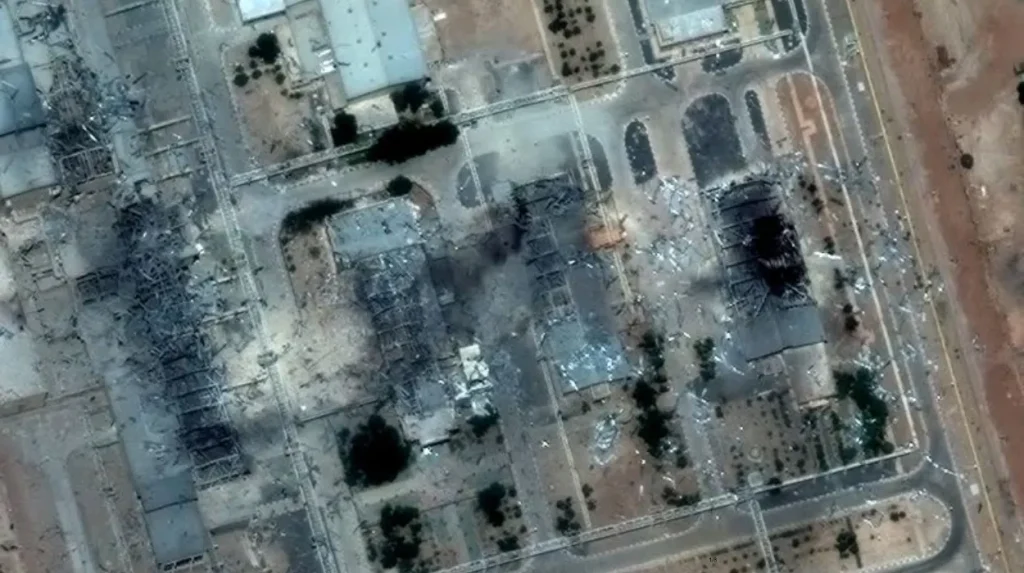
The U.S. utilized six B-2 stealth bombers delivering the U.S.’s specialist bunker-buster bombs (GBU-57 Massive Ordnance Penetrators) which left large craters that were detected via satellite images. The total bomb load included bombs up to 30,000 pounds, and cruise missiles, submarines, and warplanes were used in the operation.
Damage and Limitations
President Donald Trump stated the nuclear facilities were “completely and totally obliterated.” Independent experts, However, independent assessments suggest that Iran may have relocated enriched uranium stores before the attacks so that the only impact was likely on the nuclear materials themselves. They probably were bonding centrifuges or support structures, not on uranium stores. The goal was to delay Iran’s nuclear program.
Iran’s Response and Regional Tensions
Threats and Official Condemnation
Iran’s foreign minister Abbas Araghchi deemed the strikes a “giveaway” violation of international law and predicted “a lasting impact,” while the Revolutionary Guard called US troops in the region “vulnerable,” hinting that a retaliatory attack to take back the recent face-saving strikes was seemingly imminent.
Shortly thereafter, Iran’s parliament ratified the closure of the Strait of Hormuz, a geopolitical and economic chokepoint for international oil flows. Iran then immediately followed up the parliamentary vote by firing additional saturation rockets, further severing any connection between the attacks and diplomatic restraint.
Regional Impact
The strikes followed Israeli attacks on June 13 at Iranian military and nuclear sites, and Iranian retaliatory rocket and drone attacks on Israel. The US strikes are an escalation, and concerns about an expanded Middle East war have increased.
France’s Position: Concern and Call for Restraint
Official Statements
French Foreign Minister Jean-Noel Barrot expressed France’s concerns about the American attack and made it plain that France had no role in the attack’s preparation or execution. He made it quite evident that everyone concerned should exercise self-control and avoid intensifying or extending the dispute.
“France expresses concern to the strikes carried out today by the United States on three sites tied to the Iranian nuclear program,”
Barrot posted on social media platform X.
“France has no doubt that a sustainable solution will require a negotiated outcome as part of the framework of the nuclear Non-Proliferation Treaty.”
Diplomacy and Calls for Dialogue
France and other European partners had just held talks with Iran in Geneva where they called for return to diplomacy. French officials had noted the expected outcome for a sustainable solution was negotiation not military action. German Chancellor Friedrich Merz made the same point and called for a return to talks involving Iran, Israel, and the United States.
International Reactions: A Spectrum of Responses
Support and Alarm
- Israel: Gravely welcomed the attacks as a necessary step in eliminating an existential threat. Apart from thanking President Trump, Prime Minister Benjamin Netanyahu stressed complete coordination.
- United Kingdom: UK Prime Minister Keir Starmer called for stability and diplomacy while highlighting the threat of Iran’s nuclear aspirations and the conditional endorsement.
- Antonio Guterres, United Nations Secretary-General, expressed grave concern, called for restraint and even issued the threat of terrible consequences
- Iran’s Middle Eastern Allies: Groups, such as Hamas and the Houthis in Yemen, condemned the attacks and pledged to fight on, and even made a threat of more carnage
Escalation Concerns
Scared off by the attacks, nations such as Saudi Arabia, Iraq, Qatar, and Pakistan threatened to destabilize a region that is already dealing with potential destabilization. There is still a fair chance that the conflict will spiral out of control into a full-on war.
Strategic and geopolitical implications
Energy security risks
There are concerns around disruption to the world energy markets with the Iranian threat to close the strait of Hormuz, which is where a large share of world oil passes. This could have serious ramifications for the world economy.
The balance between deterrence and diplomacy
The US strikes exhibit that it is willing to use force to prevent Iran from obtaining nuclear weapons. France’s call for caution draws attention to the fine line we walk between deterrence and the pursuit of diplomatic solutions, and having that dialogue to avoid possibly a massive escalation event.
Strategic and Geopolitical Implications
Global Energy Security Threats
Iran’s threat to close the Strait of Hormuz (where a large portion of the world’s oil travels) could throw the world’s energy markets into chaos with dreadful global economic consequences.
The Balance of Diplomacy & Deterrence
The US strikes show, at least to some degree, that America is willing to risk a level of force to prevent Iran possessing nuclear weapons. In terms of finding the balance of deterrence with the need to be engaged diplomatically, and having the conversation that we don’t escalate to catastrophic events, France called on caution.
The Path Forward
There was no environmental harm after the strikes, according to the International Atomic Energy Agency (IAEA), which determined there was no measurable radiation. Although there is a limited window for fresh diplomatic efforts, there is still a chance of more military action.
The US bombardments of Iranian nuclear facilities signify a watershed moment in the Middle East conflict. In doing so they injected more tension and brought the possibility of broader conflict ever closer. For a country to recognize constraints on its security needs but hope to avoid a regional spillover in its reaction is reflective of France’s reasoned response, which expressed “concern” and “calm”.
The world watches closely over the coming weeks. For diplomacy to reduce bloodshed and achieve a negotiated solution balancing Iran’s nuclear ambitions with regional stability will require increased energy.