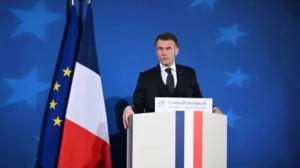
France urges Israel to avoid a South Lebanon land grab as tensions along the Israel–Lebanon frontier intensify within the broader regional conflict landscape. French diplomacy has framed the issue not only as a security calculation but also as a humanitarian and political turning point that could reshape the trajectory of the conflict. During discussions with international media and diplomatic counterparts, French officials emphasized that expanding ground operations in southern Lebanon would carry significant consequences for civilians and regional stability.
Statements from French leadership, including remarks linked to policy discussions involving Jean‑Noël Barrot, reflect a strategy focused on preventing a shift from cross-border confrontation to territorial occupation. France’s messaging suggests that escalation in the form of territorial control could deepen instability rather than resolve the underlying security concerns driving Israeli military planning.
Diplomatic Warnings About Humanitarian Consequences
French officials have repeatedly stressed that a large-scale military push into southern Lebanon could intensify displacement and damage to already strained infrastructure. Lebanon entered 2025 facing severe economic collapse, currency instability, and weakened public services, conditions that amplify the humanitarian cost of expanded hostilities.
Paris’s warning underscores how the scale of displacement already witnessed during recent exchanges could multiply if ground operations extend further north. Diplomatic statements linking military expansion to humanitarian deterioration indicate France’s attempt to influence the strategic debate in Israel through international legal and humanitarian arguments.
Balancing Security Recognition With Caution
France urges Israel to avoid a South Lebanon land grab while still acknowledging Israel’s stated goal of limiting Hezbollah’s military presence near the border. French officials recognize that Israeli policymakers view the northern frontier as a persistent security concern shaped by rocket attacks and cross-border threats.
However, France’s position emphasizes that military occupation or semi-permanent territorial control may produce unintended consequences. By presenting caution rather than outright condemnation, Paris seeks to maintain credibility with both sides of the dispute.
The Strategic Debate Around The Litani Zone
France urges Israel to avoid a South Lebanon land grab partly because of the strategic implications of controlling territory up to the Litani River. The proposed security buffer frequently discussed in policy circles would extend deep into Lebanese territory and alter the balance of control along the border.
French analysts view such a move as likely to reshape local political dynamics in Lebanon. Rather than weakening Hezbollah’s influence, they argue that an extended military presence could reinforce narratives of resistance that the organization has historically leveraged during periods of external pressure.
Geographic And Military Significance Of The Litani Area
The Litani River represents a natural geographic line often referenced in military planning discussions. Control of territory south of the river has been considered by some Israeli strategists as a way to push potential threats further from the border.
From a Lebanese perspective, however, this region includes agricultural communities, infrastructure networks, and population centers that play an important role in the country’s social and economic life. French diplomatic messaging highlights the risk that military operations there could produce long-term instability.
Historical Precedents Influencing Policy Thinking
France urges Israel to avoid a South Lebanon land grab partly because historical precedents shape expectations about outcomes. The 2006 conflict between Israel and Hezbollah demonstrated how territorial incursions can yield short-term tactical shifts without fundamentally resolving underlying security concerns.
French diplomats have pointed to these past experiences when discussing the potential consequences of renewed ground operations. Historical analysis remains a key component of the broader strategic assessment within European policy circles.
Impact On Lebanese Domestic Politics
Another concern raised by French policymakers involves the internal political dynamics within Lebanon. Territorial occupation could deepen divisions among political factions and weaken already fragile state institutions.
France’s approach suggests that maintaining Lebanese state authority in the south remains an important factor in any long-term stabilization plan. Diplomatic engagement therefore focuses on preserving conditions where political dialogue remains possible.
Legal And Humanitarian Frameworks Guiding France’s Position
France urges Israel to avoid a South Lebanon land grab by grounding its argument in international humanitarian law and established diplomatic frameworks. Paris has consistently linked its warnings to broader legal principles governing armed conflict and civilian protection.
This legal framing reflects Europe’s broader approach to conflict management, where military actions are evaluated not only through strategic effectiveness but also through compliance with international norms.
Reference To United Nations Security Arrangements
French diplomacy frequently references United Nations mechanisms governing the Israel–Lebanon border environment. These arrangements were designed to stabilize the frontier and reduce the likelihood of large-scale military confrontation.
By emphasizing these frameworks, France signals that unilateral territorial expansion could undermine the international structures intended to prevent escalation.
Civilian Protection And Displacement Concerns
Humanitarian organizations have documented rising displacement in areas affected by cross-border exchanges. France’s diplomatic messaging highlights the potential for further population movements if ground operations intensify.
This emphasis on civilian impact reflects a broader European effort to place humanitarian considerations at the center of strategic discussions about the conflict.
Economic Fragility In Lebanon
France urges Israel to avoid a South Lebanon land grab partly because of Lebanon’s ongoing economic crisis. The country’s financial system has struggled with inflation, banking instability, and declining public-sector capacity since earlier phases of economic collapse.
An expanded conflict zone could further weaken the country’s ability to recover economically, making stabilization efforts significantly more difficult.
Diplomatic Calculations And Negotiation Prospects
France urges Israel to avoid a South Lebanon land grab while promoting the possibility of diplomatic engagement between Israel and Lebanon. French officials have suggested that recent signals from Lebanese leadership regarding dialogue may represent a rare opening for political discussions.
Paris views diplomacy as a long-term pathway that could address security concerns without entrenching a cycle of military escalation. However, achieving such progress requires alignment among multiple actors whose priorities often diverge.
Signals From Lebanese Leadership
Lebanese political leaders have occasionally indicated willingness to explore negotiations aimed at stabilizing the border environment. These signals remain sensitive domestically, as discussions involving Israel carry political implications within Lebanon.
France has attempted to frame these developments as opportunities for gradual confidence-building measures rather than immediate comprehensive agreements.
Israel’s Security Perspective
From Israel’s viewpoint, security priorities dominate the policy debate. Military planners emphasize preventing attacks from armed groups operating near the border and ensuring protection for northern communities.
France’s diplomatic approach attempts to address these concerns by advocating for mechanisms that reduce cross-border tension while avoiding large-scale territorial changes.
European Mediation Efforts
France’s role as a mediator reflects a broader European interest in preventing the conflict from expanding. European governments remain concerned that escalation along the Lebanon front could connect with wider regional tensions involving multiple actors.
This perspective explains why France continues to engage in dialogue with both sides while encouraging multilateral involvement in future negotiations.
Regional Implications And The Future Of Border Stability
France urges Israel to avoid a South Lebanon land grab within a wider regional environment shaped by shifting alliances, evolving security strategies, and economic interdependence. The outcome of this debate could influence how future border crises are managed across the Middle East.
Regional governments, energy markets, and diplomatic institutions are closely watching developments along the Israel–Lebanon frontier. Each escalation or de-escalation carries implications beyond the immediate border area, affecting perceptions of stability across the region.
France’s warnings highlight the delicate balance between military objectives and political realities. Whether Israeli decision-makers interpret these signals as strategic advice or diplomatic caution will shape how the next phase of the conflict unfolds, and it may also determine how influential European mediation remains as regional actors continue redefining the boundaries between security, sovereignty, and humanitarian responsibility.