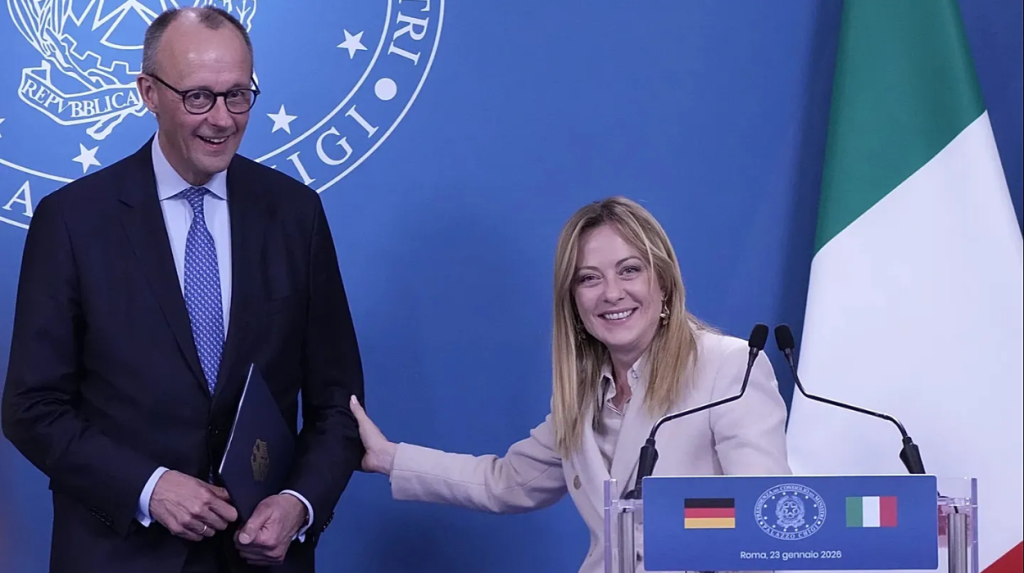
Paris is confronting a Berlin-Rome axis as European Union leaders debate how to revive the bloc’s competitiveness. As the EU’s 27 leaders gather for an informal retreat on Thursday in Alden Biesen, Belgium, two sharply contrasting economic visions are colliding.
On one side is France, pushing for pooled debt and European preference policies. On the other are Germany and Italy, now aligned in favor of deregulation, venture-capital expansion, and selective support for industry. The clash highlights deep fractures in the EU’s economic strategy as it seeks to navigate a more competitive global landscape shaped by US and Chinese assertiveness.
Why Did France Intervene at the Pre-Summit Meeting?
France made a last-minute move to join a pre-summit organized by Berlin and Rome. President Emmanuel Macron’s intervention came after Germany and Italy circulated a document outlining their agenda, sharply different from France’s priorities. Macron’s goal: assert Paris’ economic strategy and keep debt pooling—via eurobonds—firmly on the table.
This timing coincides with calls from Mario Draghi earlier this month, urging EU leaders to adopt a pragmatic federalist approach to boost competitiveness in a “more brutal world.” Draghi’s landmark 2024 report warned of a bleak economic outlook for Europe unless decisive investment steps were taken. Macron positions himself as loyal to Draghi’s vision, though politically he is considered weaker domestically compared to Italy’s Giorgia Meloni and Germany’s Christian Lindner.
Will Eurobonds Become the Summit’s First Flashpoint?
Macron is calling for the issuance of common EU debt—eurobonds—to finance €750–800 billion in annual investments, as recommended in Draghi’s 2024 report. These funds would target security and defence, green technologies, artificial intelligence, and quantum research, where Europe currently lags far behind China and the United States.
Germany, however, remains resistant, citing previous objections to joint borrowing used in the post-Covid recovery plan. Instead, Berlin and Rome advocate for venture-capital expansion, a pan-European stock exchange, and more flexible exit options for investors, according to a pre-summit document. Nordic countries have traditionally sided with Germany, although joint borrowing has precedent, including a €90 billion increase in December 2025 to support Ukraine.
How Is the European Preference Policy Controversial?
France is also championing a European preference (“Made in Europe”) policy for public procurement, aiming to protect domestic industries from what Macron calls “unfair competitors who no longer respect WTO rules.” He suggested focusing on sectors like clean tech, chemicals, steel, automotive, and defence.
Germany and Italy, however, insist the preference should be time-limited, broadly defined, and open to “like-minded” countries with EU trade agreements, to avoid stifling innovation and foreign investment. Nordic and Baltic countries, along with the Netherlands, warn that the policy could hamper access to global technology and push investors away.
What Deregulation Measures Are Germany and Italy Pushing?
Berlin and Rome are advocating a comprehensive deregulatory agenda, calling for additional simplifications of EU initiatives. They propose an “emergency brake” mechanism to intervene if legislation imposes serious administrative burdens on enterprises or national authorities. This push reflects a broader preference for market-led competitiveness over state-directed investment and intervention.
How Does the Mercosur Trade Deal Factor Into the Debate?
The EU-Mercosur trade agreement—with Brazil, Argentina, Paraguay, and Uruguay—is also under scrutiny. While most member states, including Italy, support the deal, France opposes it, citing farmers’ fears of unfair competition from Latin American imports. The European Commission plans to consult members during the retreat on the provisional implementation, following a judicial review triggered by the European Parliament, which previously suspended ratification.
Germany and Italy emphasize the importance of an ambitious EU trade policy, insisting that finalizing the Mercosur agreement is essential to account for the needs of all economic sectors, including agriculture.