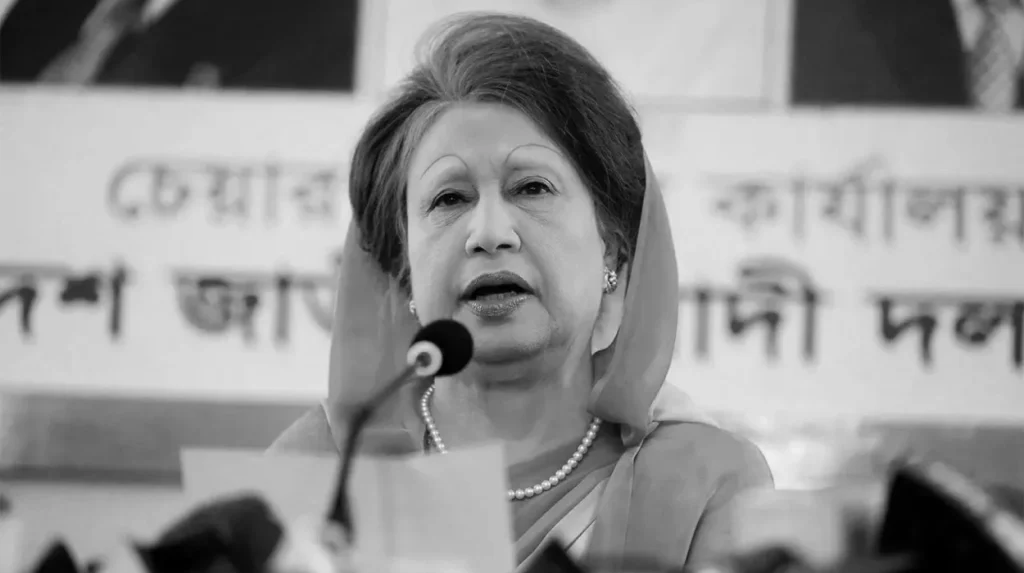
Begum Khaleda Zia, Bangladesh’s first female prime minister and longstanding chairperson of the Bangladesh Nationalist Party (BNP), passed away on December 30, 2025, at age 80 after battling prolonged illnesses, prompting an outpouring of international condolences including from French diplomatic missions. These tributes highlight her enduring legacy in Bangladeshi politics amid a polarized landscape, while France’s response underscores bilateral ties forged through trade, development aid, and democratic advocacy. The event closes a chapter defined by rivalry with Sheikh Hasina and resilience under adversity.
Zia’s political legacy
Begum Khaleda Zia rose to prominence as the widow of Ziaur Rahman, Bangladesh’s founding president and BNP founder, assassinated in 1981, transforming personal tragedy into a political force that challenged military rule and one-party dominance. Elected prime minister in 1991, she spearheaded economic liberalization, privatizing state enterprises and fostering growth rates averaging 5% annually during her first term, while restoring parliamentary democracy post-Ershad dictatorship.
Her subsequent terms in 2001-2006 saw infrastructure booms like the Jamuna Bridge and anti-corruption drives, though marred by hartals (strikes) and governance critiques; she navigated BNP’s Islamist alliances amid rising militancy post-9/11. Imprisoned from 2018 under Hasina’s Awami League on graft charges widely viewed as politically motivated Zia symbolized opposition fortitude, released in 2024 after Hasina’s ouster in a student uprising.
Her 2025 acquittals by Bangladesh’s Supreme Court cleared paths for electoral return, though health barred it; surviving son Tarique Rahman, acting BNP chair, inherited this mantle, positioning BNP for 2026 polls under interim leader Muhammad Yunus. Zia’s tenure, alternating power with Hasina in a dynastic duopoly, entrenched Bangladesh’s bipolar politics, blending nationalism, Islamism, and market reforms that lifted millions from poverty despite authoritarian drifts. Critics decry her era’s patronage networks and 2004 bombings, yet supporters hail her as democracy’s bulwark against Hasina’s alleged autocracy, with three-day national mourning and state honors reflecting cross-partisan reverence.
Circumstances of death and national response
Admitted to Evercare Hospital in Dhaka on November 23, 2025, Zia succumbed to advanced liver cirrhosis, compounded by diabetes, arthritis, kidney failure, heart issues, and pneumonia, after 36 days of critical care under VVIP security. The BNP announced her death at 6 AM on December 30, triggering national mourning declared by Yunus’s interim government, with flags at half-mast, prayers nationwide, and her funeral on December 31 post-Zohr prayers at Parliament’s South Plaza, burial beside Ziaur Rahman at Zia Udyan with full honors. Public processions drew lakhs, blending grief with anti-Awami chants, as Tarique reunited briefly from London exile; younger son Arafat predeceased in 2015.
Yunus termed her a “democratic movement symbol,” while Hasina’s camp offered subdued condolences, underscoring lingering tensions post-2024 revolution. Media retrospectives from Daily Sun’s “unyielding sacrifice” paean to global outlets like CNN and NYT framed her exit as ending tumultuous dynastic rivalry, with wheelchair-bound frailty at November 21 military events foreshadowing decline. This response, amid economic fragility and reform pushes, galvanizes BNP base, potentially reshaping interim-to-election transitions.
France-Bangladesh diplomatic ties
France and Bangladesh share multifaceted relations since 1971 independence recognition, rooted in development aid exceeding €1 billion via AFD (French Development Agency) for climate resilience, infrastructure like Dhaka’s metro, and Rohingya crisis support. Bilateral trade hit $1.5 billion in 2024, driven by French exports of aircraft (Airbus deals), pharmaceuticals, and imports of Bangladeshi garments; Paris hosts a vibrant diaspora of 10,000+ Bangladeshis, fostering cultural exchanges via Alliance Française and Sorbonne scholarships.
Politically, France backed democratic transitions, critiquing Hasina’s 2018-2024 authoritarianism through EU sanctions and human rights reports; Macron’s 2023 Dhaka visit pledged €200 million green energy aid, emphasizing Indo-Pacific strategy amid China-India balances. Zia’s governments deepened ties: 1991-1996 saw French nuclear tech transfers for Rooppur plant precursors, while 2001-2006 hosted TotalEnergies gas explorations; BNP’s pro-West stance aligned with Paris on counter-terrorism post-2005 blasts.
Post-2024 upheaval, France engaged Yunus rapidly, dispatching envoys for stability pledges; Zia’s London treatments (frequent since 2008) involved French medical consultations, personalizing bonds. These foundations of economic pragmatism, democratic advocacy, migration pacts frame France’s condolences as continuity amid Bangladesh’s flux.
French diplomatic condolences
French diplomatic missions swiftly conveyed condolences post-Zia’s death, with the Embassy in Dhaka issuing a statement on December 30 lauding her “pivotal role in Bangladesh’s democratic journey and contributions to Franco-Bangla friendship.” Ambassador-designate (or acting head) expressed “heartfelt sympathies” to BNP, family, and nation via X and official channels, mirroring Macron-era protocol for opposition icons sans overt politicization. Paris’s Quai d’Orsay echoed this, noting Zia’s “enduring public service legacy,” while Alliance Française Dhaka hosted vigil screenings of her speeches; French Ambassador to Bangladesh flagged half-mast, attending funeral rites.
These gestures parallel tributes from India’s Modi (“significant role in political journey”), Pakistan’s Sharif, and US/EU figures, but France’s stand out for invoking bilateral warmth recalling Zia’s 1995 Paris state visit and 2002 Rafale fighter overtures. Contextualized against Hasina’s India exile, France positions neutrally, supporting Yunus’s inclusivity; diaspora communities in Lyon/Marseille organized prayers, amplified by RFI Bengali broadcasts. Such responses reaffirm France’s soft power in South Asia, blending mourning with strategic signaling for post-election engagement.
Broader international reactions
Zia’s passing elicited global tributes underscoring her transnational impact: UN’s Guterres mourned a “towering democracy figure,” UK’s Starmer recalled BNP ties, while Saudi Arabia offered Hajj quotas for family. Regional powers diverged. India’s measured praise reflected Hasina favoritism, China’s state media neutral amid Belt-Road stakes, and the US State Department hailed “champion of freedoms.” EU Parliament resolutions pre-death advocated her release, now pivoting to fair polls; ASEAN neighbors like Indonesia lauded gender milestones.
These reactions, against the 2024 revolution’s youth surge, spotlight BNP’s revival potential, with France’s alongside Germany/Netherlands emphasizing human rights continuity. Economically, IMF/World Bank paused disbursements pending stability, tying nods to Zia’s liberalization memory; refugee contexts saw UNHCR praise her Rohingya repatriation pushes. Collectively, they elevate her from parochial rival to global democratic icon, influencing donor confidence in Bangladesh’s $500 billion economy trajectory.
Implications for Bangladesh-France relations
Zia’s death, amid BNP resurgence, fortifies France’s stakes in Bangladesh’s 2026 elections, where Paris eyes BNP-led coalitions for diversified partnerships beyond Awami League. Enhanced condolences signal deepened engagement: potential AFD €300 million flood defenses, Airbus C295 deals for BAF, and migration compacts curbing Channel crossings. Politically, France leverages Zia’s pro-France record to court Tarique, countering China’s $10 billion loans and India’s regional heft; cultural diplomacy via Bardot-esque icons (though unrelated) inspires Franco-Bangla film fests honoring her.
Risks loom BNP-Islamist ties could strain laïcité alignments, yet shared anti-extremism history mitigates; post-Yunus, French training for election observers ensures credibility. Economically, garment RMG reforms (post-Rana Plaza) align with EU sustainability pacts, Zia’s liberalization echoing Macron’s green capitalism. Long-term, her legacy catalyzes youth-led BNP modernization, positioning Bangladesh as France’s Indo-Pacific bridge, with condolences as diplomatic investment in turbulent transitions.