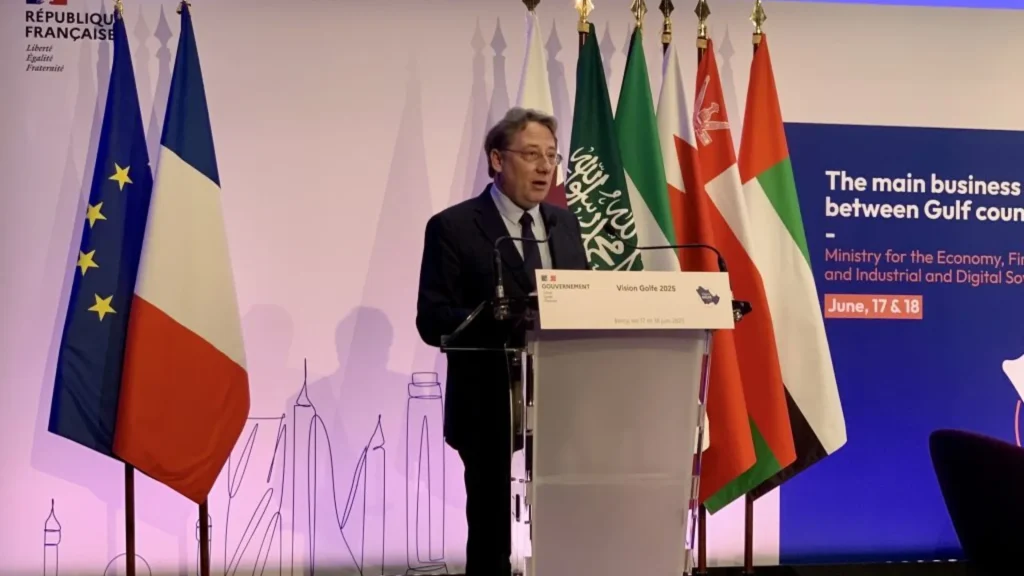
The involvement of France in the economic activities in the Gulf Cooperation Council (GCC) has taken a new turn which is increasing in terms of its depth and aspirations. At the Vision Golfe 2025, both sides reinforced a partnership of the future with an emphasis on innovation, diversification and strategic orientation. However, when buzz grows through the summits and declarations, grave doubts come into existence whether these high goals can be translated into economic transformation, especially on jobs, technological transfer, and inclusive growth.
Recalibrating the France-GCC Economic Relationship
Expanding strategic interests and bilateral trade
France-GCC bilateral trade made it to the cumulative €21 billion by the end of 2024, facilitated by more than 17,000 French companies which were present in the markets of GCC countries. French exports of high-value products, which include aerospace, luxury goods, agri-food, and energy to the region, have remained the main area of business in the region, whereas the GCC investments in France are made in the field of real estate, technology and transport infrastructure.
Vision Golfe 2025 forum brought 1,200 business leaders and government officials on board with over 2,000 business-to-business and political meetings. The agreements that are developed highlighted the next-generation areas, such as artificial intelligence, logistic automation, and climate technologies. In particular, France and the UAE introduced an innovation lab within Mohamed Bin Zayed University of Artificial Intelligence, which represents one of the first steps in the direction of integration of education and technology.
Economic convergence on future-ready sectors
The France 2030 plan by France and the Vision 2030 (Saudi Arabia), Vision 2035 (Kuwait), and so on are all centred on the similarities of the digital transformation, energy transition, and advanced manufacturing. European investment in the GCC is headed by the French because it invests in Kuwait in particular where 2,100-plus employment opportunities have created jobs in these industries, namely transportation, chemicals and defense-related industries.
Gulf also invested their resources in French projects intensively on the other hand and this had maintained French as the number one destination of FDI in Europe in the last six years.
However, the asymmetry in value creation between large-scale investment and grassroots development remains a challenge.
Assessing the Tangibility of Economic Outcomes
Scaling rhetoric into measurable results
The regularity of high-level summits suggests commitment, yet headline trade volumes mask structural inertia.France and its plan France 2030 are all centered on the similarities of the agile transition, the energy transition, and develop advanced manufacturing, as the Vision 2030 (Saudi Arabia), and Vision 2035 (Kuwait), and so on. French is leading European investment to the GCC due to the fact that it is investing in Kuwait in particular where 2,100-plus jobs have been established in the following industries namely the transport industry, chemicals and defence industries.
On the other hand, Gulf also tested their investments on the French projects intensively, and this had retained the status of France as the premier destination of FDI in Europe over the past six years.
Beyond the deal count: Long-term impact
Investment has been strategic, though mostly when it comes to port digitization and hydrogen growth have been obscure when it comes to job creation, regional innovation or SME enablement. Any tendency to make head fixing announcements with little downstream impact are putting the long term credibility of the partnership at risk.
More concerning is the concentration of deal flow around large conglomerates and state-backed institutions. Unless accompanied by mechanisms to integrate local labor markets, upskill youth, and enhance entrepreneurial access, the impact of even large-scale investments will remain narrow.
Sectoral Deep Dive: Where Progress Is (and Isn’t) Happening
Energy and infrastructure cooperation
High level cooperations with Gulf countries in solar, hydrogen, and smart grids have been established by the French major energy players. Yet the lion’s share of capital and job creation still flows into oil and gas supply chains and traditional infrastructure. This continuity reinforces established dependencies, slowing the pivot to decarbonized economic models.
While smart port collaborations between Saudi Arabia and Marseille offer long-term potential, detailed metrics on local value creation or cross-border supply chain integration are limited as of mid-2025. Progress remains mostly conceptual, with delivery timelines and impact assessments still under discussion.
Technology, education, and human capital
Collaborations between French academic institutions and Gulf universities have proliferated. Several elite French schools now run joint programs or campuses in Qatar, the UAE, and Saudi Arabia. Student mobility between the two regions is growing, alongside initiatives for tech-enabled research centers.
However, a critical gap remains between education initiatives and employment outcomes. Digital skills and AI monies Written agreements in the field of digital competencies and AI tend to be detached in the actualities of the labor market, especially in the nations that continue to rely upon foreign workers. The hype of empowerment can only be changed toward action, when more tangible incentives are provided to tech industries to adopt local talent.
Luxury goods, culture, and food security
France has always dominated in exports of luxury and lifestyles to the GCC and this has continued to be the case. Behind the Gulf investments in French agri-tech and food safety was the pandemic-induced crunch in the global supply route that pushed the two countries even closer together in the nutrition and logistical spheres. However, the value chain is controlled by French conglomerates leaving few opportunities to participate in it by the Gulf SMEs.
The cultural exchange has been picked up and there are greater collaborative exhibitions, food diplomacy and heritage branding initiatives. However, these sectors will not be able to make a significant change with regard to the level of innovation or economical diversification unless they are parts of much larger, universal commercial ecosystems.
Strategic Calculations Behind Economic Alignments
Geopolitics as an economic driver
The French involvement in the GCC has larger strategic reasons too. Paris regards the Gulf relationships as the key to guarantee energy flows, Gulf investments, and to balance Asian power in the Indo-Pacific. In the case of the GCC, France can provide access to the European markets and high-tech- without the geopolitical limitations of being too close to Washington or Beijing.
Stars of foreign and heads of sovereign wealth funds were participants of Vision Golfe 2025, where diplomacy and investment walk hand in hand. Nonetheless, the question emerges again: whether geostrategic cooperation can be able to deliver more down-to-earth and sustainable economic benefits, or whether it will still revolve around a limited number of elite-led initiatives.
Strategic but uneven engagement
Although cooperation in the field of defense, nuclear energy projects, and space technologies continues to flourish, such areas indicate a tethering together of cooperation in politically-sensitive and capital-intensive areas. The wider French and Gulf economies, the SME and entrepreneurial sphere in particular, are still not greatly attached to these top line deals.
The real diversification will indeed have to be accomplished through the simplification of cross border regulation, standardization of licensing, and instead of one-way poured investment into older assets, by making the actual co-creation of intellectual property and start-ups become an endeavor.
Sustaining Momentum Through Deliverables
The France-GCC partnership shows undeniable progress in scale and ambition. The smart port prototypes, hydrogen labs and shared degree programs are just the tip of the iceberg, with the luxury trade also figuring prominently on the agenda. However, even after a decade, most of these efforts remain in the aspiration phase having poorly developed delivery systems, inadequate transparency, and vague impact assessments.
French and Gulf officials insist that outcomes will eventually follow frameworks. Without concrete timelines, performance measures, and feedback loops, however, risk-aversion can take precedence of innovation. Policymakers are now needed to be in charge of outcomes rather than summits, particularly in the context of a global economy exposed to the shocks due to climate, cycles of inflation, and technological upheaval.
Will ambition meet accountability?
One can today see the contours of a more future-proofing of the French-GCC economic relationship, entangled in energy, education, and entrepreneurship. But as long as ambitious aspirations fail to command quantifiable sustainable inclusive results, then suspicions over the strength and substance of the partnership will be there.
Both camps need to pose the question of whether they are ready to go beyond staged performances and marshal symbolism to collaborative ventures that actually redefine their economic destinies. The pressures are becoming increasingly high on the world, due to climate needs, to digital change, and the stakes are getting high. Where Vision Golfe 2025 will become part of a new chapter, the next few years will show whether the chapter will be that of lasting change or another example of economic desire outrunning practice.