France is at a crossroads following the recent parliamentary elections, which have led to a political deadlock in the National Assembly. Despite the predictions of many opinion polls, the election results have produced a fragmented parliament with no clear majority, leaving the country facing significant uncertainty. This analysis will explore the key factors behind this political crisis, examine the implications of a hung parliament, and consider the potential outcomes for France’s future governance.
Election Results: A Nation Divided
The results of Sunday’s parliamentary elections have dealt a blow to both the far-right and the centrist factions in French politics. Voters have rejected the leadership of Marine Le Pen’s National Rally (RN), which had been projected to perform well, but ultimately ended up in third place, behind the left-wing alliance and Macron’s centrist bloc. The RN, despite its strong gains compared to previous elections, failed to secure the majority it had hoped for, leading to frustration within the party.
The most unexpected outcome of the election was the success of the left-wing coalition, the New Popular Union (NUPES), which managed to secure the highest number of seats, making it the largest bloc in parliament. However, despite its strong performance, NUPES fell short of an absolute majority, which means the country faces a political deadlock with three dominant factions vying for power: the left, Macron’s centrist coalition, and the far-right RN. This scenario presents a significant challenge for French democracy and governance.
The Rise of the Left: Will NUPES Be Able to Govern?
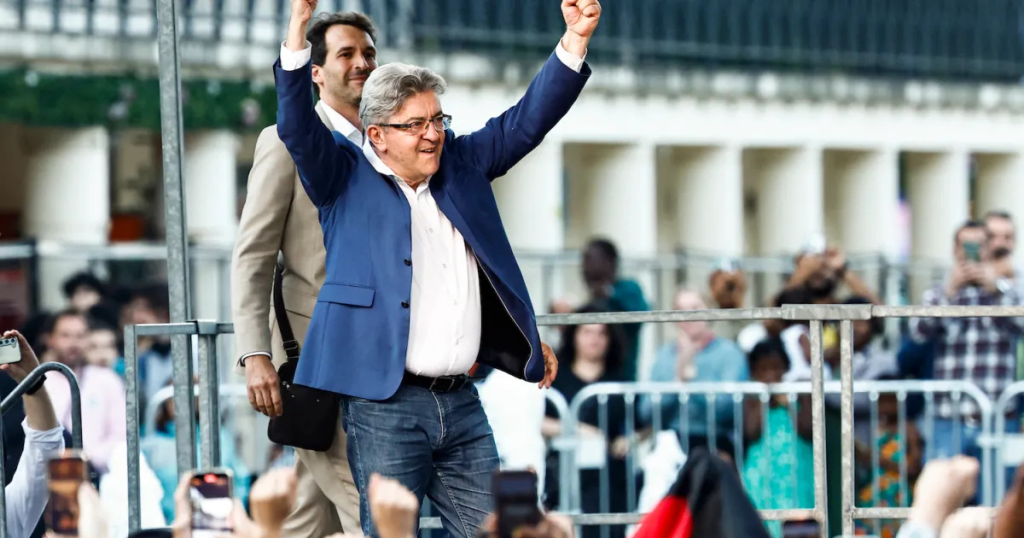
The NUPES, an alliance of the hard-left France Unbowed (LFI), the Socialist Party, and the Greens, has emerged as the most significant political force in the National Assembly. Led by Jean-Luc Mélenchon, the NUPES coalition has called for substantial economic reforms, including a cap on the price of essential goods, a minimum wage increase, and the implementation of a wealth tax. Mélenchon has demanded that the president respect the will of the people and invite his coalition to form a government.
However, despite its success, NUPES faces significant challenges in terms of governance. The coalition lacks the 289 seats required for a majority in the 577-seat National Assembly, meaning it will need to engage in complex negotiations and alliances to pass legislation. The fact that the left-wing parties come from a range of ideological backgrounds, from the hard-left to more centrist Socialists, raises questions about their ability to maintain unity in the long term.
Mélenchon, while vocal in his calls for governance, has ruled out a broader coalition with parties across the political spectrum, which leaves the left-wing alliance with limited options. The coalition’s internal cohesion will be tested as the parties negotiate their policy priorities, and there are concerns about potential fragmentation as the political stakes rise.
Macron’s Centrist Bloc: A Weakened Position
The centrist alliance, which was formed under Emmanuel Macron’s leadership, has suffered a significant blow in the election, falling far short of the majority needed to maintain control of the government. This outcome comes as a major setback for the president, who called for the snap election after his alliance faced significant losses in the European Parliament elections just a month earlier.
Macron’s government is now faced with the prospect of leading a fragmented parliament, which will make it difficult to push through major reforms or pass key legislation. The president’s En Marche movement no longer has the dominance it once enjoyed, and the election results have made it clear that France’s political landscape is undergoing a dramatic shift.
The question now is whether Macron can form a workable coalition with other parties to regain some semblance of control. While there has been talk of potential cross-party alliances, the fractured nature of the parliament and the ideological divides between the left, centrist, and far-right factions make such cooperation difficult. Macron’s call for unity may fall on deaf ears, and his ability to steer the country through domestic and international challenges will be severely limited.
The Far-Right: Marine Le Pen’s National Rally Disappointment
The National Rally (RN), under the leadership of Marine Le Pen, had high hopes for a victory in the elections, as opinion polls consistently projected them to be the dominant force in the National Assembly. However, despite significant gains compared to previous elections, the RN fell short of expectations, securing only third place behind NUPES and Macron’s coalition.
Le Pen, who has previously positioned herself as the face of France’s nationalist, anti-immigration movement, had hoped that the RN would capitalize on voter dissatisfaction with Macron’s presidency, especially in the wake of rising living costs, security concerns, and public service failures. However, even though the RN was able to expand its voter base beyond its traditional strongholds, it still lacked the broad support needed to secure a majority.
Le Pen has vowed to continue her party’s efforts, asserting that the RN’s victory has only been delayed, not defeated. While the party is likely to remain a strong political force in the coming years, its inability to secure the leadership of the National Assembly will be a blow to its momentum, particularly ahead of the 2027 presidential election.
Economic and Market Reactions: Uncertainty Looms
The political deadlock in France has had immediate consequences for the country’s economy and financial markets. The euro dropped in value after the election results were announced, reflecting investor concerns about the uncertainty surrounding France’s political future. With no clear majority in parliament, the risk of political gridlock and prolonged instability is high, and businesses are wary of potential delays in key economic reforms.
Aneeka Gupta, a macroeconomic research director at WisdomTree, suggested that the market could experience a “brief respite” due to the failure of the far-right to dominate, but warned that political paralysis could continue for the foreseeable future. This would make it difficult for the French government to enact fiscal policies or undertake necessary reforms to address the country’s cost of living crisis, which was a major factor in voters’ dissatisfaction.
What’s Next for France? Political Negotiations Ahead
With the results still being finalized, much remains uncertain about the future direction of French politics. Prime Minister Gabriel Attal has indicated that he will submit his resignation, though he will remain in a caretaker role until a new government is formed. The coming weeks will see intense negotiations as Macron’s team, the NUPES, and the RN seek to find a path forward.
Ultimately, the key question is whether any coalition can reach the necessary 289 seats to govern. Given the ideological divides between the left, centrists, and the far-right, it seems unlikely that any cohesive, stable government will emerge in the short term. This political deadlock is likely to shape France’s domestic and foreign policy for years to come, leaving the country in a state of uncertainty as it grapples with its economic challenges, the fallout from the war in Ukraine, and its position within the European Union.
In conclusion, the results of the French parliamentary elections have set the stage for a period of political turbulence. With a fragmented National Assembly and no clear path to a majority, France faces significant challenges in terms of governance, economic stability, and its role on the world stage. The coming months will be critical in determining whether the left, centrist, or far-right factions can overcome their differences and provide effective leadership for the country.