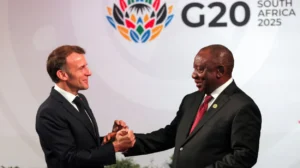
French President Emmanuel Macron has confirmed he plans to establish a common Franco-Haitian commission to study France’s past with its former colony and its influence on the nation’s development since gaining independence – most particularly the request that Haiti owe France reparations to reimburse slave-owners for their losses in exchange for being recognized.
“This choice put a price on the freedom of a young nation, which was faced with the brutal power of history the moment it was created,”
Macron said in a statement issued on Thursday.
“Today, on this bicentenary, we must. confront history. Haiti was born out of a revolution. that boldly enshrined the universal values of Liberty, Equality and Fraternity. Haiti’s struggle, in synchrony with the values of the French Revolution, should have provided France and Haiti with a chance to create a common destiny,”
he went on.
“Accepting the truth of history is not forgetting and erasing. For France, it also implies taking its portion of the truth in the painful making of the memory for Haiti, starting in 1825.”
Macron said the Franco-Haitian commission will suggest recommendations to the two governments “so that they can learn from them and build a more peaceful future,” but the timeline and objectives are murky.
Ransom-induced freedom
A mere two hundred years ago, on 17 April 1825, France had formally recognized the independence of Haiti. It could have been a time for rejoicing for the world’s first nation-state founded on the heels of a victorious slave revolution. Instead, this was the beginning of an atrocious financial and political struggle.
In exchange for recognition, France insisted on 150 million francs in gold. The funds would be used to reimburse former slave owners for their losses. French warships anchored offshore and King Charles X made it abundantly clear: if Haiti did not agree, there would be war. The nation that had repelled slavery was forced to pay its former masters for the right to be free.
The paradox is that the conquerors ended up paying ransom to the vanquished, for Haitians had defeated the French army in 1803 to announce their independence. It was an unfair payment. The actual victims were the slaves,” declared Jean-Marie Théodat, a Haitian geographer and lecturer at the Sorbonne.
A relentless cycle of debt
The first payment of 30 million francs was six times Haiti’s total national budget. To fulfil this obligation, Haiti took on significant debt from French banks. For over a century, interest and fees accumulated, with payments persisting until the 1950s.
The New York Times reported in a 2022 investigation that the repayments made by Haiti totalled the equivalent of $560 million today. It is estimated that the broader impact on Haiti’s development has reached a minimum of $21 billion.
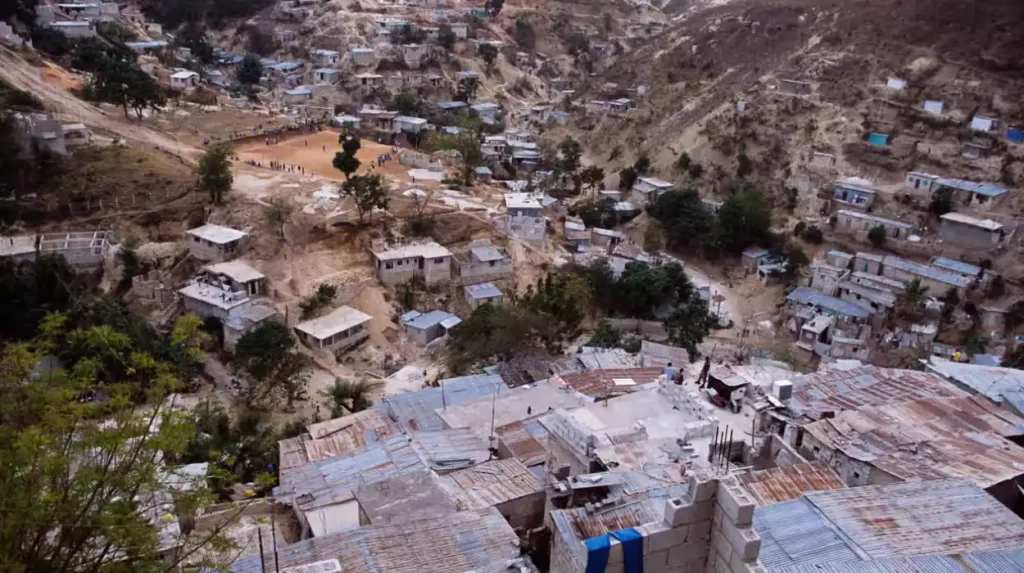
“Due to this structural resource deficit, elements of state modernisation, like schools and hospitals, were unable to thrive,” stated Théodat. Some economists contend that had it not been for this initial setback, Haiti’s economy might closely resemble that of the Dominican Republic today. However, it continues to be the poorest nation in the Americas. Currently, Haiti faces a crisis, with armed gangs dominating 85 percent of the capital and public services in disarray.
The issue of restitution
Within France, two differing resolutions regarding Haiti have been filed with the National Assembly. The first, on behalf of left-wing party France Unbounced (LFI), demands an era of enhanced cooperation between nations and an official acknowledgment of they shared history together. When you see what French governments and regimes have done to Haiti, and the little they’ve invested, it’s not enough,” declared Gabrielle Cathala, an LFI MP.
Her resolution also urges the French government to acknowledge the crimes against humanity that have been perpetrated in Haiti, and to improve cooperation, particularly in the field of security. A second motion, backed by Communist and overseas MPs, is more radical, calling for reparations and full reimbursement of the original debt.
“Forgiveness doesn’t heal the wounds, as we say in Creole. Symbols are needed, but we also need action to actually assist the Haitian people in getting out of this grave situation,” declared Martinique MP Marcellin Nadeau.
In January, ex-Haitian president Leslie Voltaire told that he brought the question of reparations to Macron’s attention – a word which was not used in the statement issued by the Elysée Palace on Thursday.
Over the past few days, French intellectuals and pundits have again demanded reparations. Théodat explained that the matter is closely monitored by descendants of slaves everywhere, stating that: “Haiti is a symbol.” In other former French colonies since the early 2000s, comparable calls for justice have been made in Martinique, French Guiana and Réunion.