In the summer of 2025, heatwaves in Spain and France are at an unprecedented level with temperatures reaching 44 degrees Celsius in some areas. There has been a rare red weather warning issued by French authorities across several departments of the southwest such as Ardeche and Rhone in one of the most brutal notifications in the meteorological history of France. The daytime temperatures of 43C and night low ones over 25C have not allowed the people in a particular country in Spain to relax.
A heat dome, situated over southern and western Europe and extended over an extensive area, is the driver of these unprecedented conditions. According to the meteorologists, there are parts of the country registering temperatures that are much higher than the ones recorded during this season and the dome may continue well into the first fortnight of the month of August. Such a protracted incident is already being linked to potential issues regarding the human health, resiliency of infrastructures, and wildfire.
Human Health Under Severe Threat
The scale of the crisis has been majorly underscored by the French meteorological bodies stating that under red alert scenarios; everyone, including healthy individuals, is under threat. Nevertheless, the highest risks are posed to elderly people, persons with chronic diseases, workers in the field, and people living in social isolation. In Spain, there are warnings of the same nature highlighting the compound effect of night temperature scorching, and the inability to restore the human body in a day.
Emergency Health Responses
Medical institutions in both France and Spain are seeing elevated cases of heat-related diseases, which are dehydration, heat exhaustion, and heatstroke. Previous statistics published towards the beginning of 2025 show that the heatwaves experienced in June in Europe caused more than 2,300 excess deaths covering 12 cities; climate change was slated to cause 65 percent of these deaths. The current figures indicate that this year higher than those recorded summers in terms of the dead would be registered in case the conditions continue in the same way.
Socio-Economic and Infrastructure Impacts
The energy sector has been significantly disrupted. In France, the nuclear power stations including Golfech, Blayais, and Bugey have decreased their activities with high river temperatures that hinder cooling activities. With these operational constraints, high demand of air-conditioning systems has increased electricity prices by 108% in France and 15 percent in Spain due to the heatwave.
Agricultural Losses and Food Security Risks
In both the countries agriculture is facing dire conditions. Heat and limited soil moisture has decreased harvests of major crops and water supplies for irrigation are highly stressed. Increased pressure on water resources is further compounded by the competing interests between agriculture, human consumption and industrial usage which have necessitated an emergency cautiousness strategy in various provinces.
Using economic modelling, it has been hypothesized that the heatwave may draw a 0.5 percent loss to the GDP on Europe in the summer seasons, and a 1.4 percent loss was predicted on Spain, due to the loss of work and productivity efficiency to the heatwave, and loss of crops and infrastructure damage.
Environmental Stress and Wildfire Escalation
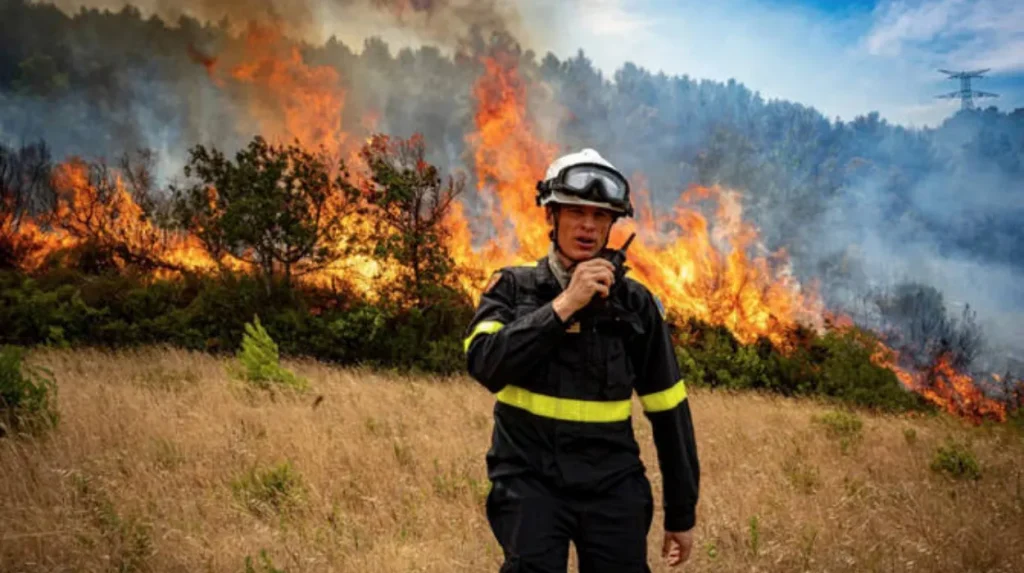
The high temperatures have escalated the risk of wild fires, especially on the southern parts of France and the Iberian Peninsula. Hundreds of hectares have already been destroyed with some people being displaced and habitats being destroyed containing a lot of biodiversity. The particles and smoke in such fires are further adding onto the health hazards to the population by deteriorating the quality of air particularly to individuals with respiratory disorders.
These environmental pressures are playing out in a feedback loop–the warmer the temperature the more likely wildfires will spark as stored carbon in the vegetation and the soil is lost to climate warming.
Europe’s Climate Vulnerability in 2025
Scientific evaluations have also proved that Europe is warming at almost twice the global average. This is according to the Copernicus Climate Change Service data, in the organization which states that the temperatures in the continent are already at 2.3o C higher than it was before the industrialization period. The rate of warming is increasing, and this has a direct effect on the number and length of heatwaves experienced like in France and Spain in the current year.
Atmospheric Disruptions and Heat Dome Formation
The persistent heat dome over Europe is linked to disrupted atmospheric circulation patterns, which scientists attribute to anthropogenic climate change. These altered patterns not only trap heat but also delay the arrival of cooling weather systems, extending extreme weather events beyond historical norms.
Calls for Action and Public Awareness
National governments and EU institutions face growing pressure to enhance both adaptation and mitigation strategies. The problems caused by urban heat islands require the redesigning of the landscape in cities to have more green areas, reflectors, and covered open spaces. In the countryside, at the same time, there is a need to widen water management systems to service agriculture and communities during long heat waves.
Climate Activism and Public Messaging
Climate communicators and activists are raising the pressure of such changes. This individual has addressed the matter and is summarizing the instance as follows: The human and ecological cost of the 2025 European heatwaves has been stressed by Mike Hudema, and this, in fact, should not be viewed as a random event anymore but a repeat of the results of inadequate climate mitigation efforts. His message highlights the importance of climate adaptation and climate mitigation being a priority of political leaders.
France and Spain are dealing with an extreme heat wave, with temperatures soaring to 40 °C plus in many regions. Climate change makes these heatwave events up to 10x more likely. This is not normal, this is not "summer"
— Mike Hudema (@MikeHudema) July 5, 2025
No time to wait. #ActOnClimate#climate #energy @PGDynes pic.twitter.com/ZCMhgmgkF3
Beyond Immediate Crisis Management
After governments deal with immediate responses to emergencies (cooling centers, hydration campaigns, public warnings) there is a larger problem of the capacity of the system to adapt to frequent climate shocks. This entails the development of renewable energy, the phasing out of fossil fuel use and the enhancement of international commitments to climate change in line with the 1.5oC goal on the Paris Agreement.
The summer in 2025 survived through numerous crises and records of temperature levels, as well as a stress test of potential preparedness of the European region. The situation in France and Spain proves the extent to which climate change is correlated with the aspects of public health, financial stability, and geopolitical sustainability. The decisions taken during the upcoming years will define whether or not such heatwaves will be a sporadic crisis or the regular fall or summer.