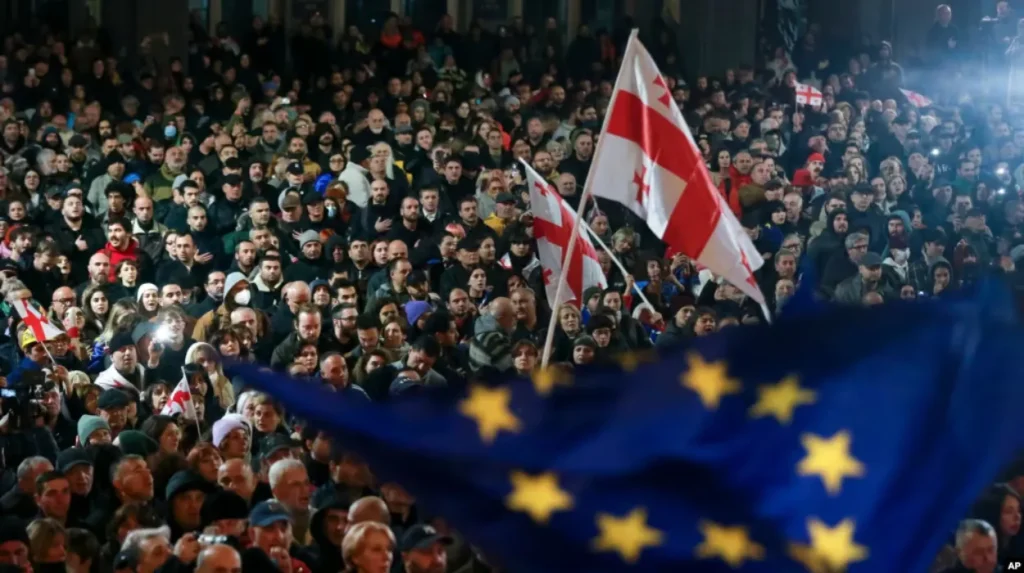
Many opposition supporters gathered in Tbilisi, Georgia’s capital. They refused to accept the 25 October parliamentary election result and protested against it. They challenged the victory of the ruling party with charges that Russia was the key player in rigging the vote.
Georgian and EU flags were waved outside the parliament. Protestors demand the fresh elections be monitored by observers belonging to foreign countries. They also want a deep investigation into various claims of election fraud. It reflects public frustration over the fairness of the process.
Many people show favoritism to continue the fight, such as Giorgi Vashadze, leader of the Unity National Movement Coalition. He declared that the opposition would not back down, signaling the likelihood of ongoing protests.
These events highlight ongoing political tensions in the nation. It is raising concerns about the democratic stability of the nation. The government’s decision about these demands is also crucial. How the leaders address the crisis and rebuild the public trust in the electoral system.
Furthermore, opposition leaders also want a loyal election system. They want systematic change. According to leaders of the opposition party, the elections were illegitimate, citing widespread manipulation. These are the major reasons behind refusing to accept the election results. They want elections again and have a purpose to establish a government that aligns the nation with European integration.
According to the Central Election Commission, the ruling Georgian Dream Party secured 54% of the vote. But the opposition party refused to accept these results. They claimed that many irregularities had undermined the electoral process. Furthermore, many European observers also show concern. They described the election atmosphere as “divisive,” with reports of bribery, double voting, and violence tarnishing its credibility.
In response to all of these concerns, opposition leaders plan to boycott the results and protest against the winning party, escalating tensions.
The situation poses a significant challenge to Georgia’s democratic institutions and its aspirations for closer ties with Europe. The outcome of this standoff will likely shape the country’s political trajectory.
Concerns of growing authoritarianism and a move toward Moscow’s influence have been raised by Georgia’s political circumstances. The billionaire Bidzina Ivanishvili founded the ruling Georgian Dream Party, which is accused of enacting Kremlin-style laws that restrict LGBTQ+ and free expression. Concerns regarding Georgia’s democratic future are raised by critics who assert that Ivanishvili’s connections to Russia have influenced these choices.
Despite playing a mostly symbolic role, President Salome Zourabichvili has publicly criticized the government’s policies. She thinks Russia is pressuring Georgia to renounce its EU membership aspirations. Zourabichvili has called on the US and the EU to back continuing demonstrations in favor of democracy and human rights.
International responses have been conflicting. Georgia is in a vulnerable situation domestically and diplomatically as the Kremlin denies any role in the alleged election violations, despite calls from the US and EU for a thorough inquiry.
An important turning point in Georgia’s campaign to join the EU was the country’s recent parliamentary election. The vote was interpreted by many as an opportunity to reaffirm their support for democratic principles and closer relations with Europe. But there have been obstacles in the way. After Georgia’s government passed a contentious “foreign influence law,” based on Russian legislation, which sparked concerns about a loss of democracy, the EU suspended Georgia’s bid for membership.
Lawmakers from EU nations showed unity during a demonstration in support of Georgia’s EU ambitions. Zygimantas Pavilionis, a Lithuanian lawmaker, emphasized the stakes and cautioned that forces are working to erode Georgia’s democracy, independence, and aspirations to join the EU and NATO. He exhorted Georgians to defend their future and rights.
This illustrates a more profound tension between the goals of the people and the policies of the government. In order to advance, Georgia needs to resolve democratic issues and reaffirm its dedication to European integration, which is a top priority for many Georgians.