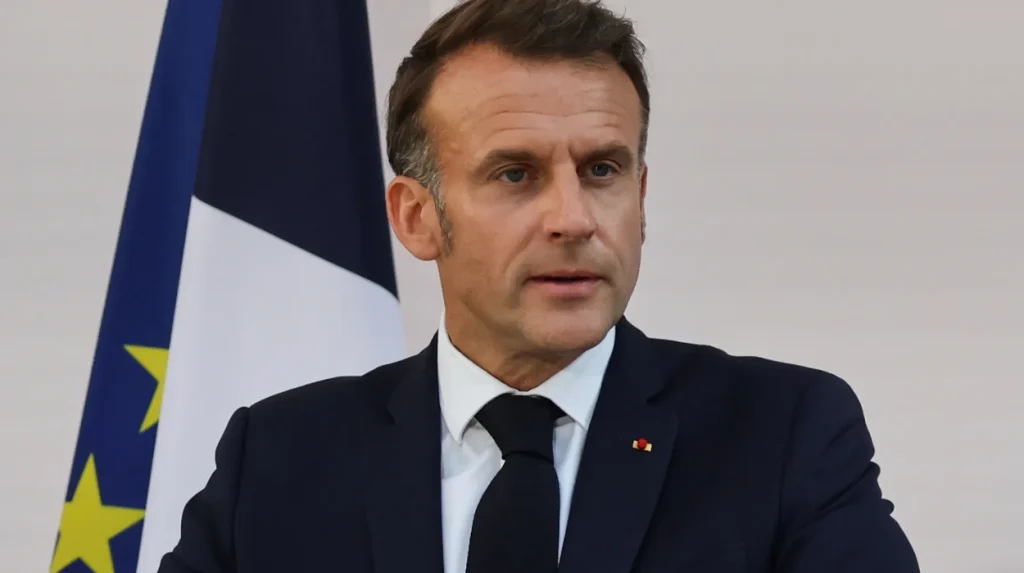
The July 2025 incident in France was a momentous event in global relations when it was declared the French government wants to recognize the State of Palestine officially in the next September meeting of the United Nations General assembly. Taken under the direction of its President Emmanuel Macron, the move makes France the first G7 country to support the recognition of Palestinian statehood. Macron justified this move as part of the continuing French commitment to a two-state solution and that the ending of the war in Gaza was urgent and he supported a ceasefire, increased humanitarian assistance and that a demilitarized Palestinian authority which is ridden of Hamas control should be achieved.
The declaration has been issued following challenging situations in Gaza and by dissatisfaction with decades of frozen peace talks. The strategy of Macron is based on revitalizing the process of international dialogue and accepting the progress of the Palestinian Authority regarding updating governance. But the action by France has received sharp diplomatic responses, particularly by the Jewish groups and their allies who were worried about the timing and the implication of it to Israel security as well as regional stability.
Jewish Community Response and Diplomatic Fallout
Rebuff by Major Jewish Organizations
In the wake of the announcement, the big Jewish advocacy organizations in the US, such as the American Jewish Committee, the Anti-Defamation League, and the Conference of Presidents of Major American Jewish Organizations, all together turned down a planned meeting with the French Foreign Minister, Jean-Noel Barrot. The denial was a combined rebuke indicating that there were grave diplomatic splits between France and its old Jewish allies.
Such organizations complained that France, by recognizing alone, did not take into account certain major realities on the ground, the unfinished crisis of the hostages, after the October 7 attack by Hamas, and the importance to Israel of secure national boundaries. They described the action as an insult to the victims as well as the strengthening of militant organizations through the award of recognition without a workable peace process.
Internal French Jewish Perspectives and Broader Community Concerns
Domestic Jewish institutions in France came out in opposition to the decision as well; CRIF and the Consistoire Central. Their reasons were not about statehood but when, symbolic and political message of the state at a volatile time. France having the highest Jewish population of land in Europe, the government is now prone to national sensitivities, as well as international criticism.
This internal contradiction is a manifestation of an awkward ballet, which France must do; that of maintaining a foreign policy grounded in human rights and conflict resolutions, all the while balancing between the strong, personalistic interests of the Jewish and the pro-Palestinian communities.
International and Regional Repercussions
Reactions from Israel, the United States, and Other Actors
The reaction of the Israeli government was powerful. The Prime Minister Benjamin Netanyahu criticized the decision as an incentive to terrorism and a loss to regional stability. France was accused by the Israeli officials of sabotaging the campaign to isolate Hamas and threatened diplomatic action. The discussion that surrounded the French recognition of the state provided the legitimacy of the description of a fractured political system that could not ensure the security interests of the state of Israel.
At Washington, the secretary of state, Marco Rubio, termed the move as a reckless move by France that could undermine the current fight against terror and other diplomatic efforts. Former President Donald Trump shrugged off the announcement as a show, referring to it as a symbol of posturing with no real effect.
On the contrary, most countries in the Global South and a few states in the EU hailed the French effort as a bold step. Palestine authorities embraced it as overdue recognition of their sovereignty and struggle within the established state limits against extended annexation. Indeed, UK Prime minister Keir Starmer has pointed to the fact that Britain could do the same after ceasefire, which depicts the sense of a gradual yet significant shift in diplomatic form in Europe.
Implications for European Diplomacy and Middle East Peace Prospects
The move by France can trigger a whole-change in the European Union. Being a permanent member of the UN Security Council, and one of the most influential representatives of European diplomacy, France may receive support from other EU member states in recognition of Palestine. It is however a move that threatens to resign the differences between EU and NATO ranks where there exists no unification on Middle East Policy.
The inconsistency also questions the unity of the multilateral efforts relating to peace, as France will have to act as a mediator between the contradicting positions held by member nations and eventually pursue its vision of conflict solving. Awareness of the French independent diplomatic identity, on the one hand, strengthens the structural challenges of ascertaining a cohesive Western stand in the state of affairs surrounding Israel-Palestine.
The Challenge of Reconciling Symbolism with Practical Peace
Although the importance of recognition by France is tremendous symbolically, it still fails to address highly important problems that include the problem of borders, the status of Jerusalem, and political division between the Palestinian Authority and Hamas. The opposition says that rewards not followed by any advancement in either negotiations or enforcement processes have the effect of strengthening moderates just as calm and sincere peace attempts are intercepted.
All of these proclamations as observed in the support of a demilitarized Palestinian by the president Macron only leads to France pursuing a balanced stand as desired although there is still a lot of suspicion on the real consequences of the same. There is also a fear that these types of diplomatic moves will divert political attention off practical solutions and towards ceremonial bravado.
There is an increasing sense of humanitarian needs in Gaza and true peacebuilding goes beyond recognition. A long-term multilateral strategy of a combination of diplomacy, assistance and coordination in security will be invaluable to converting symbolic steps to progress.
Navigating Domestic and Global Political Currents
France’s Balancing Act Amid Domestic and Global Pressures
Locally, Macron entertains an already divided electorate in a country that has sizable Jewish and Muslim communities. His announcement followed earlier announcements that he made in June 2025 but its formalization attracted more attention. France has now been in a position of balancing world ambitions and national unity more especially before contentious political elections.
Internationally, the move reinforces France’s image as an assertive diplomatic player willing to challenge traditional paradigms. Yet, it must manage the resulting tensions with allies and address perceptions of undermining Israeli security at a volatile time.
France’s recognition also invites scrutiny from media, think tanks, and humanitarian organizations, all watching how it reconciles the decision with its commitments to fight extremism, promote dialogue, and maintain alliances.
Broader Diplomatic Dynamics and Future Trajectories
The response from Jewish groups illustrates a deeper challenge in contemporary diplomacy: reconciling moral imperatives with political complexity. France’s decision could set a precedent, encouraging others to break with cautious diplomatic orthodoxy. At the same time, it might deepen global polarization over Middle East policy.
As the UN General Assembly session approaches, the pressure will mount for France to demonstrate that its recognition initiative contributes to actual conflict resolution and does not merely shift diplomatic fault lines.
This person has spoken on the topic: Political commentator @SocialistMMA recently noted that
“France’s recognition decision reverberates beyond diplomacy into fracturing communal ties and raising urgent questions about how Western democracies balance human rights, political realities, and ally relationships in the Israel-Palestine conflict.”
Zionists are melting down because France will officially recognize a Palestinian state.
— Revolutionary Blackout🥋 (@SocialistMMA) July 25, 2025
Don’t buy into the hype tho
France is still complicit with genocide and this is just a stalling tactic while Israel finishes the job
pic.twitter.com/VF6WRnUNQX
France’s move to recognize Palestinian statehood highlights the fragile balance between symbolism and substance in global diplomacy. As its leadership shapes new Middle East policies, the test will lie in aligning principled recognition with practical peacemaking. Whether this signals a broader shift or remains a diplomatic outlier, the impact on relations with Israel, Jewish communities, and Western alliances will echo long after the UN session ends.