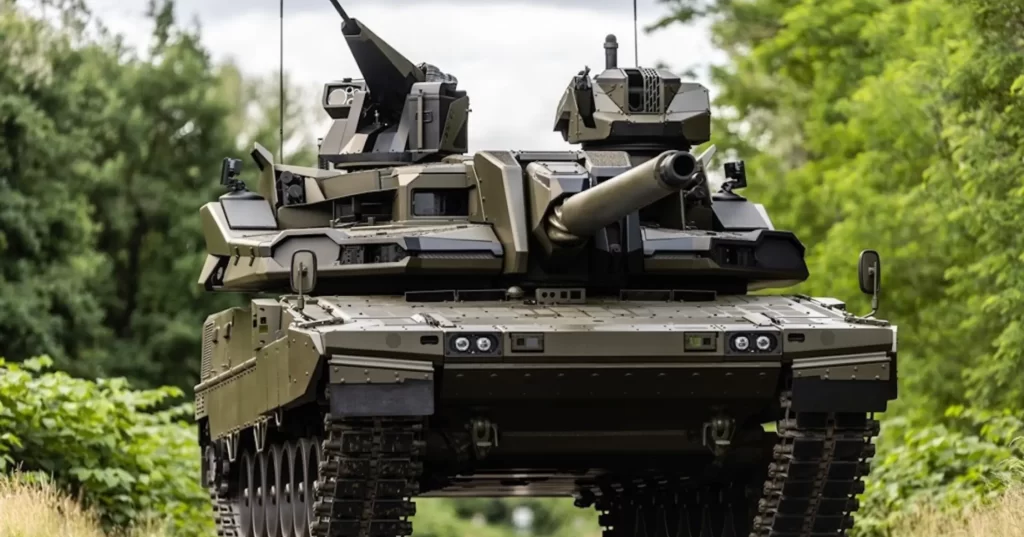
On April 26, Defence Ministers of two nations France and Germany signed off on an agreement that is related to the future battle tank ground combat system. In this industrial work, both nations partake equally in addressing a historical challenge in multinational European defense projects.
Furthermore, under the pacts, Germany will be on top to make the project successful. It is anticipated that Germany will commence the process of awarding contracts for the initial demonstrator phase before the conclusion of the current year.
Both France and Germany are driven by the shared objective of procuring a successor to their existing main battle tanks, the Leclerc utilized by the French Army and the Leopard 2 utilized by the Bundeswehr, with the targeted timeline for deployment set at 2040.
Both nations France and Germany are going to restart the old project. The name of this project was Main Ground Combat System (MGCS). In 2012 they initialized this project and then after some time it stopped because they couldn’t agree on who would do what work.
Now two different parties of France and Germany named as French Armed Forces Minister Sebastian Lecornu and Germany’s Defense Minister Boris Piorius are working together. They work for more than 8 years to find the path that makes the project successful. Different companies such as France’s Thales, Franco-German KNDS (composed of Germany’s Krauss-Maffei Wegmann (KMW) and France’s Nexter Defense Systems) and Germany’s Rheinmetall can collaborate together to start working on the proposal.
There are 5 different phases of this project. The first phase of MGCS project involves analysis and operational needs and the 2nd one involves the concept of survey. Both of these phases are finished now. The 3rd phase of the project related to development and technological capability demonstration. After the completion of the 3rd phase the project will enter in the fourth phase that is related to integration and systems demonstration.The end phase related to mass system production.
The MGCS aims for a main battle tank combined with AI-enhanced unmanned ground systems. Germany plans for a flexible system with various tank types sharing a common base. They also consider using a hybrid engine to reduce noise. Although concerns like vulnerability to drone attacks and the need for stronger cannons are important, the MGCS is still in the planning stage.
Lecornu emphasizes that the future MGCS will prioritize evolving tank needs over futuristic concepts. He envisions a tank vastly different from current models. To achieve this, designers must analyze recent military conflicts, like the Second Nagorno-Karabakh war and the Russia-Ukraine conflict, where many tanks were destroyed. They’re focusing on factors like mobility, weight, firepower (with a 130mm or 140mm cannon likely), and armor for the new design.
It is good for both nations to set aside the disagreement about industrial work. For a better future they have to restart their joint project to meet the 2040 deadline. The enthusiasm of the both nations pushes them to reach a political agreement and make the project successful as soon as they can.
The importance of this step becomes clear when considering the condition of both armies’ current equipment and the likelihood that France might require the MGCS earlier than 2040, perhaps by 2035. This misalignment in timelines could pose challenges for both partners.
With a contract secured to produce the latest 2A8 variant of the Leopard 2 tank in the coming years, KMW will provide a temporary solution for the Bundeswehr, allowing time for the MGCS development without an urgent need for replacement.
The production of the Leclerc ceased in 2008, this is the reason that French Army need their new tank. While 200 French Army Leclerc tanks are being upgraded to the XLR standard, these are not new-build versions like those for the Bundeswehr.