France and Germany are circulating a joint proposal to substantially reform the European External Action Service (EEAS) and strengthen the EU’s foreign‑policy machinery under High Representative Kaja Kallas. The paper, reported by Politico, seeks to make the HRVP the central strategic coordinator of EU external action while partially integrating the EEAS into the European Commission, partly to cut costs as the bloc trims its long‑term budget. The initiative arrives amid intensifying geopolitical pressure, with officials arguing that fragmented institutions and slow decision‑making are undermining Europe’s ability to act as a coherent global player.
The core of the Franco‑German proposal
In essence, the Franco-German paper attempts to enhance the influence of Kallas while realizing the fact that most of the influence regarding conducting foreign policy lies in the hands of the Commission. The proposals include the transferring of some of the 5,000 staff members and the responsibilities of the EEAS into various departments of the Commission even though the EEAS will still remain independent as a diplomatic organization. The idea is that the HRVP will have greater coordination capabilities with the external organs of the Commission, which will be especially true regarding migration and development assistance, so as to align all the aspects of diplomacy, trade, visas, aid, and missions to the EU abroad to one strategy.
The document directly invites comments by presenting “five guiding questions” about the reform of the institution. These include questions on how to make the EU more strategically assertive as a global foreign actor, how to increase the value of the 145 delegations of the EEAS in the world, how to fulfill the mandate of the EEAS under the treaties, how to make the structure of the institution consistent with the Commission and the Council, and how to increase the contribution of the EEAS to the leader discussions.
Why Paris and Berlin are pushing now
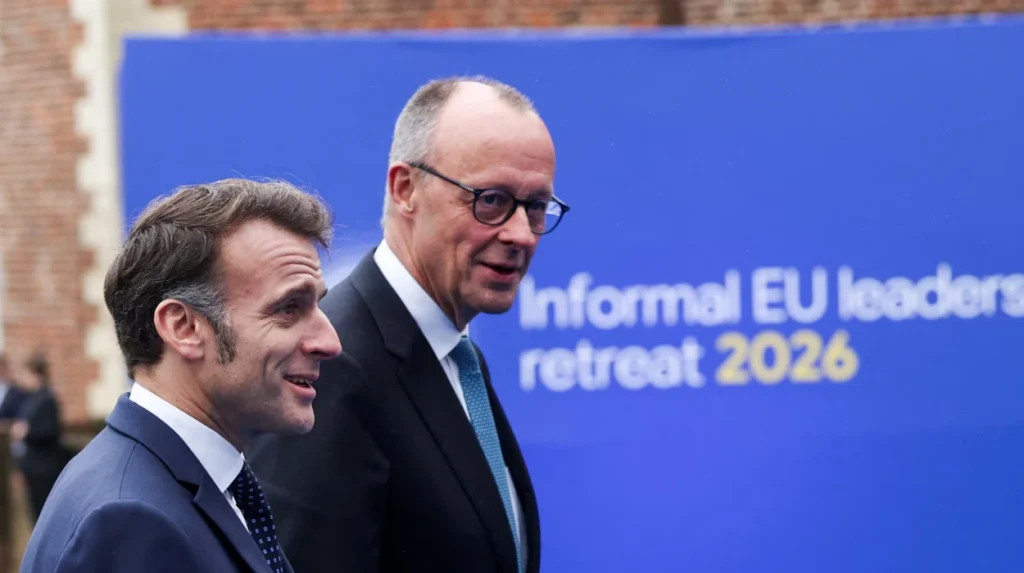
The reform is justified as a way of adapting to the shifting international scene where “hard power politics,” AI-enhanced info-warfare, and austerity make for a “root-and-branch rethink” of EU’s diplomatic approach. As diplomats told Politico, another part of the rationale lies in cutting costs by merging some functions at the Commission because the EU faces the challenge of having to cut its budget for years to come. On the other hand, the document recognizes one thing: a lot of the power to make foreign policy decisions — from trade to aid, from visas to missions — resides in the Commission, thus HRVP has to have better tools at his disposal to translate political will into action. The move is also in line with a wider Franco-German attempt to revive their bilateral “engine” following Friedrich Merz’s election as German Chancellor in May 2025, with Paris and Berlin trying to breathe new life into their joint work on European sovereignty and foreign-policy capacity.
What the reform would change in practice
From an implementation perspective, it will lead to moving some of the EEAS units to the Commission’s directorate and will involve assigning Kallas with the job of creating coherence in the external activity of the EU. In other words, when the EU applies diplomacy, imposes sanctions, conducts negotiations for trade deals, manages migration agreements or develops infrastructure, all these tools should not contradict each other and work in a different strategic direction, but rather complement one another.
The idea is to bring together the HRVP, the Commission, and the Council in order to increase coordination and improve crisis reaction, especially in regions, where the EU’s reputation is at stake. Moreover, the reformation focuses on the use of the EEAS’s global network. With nearly 145 delegations in the world, the institution is expected to go beyond reporting tool and become a functional center which is to support EU actions in the area of migration, security and development issues. The five questions are formulated with the purpose of starting a debate on how to make the delegations provide a valuable contribution beyond the diplomatic one.
Stakes for Kaja Kallas and the HRVP role
For Kallas, the proposal offers a chance to cement her position as the EU’s chief foreign‑policy coordinator, with enhanced authority to align the Commission’s external tools behind a single strategy. One EU official, speaking anonymously, captures the logic:
“The EU would have more leverage globally if we’d better align the tools we have — from diplomacy to visa policies, trade, aid and EU missions — in pursuit of European interests. The HRVP [Kallas] can provide that strategic direction, given her link to the Council.”
If adopted, this would move the HRVP closer to the center of gravity in Brussels, where budgetary and regulatory power over external action largely resides.
However, the plan also carries risks. By pulling some EEAS functions into the Commission, the reform could dilute the service’s distinct diplomatic identity and make the HRVP more dependent on Commission priorities and internal bargaining. Critics may argue that structural tinkering cannot overcome the fundamental constraint that EU foreign policy ultimately depends on member‑state consensus, especially when national interests diverge on sensitive issues.
Skepticism and the limits of institutional engineering
Not everyone in Brussels is convinced that now is the time for major institutional change. One EU diplomat tells Politico,
“A big institutional change right now is not realistic,”
ruling out major reforms before the end of Ursula von der Leyen’s second Commission term in 2029. This skepticism reflects a broader caution: even if structures change, foreign policy effectiveness still hinges on member‑state consensus, which critics say is the real bottleneck.
Another official warns against overestimating what organizational charts can achieve:
“Let’s face it … EU foreign policy only works if Member States want it. Shifting some teams from the EEAS to the Commission won’t fix the Middle East or stop Russia’s war.”
The point is blunt but important: no amount of internal streamlining can substitute for political unity when the EU faces hard choices on conflicts, sanctions, or neighborhood policy.
The budget dimension: capability upgrade or cost‑cutting?
The cost issue has also surfaced several times in the reporting. According to diplomats speaking to Politico, one rationale for the reform is to save money by centralizing certain capabilities within the Commission as the EU downsizes its long-term budget. But this brings forth an important question: is the Franco-German proposal primarily an improvement in strategy, or is it a financial maneuver under the guise of improving capabilities? In the former case, there could be a risk that the reform will turn into a zero-sum game where the EEAS loses in terms of capability without gaining in terms of coherence. Proponents of the reform believe that the centralization of functions will result in elimination of duplication and fast decision-making; however, the office of the HRVP could be overstretched in this case.
How this fits into wider EU reform debates
The EEAS proposal does not exist in a vacuum. German Foreign Minister Johann Wadephul has separately advocated replacing unanimity in foreign policy with qualified‑majority voting to avoid blockages, as part of a wider EU reform agenda. This reflects a growing recognition that institutional design matters: if a single member state can veto decisions, the EU’s ability to act decisively will remain limited, regardless of how well its external tools are coordinated.
At the same time, the Franco‑German reset since Merz’s appointment has sought to restore momentum on European sovereignty, including on foreign‑policy capacity. The EEAS reform pitch can be read as a concrete step in that direction: a bid to make the EU’s external action more coherent, faster, and more cost‑effective, even if the ultimate test remains political unity among member states.
What success would look like—and what could go wrong
In terms of success, there will be a more strategically assertive EU that is able to coordinate its diplomacy, trade, aid, visas, and mission efforts in one strategic direction through the efforts of the HRVP. The 145 delegations of the EEAS will be more than just reporting stations but operational centers that help coordinate the activities of the EU in regards to migration, security, and development. Such an approach may lead to a faster and more consistent response from the EU, thus increasing its reputation as an international player. However, there are many scenarios that may turn into failures. In case the reforms are used mostly for saving money, the EEAS will reduce its capacity while not becoming any more coherent. In case the member states have different opinions about the matter, it will not matter how much the internal processes are streamlined because there will be no coherent foreign policy.
The road ahead: 2029 as a realistic horizon?
Taking into account the skeptical attitudes in Brussels, it seems that any institutional reform can be expected only at the end of the second term of President von der Leyen in 2029. Hence, it might appear that the Franco-German document is more focused on setting the agenda rather than on immediate implementation. By putting forward the EEAS reform today, Paris and Berlin demonstrate that they perceive a need for a more centralized framework of European external action as an indispensable element of a more active Europe. Meanwhile, the five guiding questions may function as the test for ideas with member states, the Commission, and the EEAS providing input into the next version of the proposal. Thus, the success of such an approach will depend on the ability of the EU to find the political will for bringing its tools (and member states) under one roof.