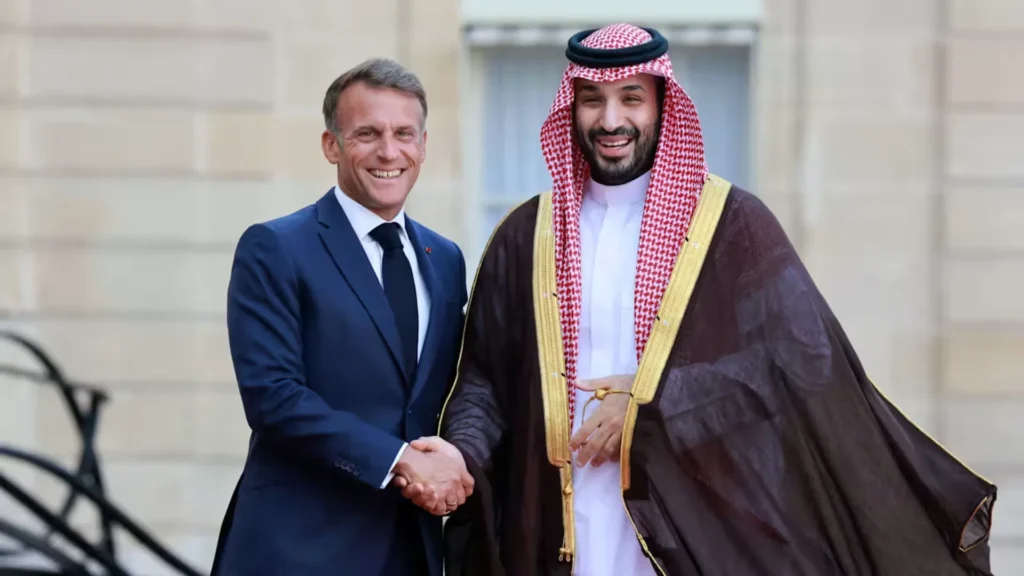
France and Saudi Arabia signed an agreement for a new theme park complex in Cergy-Pontoise, northwest of Paris, worth $7 billion through a joint project initiated by Qiddiya Investment Company. The agreement signed on 24 August 2026 when Saudi crown prince, Mohammed bin Salman visited Paris, is one of the biggest foreign direct investments in the French leisure industry in recent years and shows the importance of entertainment facilities as tools for diplomatic engagement, soft power projection, and brand positioning.
The project will be located in Cergy-Pontoise in a former amusement park known as Mirapolis, which was shut down 35 years ago. According to French government officials, it is a three-park complex project, which includes accommodation, dining, and residential components alongside its other amenities, which also include a manga/anime-themed park, specifically featuring Dragon Ball (reported widely as Dragon Ball Z).
While no opening date has been announced, the scale and symbolism are clear: President Emmanuel Macron framed the venture as a generational investment win, posting on X that
“nothing like this has happened since Disneyland Paris.
The mechanics of the deal: what is known, and what remains opaque
At the heart of the deal lies a €6 billion investment promise by Qiddiya, the Saudi entertainment and investment firm related to the Public Investment Fund (PIF). It includes three theme and leisure parks as well as real estate and hospitality components. According to a statement at the Élysée Palace, Qiddiya confirmed the location for the parks – Cergy-Pontoise. At the same time, Macron highlighted the job creation potential of the deal as “extraordinary.” The president called it a “new global destination” to be built on the outskirts of Paris. Official estimates, which speak about 22,000 jobs (construction, operation, hospitality, and other services), became one of the main topics when French officials were speaking about the economic impact of the project. However, some crucial aspects are still kept secret. In particular, the master plan has not been revealed yet. It means that the land use plan (size of each park, attractions included, hotels’ capacity in terms of beds, residences, and transport infrastructure) is still unknown. In addition, financing details are vague. Specifically, there are no information about French government co-financing (if it will be), any tax incentives, and any guarantees that may be used by the developers and therefore impact the risks of the project. Finally, licensing agreement with Dragon Ball rights holders and possible involvement of Japanese partners in the deal besides the license is still unknown while the Paris project is expected to resemble Qiddiya’s existing Dragon Ball Park in Saudi Arabia.
That Saudi reference point matters. The Qiddiya Dragon Ball park in the kingdom covers more than 500,000 square metres, features recreations such as Kame House and Capsule Corp, includes over 30 attractions and five major rides, and is anchored by a 70-metre Shenron statue. If the Paris iteration approaches that footprint and ride density, it would represent a significant addition to Europe’s themed entertainment map, competing directly with established destinations for domestic and international visitors.
Why Dragon Ball? Cultural resonance and calculated brand alignment
This is not a coincidence because Dragon Ball emerged as a theme as a result of conversations between Macron and Mohammed bin Salman when Macron visited Saudi Arabia in 2025. The popularity of the manga series spans generations in Europe and the Middle East. The series’ appeal transcends millennial and Gen Z generations and is thus attractive to theme parks looking to attract visitors from such demographics by creating interactive experience centers based on intellectual property. The appeal of the manga to Saudi Arabia lies in the ability to provide a culturally relevant product that does not attract political sentiments and which can thus be scaled across markets easily.
To France, manga represents an approach to cultural strategy that the country has always employed with regards to Japanese culture, which includes anime conventions and museum exhibitions. The approach provides an opportunity for the park to differentiate itself from the fantasy IP world of Disneyland Paris. However, dependence on one IP creates challenges with regards to diversification of themes in case the IP becomes less appealing or licensing becomes harder.
Economic stakes: jobs, FDI, and the politics of place-making
The 22,000-job estimate is the project’s most potent political asset in France. In a European context where large-scale greenfield investments are rare, the promise of sustained employment across construction and operations offers a compelling narrative for national and local officials. Cergy-Pontoise, a planned urban center with existing transport links, stands to benefit from renewed visibility and infrastructure upgrades, though the precise distribution of jobs—temporary versus permanent, skilled versus entry-level—will shape the project’s real socioeconomic impact.
From an investment standpoint, the deal signals Saudi Arabia’s continued push to diversify beyond oil by exporting capital into high-profile leisure and entertainment assets abroad. Qiddiya’s involvement ties the Paris project to a wider portfolio that includes giga-projects in the kingdom, reinforcing the message that Saudi capital is not only building domestically but also seeking global footholds in sectors with long cash-flow horizons. For France, the €6 billion commitment is a rare foreign direct investment headline in a sector that typically sees incremental expansions rather than transformative new builds.
However, the economics of themed entertainment are notoriously capital intensive and cyclical. Success depends on sustained visitor numbers, ticket pricing power, ancillary spend (food, merchandise, hotels), and the ability to refresh attractions to maintain repeat visitation. The absence of an opening timeline and a detailed master plan means that financial modeling remains speculative for now, and the project’s viability will ultimately hinge on execution discipline, cost control, and alignment with regional tourism flows.
Strategic context: the wider France–Saudi package and diplomatic signaling
The theme-park MoU did not arrive in isolation. It was one of several agreements announced during Mohammed bin Salman’s Paris visit, spanning defense, transport, energy, AI, and culture. A letter of intent between defense ministries aims to strengthen cooperation in emerging technologies, while Alstom secured a €500 million contract to supply additional trains for the Riyadh metro and establish an assembly plant. CMA CGM confirmed a €434 million investment to develop a new terminal at Jeddah’s deep-water port, and Orano signed an MoU on civilian nuclear cooperation, alongside discussions involving Mistral AI and an extension of the Al-Ula cultural and archaeological project through 2035.
Read together, these deals illustrate a deliberate strategy of interlocking economic and diplomatic ties. The theme park, as the most visible consumer-facing element, functions as a flagship symbol of partnership, while the defense, transport, and energy agreements deepen institutional linkages that are less susceptible to public scrutiny. In that sense, the Paris park is both an economic asset and a diplomatic signal: a statement that France and Saudi Arabia are willing to normalize and expand cooperation across sensitive domains, even as rights controversies persist.
Rights backlash and the “entertainment-washing” critique
The celebratory framing of the deal has been met with criticism from parts of the French press and civil society organizations. Unions representing journalists and organizations defending freedom of the press criticized the visit of Mohammed Bin Salman in Paris following the 2018 murder of journalist Jamal Khashoggi and several lawsuits against the crown prince for torture and enforced disappearance.
For those opposing the deal, the very fact of an investment of 6 billion euros for a cultural and entertainment enterprise represents a normalization process which could end up overshadowing any remaining human rights issues. This debate is likely to impact the framing of the news by some outlets, which could see in such a big investment in sport and entertainment what is referred to as “sportswashing” or “entertainment washing,” meaning the investment of big money in culture and entertainment to improve one’s image. The counter-argument put forward by the French government and businessmen is that big investments and job creation should be viewed positively, and engagement is better than isolation.
Execution risks and the road ahead
Even with political backing, the project faces significant execution risks. Themed entertainment developments of this scale require multi-year construction timelines, complex permitting processes, and coordinated infrastructure upgrades to manage visitor flows. The lack of a published master plan means that environmental assessments, traffic modeling, and community consultations are still to be fully aired, and any delays or cost overruns could test the resilience of the investment thesis.
There are also market risks. Europe’s theme park sector is competitive, with established players constantly refreshing their offerings. A Dragon Ball–anchored park must deliver a compelling guest experience that justifies travel time and expense, particularly if it aims to draw international visitors beyond the Paris region. Licensing dynamics, creative execution, and operational excellence will be decisive; a park that feels derivative or underpowered relative to its Saudi counterpart could struggle to meet attendance and revenue targets.
Finally, the geopolitical dimension cannot be ignored. Shifts in France–Saudi relations, changes in EU policy toward Gulf investments, or new rights-related developments could alter the project’s political cover and public reception. While the MoU signals strong intent, the path from memorandum to ribbon-cutting will require sustained alignment across governments, investors, and local stakeholders.