On Ukraine’s 35th Independence Day, the European Union delivered more than ceremonial congratulations. The European Commission announced that it had approved €6.1 billion in new defence procurement funding for Kyiv, explicitly earmarked for air and missile defence systems, missiles, ammunition and radars. The move is framed by Brussels as both a technical disbursement and a political statement: as Russia intensifies its bombardment campaign, Europe is “stepping up” to help Ukraine protect its people and defend its skies.
It is all carefully timed. The pledge comes amid a “Coalition of the Willing” leaders’ gathering in Kyiv, where some 30 nations will meet to discuss ways of fortifying Ukraine’s air defense as winter approaches and outline security arrangements for Ukraine after the ceasefire. In this setting, the most recent EU contribution is not simply another entry in a growing list of aid contributions; it represents a calculated move by Europe that is going to continue to serve as the financial and industrial underpinning of the Ukrainian resistance effort despite behind-the-scenes political wrangling.
The Mechanics: Where the €6.1 Billion Fits in the €90 Billion Loan
The importance of this €6.1 billion loan can be understood by looking at the bigger picture of how it fits into the scheme of the EU’s €90 billion Ukraine Support Loan (UASL) of 2026–2027. It was agreed upon by the Council via enhanced-cooperation procedure in April 2026, after Hungary and Slovakia voiced potential vetoes, in the framework of €60 billion dedicated to defense equipment purchase and €30 billion of general budget support. From €60 billion allocated for defense, €28.3 billion are available in 2026 with the aim to enhance Ukraine’s defense industry and procurement capabilities in the current military campaign season. This loan of €6.1 billion is supplementary to €16 billion that have been already approved for defense purchases through the UASL and €8.35 billion that have been already disbursed as of late August 2026.
On Ukraine’s Independence Day, we show our unfaltering support.
— Ursula von der Leyen (@vonderleyen) August 24, 2026
Today, we approved €6.1 billion for the air and missile defence systems, missiles, ammunition and radars that Ukraine urgently needs.
Europe stands with you today, tomorrow, and for as long as it takes.
З Днем… pic.twitter.com/QCg62KaXqW
The Commission’s language is precise: the funds
“cover air and missile defense systems, missiles, ammunitions and radars, reaffirming Europe’s commitment to supporting Ukraine’s defense and resilience against Russia’s ongoing aggression.”
Crucially, the loan is financed via EU borrowing on capital markets, not by a direct transfer of frozen Russian sovereign assets. Ukraine is expected to repay the €90 billion only after Russia pays reparations, while Russian assets in Europe remain frozen in the meantime. Within the €60 billion military portion, third‑country procurement is allowed only as a last resort, reinforcing a “European first” sourcing principle that ties this aid package to the bloc’s own defence‑industrial ambitions.
Why Now: Record Missile Strikes and the Logic of Urgency
This particular tranche is justified by the Commission based on concrete figures. According to officials, there were 376 missile strikes in July 2026 alone, which is said to be the highest figure for one month ever since the missile and drone attacks became widespread. It has resulted in an increase in the cost of lives of people in terms of casualties: 437 civilian deaths and 2,610 wounded in July 2026 have been recorded by UN observers – the most lethal month for civilians since May 2022.
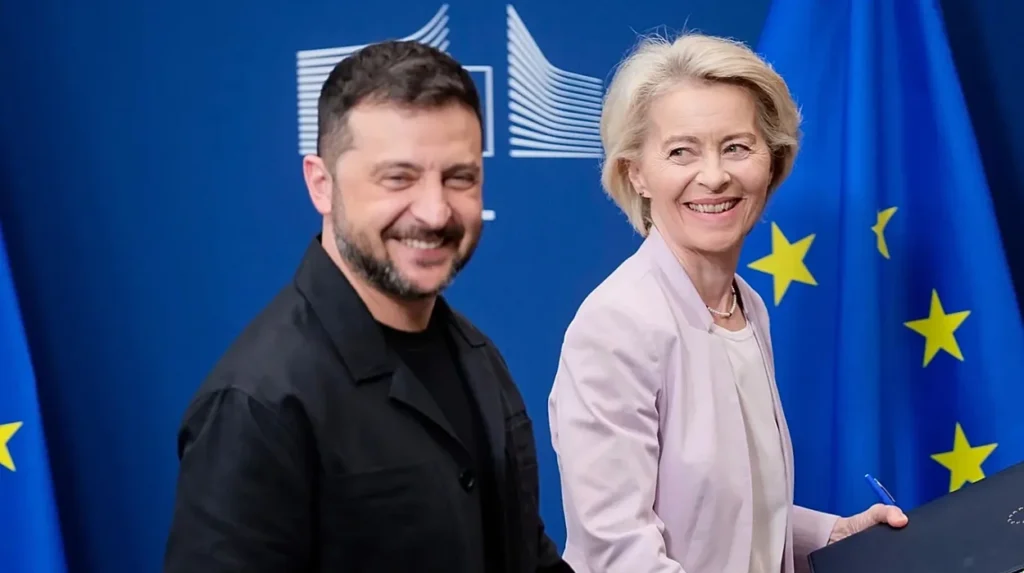
Commission President Ursula von der Leyen framed the decision in stark terms:
“Today, we have approved €6.1 billion for the air and missile defence systems, missiles, ammunition and radars that Ukraine urgently needs.
As Russia intensifies its attacks, we are stepping up to help Ukraine protect its people and defend its skies.”
She added,
“Europe stands with Ukraine and we will deliver what it needs, when it needs it.”
On social media, she linked the approval directly to the attack statistics:
“On Ukraine’s Independence Day, we show our unfaltering support… With 376 missile strikes recorded in July alone, reinforcing Ukraine’s defences has become increasingly urgent.”
EU Defence Commissioner Andrius Kubilius echoed this urgency, saying the EU is taking “concrete action” against “relentless” Russian threats, enabling Ukraine to procure
“the missiles and air-defence systems it urgently needs to protect its people and defend its sovereignty.”
The subtext is clear: air defence is no longer a niche capability but the central pillar of civilian protection and military endurance as Russia leans harder on long‑range strikes.
What the Money Will Buy: Systems, Not Just Symbols
The Commission does not mention any platforms in its statement, but the categories are telling. The bundle includes, among others, systems for air and missile defence (interceptors, launchers, command-and-control system), missiles (generally, surface-to-air and presumably other strike missiles), ammunition (mostly artillery and conventional ones), and radars (airspace surveillance and fire control, among others). The composition suggests a two-pronged rationale: fill in the holes in the layered air defence of Ukraine against ballistic missiles and jet-powered drones; and maintain the firepower on the ground so that the defensive progress would not be offset by the lack of artillery. Brussels also stresses that most procurements will come from European defence firms, which focuses on firepower to counter Russia’s increased employment of ballistic missiles and jet-powered drones.
It helps to achieve a number of goals simultaneously: reduces the chain of supply compared to deliveries across the Atlantic; complies with the European push for expanding its own defence-industrial sector; and gives rise to a political lobby within EU countries, which gets contracts. The rule of “European first” is not merely economic protectionism; it is a way of managing risks to ensure there would be no delays in procurements if non-European suppliers encounter difficulties.
Political Timing: Independence Day, Kyiv Summit, and Winter Readiness
As important as the news itself, is the way in which it was announced. Through the €6.1 billion funding on 24 August, the EU places itself within the Ukrainian narrative of sovereignty and resilience. Moreover, it directly dovetails with the upcoming “Coalition of the Willing” meeting in Kyiv, where the leaders are to discuss bolstering air defence systems as well as agreeing on security guarantees for the post-ceasefire phase. Within such an environment, the EU funding becomes a source of leverage, proving that Europe is able to complement diplomatic efforts with tangible procurement capabilities.
The Ukrainian authorities responded positively to this development. The Ukrainian Prime Minister Sergii Koretskyi endorsed the announcement through social media, supporting the official stance on the importance of timely defence assistance from the West to cover Ukraine’s air defence. While not mentioned explicitly by name in the Commission’s announcement, President Zelenskyy has made several comments warning about Ukraine’s shortages of missiles and the need to provide more extensive air-defence packages before the coming winter. He compared annual amounts of missiles received in the past to the projected amount in 2026 and called for larger interceptors packages.
The Wider Aid Picture: Industrial Deals, Drones, and Frozen Assets
This defence tranche is not standing alone. The EU’s 2026 funding package envisages €45 billion worth of aid for the year, alongside the €90 billion loan scheme for two years. Simultaneously, the EU is pursuing an industrial policy: in July 2026, von der Leyen travelled to Kyiv in order to inaugurate an EU-Ukraine Defence Industrial Partnership and an EU-Ukraine Drone Deal worth €1 billion for drone manufacturing. The idea is that assistance should be seen not just as purchasing off-the-shelf systems, but also as developing capabilities in Ukraine for mass production of vital ammunition. Another politically fraught track concerns the frozen assets of Russia in the European sovereign sector.
The EU uses lower amounts (such as €80 million in March 2026) of revenues made from these assets rather than the principle itself, and the main €90 billion loan is financed via EU borrowings, not the transfer of frozen assets themselves. However, countries such as Belgium have already declared their openness to re-evaluation of the asset transfer issue for Ukraine if the risks are evenly distributed across the continent, as stated by Deputy Prime Minister and Minister of Foreign Affairs Didier Reynders. This discussion will still be shaping the political context around the implementation of the procurement tranche, even though the €6.1 billion tranche is legally separated from the asset issue itself.
Strategic Implications: What This Means for the War and for Europe
At the operational level, the €6.1 billion is designed to do three things. First, it aims to raise the density of interceptors and sensors around key cities and critical infrastructure, reducing the probability that Russian missiles penetrate defences in decisive numbers. Second, it seeks to stabilise ammunition stocks so that Ukrainian forces can maintain pressure on the front without being forced into conservation modes that cede initiative. Third, it intends to lock in European industrial capacity for the medium term, ensuring that the supply side does not become the weak link as the war drags on.
At the strategic level, the package reinforces a broader European narrative: that security on the continent is now inextricably tied to Ukraine’s ability to defend itself, and that the EU is willing to use its financial heft to underwrite that defence. The emphasis on European sourcing also dovetails with longer‑term ambitions to make the EU a more autonomous security actor, less dependent on external suppliers for critical munitions. In that sense, every interceptor purchased under this tranche is both a tactical asset for Kyiv and a building block for a more integrated European defence ecosystem.
Risks, Constraints, and the Road Ahead
One tranche alone does not solve the problem of Ukraine’s air defence system. Fighter jets are destroyed rapidly, radar systems need to be maintained and integrated, and production lines take time. Then there are political risks associated with discussions regarding frozen funds, burden sharing, and election cycles in the member states which might affect further disbursement. While the Commission’s decision on ‘European first’ procurements may be considered as a strength from an industrial policy perspective, it could turn out to be a limitation if European plants fail to meet demands fast enough.
However, the trend is evident. The EU is shifting from one-off aid packages to a more systematic loan-based approach where multilateral financing is made conditional on procurement category. This tranche for €6.1 billion is a part of that shift: it is big enough to make a difference on the battlefield, specific enough to target the most urgent vulnerabilities, and timely enough to give Europe a say in the diplomatic negotiations currently taking place in Kyiv. In the words of Ursula von der Leyen:
“Europe stands with Ukraine and we will deliver what it needs, when it needs it.”