The Russian Embassy in Rome pointing fingers at Ukraine in connection with the bombing at a Moscow restaurant has brought a localized act of violence into a political and propaganda fight. An explosion occurred in Balzi Rossi, an Italian restaurant located in central Moscow, resulting in several deaths and more than 19 to 21 injuries, according to some reports. However, the most controversial element of the case is not the explosion per se, but rather how Moscow has been able to use it for its political benefit.
Embassy claim and its message
The embassy’s statement was unusually pointed in its language and audience. It said “Kyiv terrorists” wanted
“to scare the Italians working in Russia and to show them that they too are in the crosshairs and could become the scoundrels’ next victims.”
That wording does more than assign blame; it casts the attack as a warning to the Italian community and a supposed act of intimidation designed to widen fear beyond the immediate blast site.
The embassy also said the Italian chef and staff escaped harm only because of the
“vigilance and selfless dedication to his professional duty”
of a Russian security guard. That detail is important because it lets Moscow present the incident as both a security failure and a story of Russian protection, even while implying that Ukraine was behind it.
What happened in Moscow
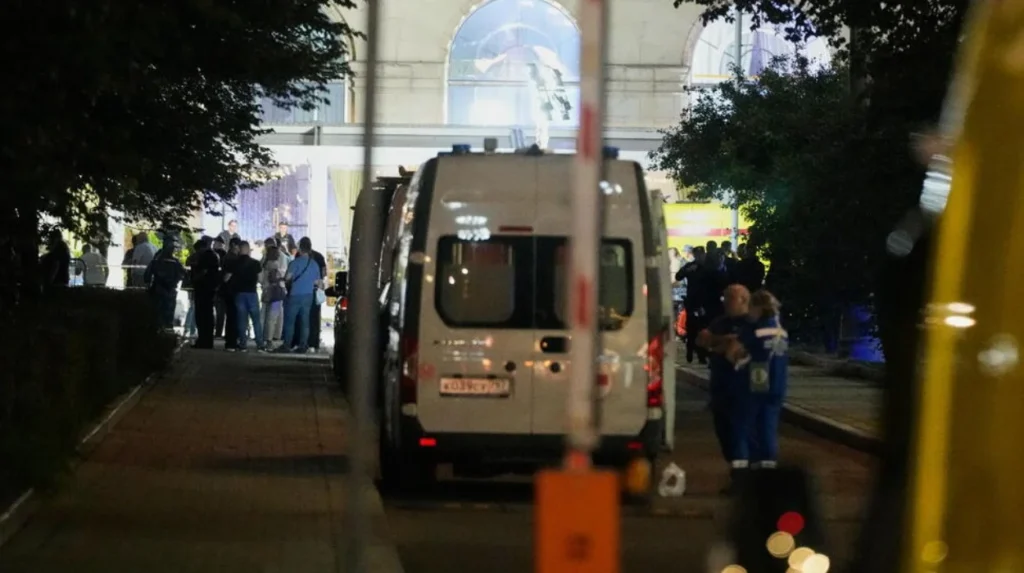
The bombing took place on Saturday evening at the Balzi Rossi, a luxury Italian restaurant located at the Kudrinskaya Square in the heart of Moscow and situated on the ground floor of a “Seven Sisters” skyscraper in Moscow which is a product of Stalin’s era. The first information released by the Russian authorities stated that three people had been killed and 21 had been injured due to the explosion of an explosive device near the entrance of the restaurant. However, the subsequent reports released by the embassy officials stated that the number of casualties increased to five but the injuries came down to 19. According to the officials, an unidentified woman tried to enter the venue having an explosive device and it was stopped by the security guard who died along with the woman and one of the guests in the restaurant.
Conflicting figures and uncertainty
The fluctuating casualty figures are significant in light of the confusion that is likely to be prevalent after an attack such as this one in Russia. While some casualty figures were put at three killed and 21 injured, the Russian Embassy in Rome gave figures of five dead and 19 injured. The figures could have differed due to the fact that those who got injured might have died in the process. However, there are also different Russian sources giving varying casualty figures for the incident. There was also no immediate reaction from Ukraine, nor was there any mastermind of the incident identified by Russian authorities.
Moscow Mayor Sergei Sobyanin called it a “brutal terrorist attack” and said those responsible would be found and punished, but he did not name any suspect or attribute responsibility to Ukraine in his initial remarks.
Why the Italian angle matters
This particular frame employed by the Russian embassy in relation to Italians is not a coincidence. When Russia talks about the attack as being an attempt to scare “the Italian community in Russia,” Russia is looking to internationalize the event and get Italy to be part of the story in order to create an emotional link to the story. Such a tactic is typical of Russian diplomacy where Russia attempts to tie a security-related situation in Russia with the interests of another nation to increase sympathy for Russia and suspicion against Ukraine. This is why the venue is politically important in the first place, because when the attack happens in an Italian restaurant, Moscow has a reason to hint at the fact that Ukrainian supporters or even Ukrainians themselves have become a threat to foreigners in Russia.
Moscow’s broader war narrative
The embassy’s accusations fit a longer Russian pattern of blaming Kyiv for attacks on senior military figures and symbolic targets since the full-scale invasion of Ukraine in 2022. The AP report noted several previous incidents, including the shooting of Lt. Gen. Vladimir Alexeyev, the car bombing that killed Lt. Gen. Fanil Sarvarov, the April 2025 bomb that killed Lt. Gen. Yaroslav Moskalik, and the December 2024 attack that killed Lt. Gen. Igor Kirillov.
Russia has openly blamed Ukraine for some of those attacks and has used them to justify tighter security around military and government officials. So when the embassy now points to Ukraine in the Moscow restaurant case, it is not just making a claim about one explosion; it is placing the blast inside a larger narrative of Ukrainian sabotage, terror, and escalation.
Target, motive and questions
One of the most important unanswered questions is whether the restaurant was the actual target of the bombing or whether it was an attempt to target someone present at the private function hosted at the restaurant. Russian media outlets speculated that it might have been a deliberate attempt on the life of a Russian general who was celebrating his birthday, even going so far as to speculate that this might have been Col.-Gen. Alexander Chaiko; but these allegations could not be independently verified.
Kommersant and other media outlets also speculated that the explosion might have been remotely detonated in order to inflict maximum casualties among the guests at the summer terrace of the restaurant. Yet this speculation brings up another factor – the woman might not have known what she was carrying. In which case, it becomes clear that there were many people involved in this act besides her. At least, as of now, there is no evidence of Ukrainian involvement in the crime.
Political and diplomatic impact
Italy’s response also matters because the Russian Embassy’s claim was made in Rome, not only in Moscow. By placing the allegation before an Italian audience, Moscow is trying to create diplomatic pressure and a sense of shared threat, even as Italian officials are likely to treat the accusation as unproven. The AP report said Italy’s foreign minister Antonio Tajani dismissed the Russian account as a “colossal lie.”
That rejection shows how quickly the incident became a diplomatic irritant beyond the immediate casualties. Rather than uniting around a condemnation of the bombing, Moscow and Rome are now locked in a familiar information struggle over responsibility, motive and intent. For Italy, the challenge is to avoid being drawn into Russia’s narrative while still responding to the human tragedy and the presence of an Italian venue at the center of the blast.