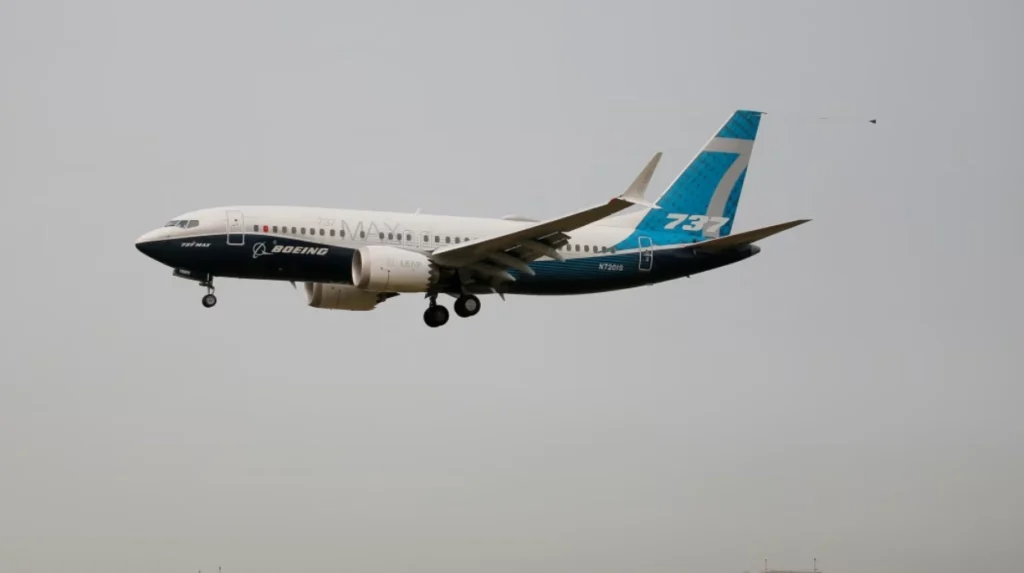
The latest FAA warning adds another layer of pressure on Boeing, this time over a safety issue that is smaller in scale than a structural defect but still serious in regulatory and public-safety terms. The agency has proposed inspections for passenger seats on 453 Boeing 737 MAX aircraft registered in the United States after identifying a potential installation problem that could leave some seats improperly secured. While the issue does not involve engines, flight controls, or a catastrophic airframe failure, aviation regulators treat even “minor” cabin hardware defects as significant when they can affect injury risk, evacuation speed, and overall airworthiness.
The central issue is a problem that there could be seat assemblies which were not appropriately assembled on their tracks. What this practically means is that the seats may be able to move out of place when put under certain forces, such as during rough weather or in the case of an emergency landing. According to the FAA, this defect poses the danger of injury to both passengers and crew, as well as creating the potential for blocking of the aisle in the event of a fast evacuation. In aviation safety, this is no trivial matter.
Why the FAA is acting now
The thing is, this particular development is not only due to the large number of planes that have been potentially affected by this problem, but also the fact that the FAA decided to react based on the information provided through this report and evaluation of the risks of installing as a whole fleet. The report shows that the inspection that will be proposed will affect 453 airplanes, and they are all related to the 737 MAX airplane series. The FAA has also noted that it could affect up to 69 track-mounted passenger seat assemblies per aircraft, which indicates that it is not some kind of defect affecting one row of seats in one production batch.
On the contrary, it looks like it is some sort of assembly process problem that could have appeared in several different airplanes. Another interesting aspect of this development is that the FAA is trying to react to this problem in advance, even though there was no such emergency before. The reason why the regulators do that lies in the fact that this potential defect could affect passengers’ safety in an emergency situation.
The safety risk in context
Seat integrity may sound like a routine maintenance concern, but the context matters. On an aircraft, every fixture in the cabin has a safety function, especially when the plane is experiencing high load, turbulence, or a sudden stop. A seat that is not properly attached could become a hazard not only to the passenger using it but to nearby travelers and crew. The FAA specifically warned that improperly installed seats could injure people if they detach or move unexpectedly. The agency also noted that such a defect could slow an evacuation, which is one of the most sensitive issues in aircraft certification and emergency planning.
That point is important because regulators do not judge cabin safety only on whether a defect is technically dangerous in flight. They also assess whether it could worsen the outcome in a time-critical emergency. A seat that remains stable during normal operations but fails during a hard landing still poses a serious problem if it impedes people trying to get out of the aircraft quickly. In that sense, the issue is less about comfort and more about survivability.
Boeing’s response
However, as seen from Boeing’s position, the corporation appears quite cooperative in terms of the problem in question. It is known that Boeing stated that the corporation has already provided operators with guidelines on the installation of seats back in December 2025 and it stands for making this guideline mandatory via the FAA. This fact is crucial since it means that Boeing has already identified the problem before its regulation and made recommendations for its resolution. By supporting making the guideline mandatory, the company demonstrates its readiness to cooperate in creating uniform regulations for this problem.
However, this fact cannot make the reputation damage disappear. Even though the technical problem is small enough, the appearance of the notice about safety-related problem adds to the image of Boeing as being under constant control. As such, the company has been working hard on restoring its reputation after major controversies related to the manufacturing problems for many years now.
What the numbers show
The scale of the proposed action is significant. The FAA’s proposed inspection covers 453 U.S.-registered Boeing 737 MAX aircraft. That is a large enough number to matter operationally for airlines, even if the inspection itself is relatively limited in scope. The agency also estimates that the correction could involve as many as 69 seat assemblies per aircraft, but no replacement parts are required. The estimated workload is about one hour per assembly, which means the total maintenance burden could still be substantial across an entire fleet, depending on airline scheduling and the number of affected seats found on each aircraft.
This combination of a wide fleet impact and a relatively simple fix is one of the reasons the story is drawing attention. It is not a crisis on the scale of a grounding, but it is also not a trivial paperwork issue. It sits in the middle ground where regulators can act decisively without triggering the kind of operational disruption associated with a major fleet-wide mechanical failure.
Why this matters beyond the cabin
It is also a reflection on the way that post-incident aviation safety policing works. The regulators have become more inclined to consider even minor workmanship concerns if they imply a process failure. An improperly fitted seat is not only a concern related to the seat; it can also mean that the procedure which should ensure its quality has failed to operate correctly.
This is the reason why this case is not only interesting for airline passengers but also for aircraft manufacturers who will need to test the efficiency of their process control system with the help of an aircraft operator and a regulator. For Boeing, this kind of inspection is particularly painful in the current context when the confidence level is rather low. Boeing’s manufacturing practice has been subjected to a thorough analysis for several years, and each new issue adds one more piece to the story.
Airline impact and operational handling
For airlines, the immediate concern is how to inspect aircraft without causing unnecessary disruption. Because the proposed fix does not require parts, the inspection can likely be folded into maintenance schedules more easily than a major repair campaign. Still, large fleets mean logistical complexity, especially for carriers that rely heavily on the 737 MAX for short- and medium-haul operations. Any required inspection wave must be balanced against flight schedules, aircraft rotation, and maintenance windows.
That said, the limited nature of the correction is important. If the FAA finalizes the directive in the form described, the process should be manageable for most carriers. The risk is less about prolonged grounding and more about the administrative and operational burden of confirming compliance across dozens or hundreds of aircraft. In aviation, that can still be expensive and time-consuming, even when the technical fix itself is simple.
Broader significance for Boeing
This particular event serves to prove an even larger point about where Boeing is at this point in time: Even small defects are big news stories nowadays. The company cannot be judged anymore solely based on whether or not its airplanes are flying in safety right now, but whether its manufacturing and quality control systems ensure that there will be no avoidable problems with its planes. This particular defect might not make for sensational news stories for too long, but it will serve as additional fuel to Boeing’s ongoing struggle with its reputation whenever a new FAA notice gets issued. Indeed, the message coming through from the regulators is very clear. It is not just the large scale defects which define the safety of commercial aviation, but also how the industry as a whole approaches the identification, reporting, inspection, and correction of minor defects before they become major ones.