France’s request for emergency assistance from the European Union underscores how quickly the current wildfire emergency has outgrown local response capacity. What began as a dangerous blaze near the country’s Atlantic coast has turned into a larger crisis involving mass evacuations, coordinated European support, and renewed questions about how prepared southern Europe is for increasingly severe fire seasons.
President Emmanuel Macron’s statement that France had requested help through the EU’s civil protection system is the clearest sign yet that the situation has become too intense for national resources alone. His description of the fire conditions as “extremely tense”, as Macron put it, reflects both the speed of the fire’s spread and the pressure on firefighters trying to contain it. With more than 10,000 people evacuated overnight in southwestern France, the disaster is no longer just a local emergency; it has become a test of European solidarity and crisis response.
A fast-moving emergency in southwestern France
The blaze has been located close to the French coastline along the Atlantic. Reuters news agency reports that the French government decided to completely evacuate the area around the Cap Ferret peninsula, which is one of the most popular tourist spots of France’s Atlantic Coast, as the blaze encroached on inhabited areas. This evacuation order reflects the fact that the fire has rapidly been perceived by officials as a threat to people’s safety, not simply a forest fire burning in remote territory.
The extent of the evacuation operation itself is particularly important. More than 10,000 people have had to leave their homes overnight in southwestern France, a fact that speaks to both the extent of the affected territory and the rapid reaction of the local authorities in order to ensure their people’s safety. In a region known for its beaches, holiday villas, and tourism, an evacuation of this magnitude also comes with considerable costs.
The geography matters too. Coastal and rural areas in southwestern France can be difficult to defend once strong winds and dry conditions combine to push flames across multiple fronts. Once a wildfire starts moving rapidly through such terrain, the challenge becomes not simply extinguishing it but slowing it enough to give authorities time to evacuate people and protect key infrastructure.
Macron’s message and political significance
Macron’s public statement carries importance beyond the operational details. By announcing the request for EU help himself, he signaled that the crisis has reached a point where France is prepared to openly lean on European partners. His words,
“The situation remains extremely tense,”
as Macron said, were not just a description of the fire but a political acknowledgment that the emergency is still unfolding and that the coming hours remain critical.
La situation reste sous très forte tension face aux incendies qui frappent le pays, en particulier en Gironde.
— Emmanuel Macron (@EmmanuelMacron) July 23, 2026
Mes pensées vont à nos sapeurs-pompiers et aux forces de secours qui luttent sans relâche sur le front des flammes. Leur courage force le respect.…
The selection of language also plays an important role since French presidents are usually quite cautious in terms of setting the tone when addressing the issue of domestic emergencies. In his speech, Macron is trying to convey the idea that the government views the fire as a high-level national emergency. Additionally, he is giving assurances that reinforcements are on the way and the problem is not being solved alone by France.
The involvement of the EU civil protection mechanism is another key element of the statement. This shows that France is not just calling on some people or countries for assistance, but triggering a specific system of European emergency response. In this case, it allows avoiding delays and bureaucracy while moving aircraft and specialists where they are needed most.
Europe’s firefighting solidarity
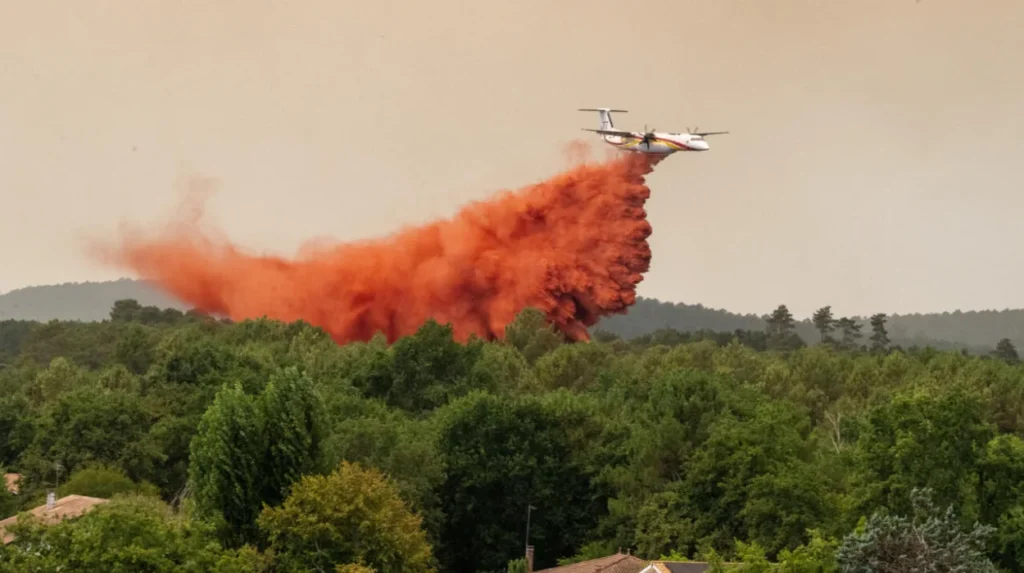
The EU response shows how wildfire emergencies increasingly cross national lines. According to the information available, the European Commission had already said the bloc was providing three water-bombing aircraft to France. Macron later said reinforcements would arrive soon, including two Croatian Canadair aircraft, two Portuguese Air Tractor planes, and two heavy Black Hawk helicopters from the Czech Republic and Slovakia. That mix of assets suggests the response is not symbolic; it is operational and significant.
This is to serve as a reminder that wild fire management in Europe has become a collective responsibility. Even though member states may be equipped with effective national fire services, extreme conditions are capable of challenging the latter to the extent that intervention by other parties becomes necessary.
Aircraft are particularly useful in the sense that they can reach remote and inaccessible places, reduce the speed of spreading fire, and thus provide more time for rescue teams. On the other hand, helicopters may prove particularly useful in cases requiring precise delivery of firefighting supplies to remote locations that are inaccessible to aircraft of larger size. The existence of the European Civil Protection Mechanism has been introduced specifically to cover such situations. The mechanism allows one to ask for assistance in case the situation surpasses the capacity of individual countries. For France, it means that the severity of the fire requires coordinated European response.
Evacuations, tourism, and public safety
The evacuation of Cap Ferret is one of the clearest signs of how close the fire came to populated and economically important areas. Cap Ferret is not only a residential and coastal destination but also a major tourism zone, which means evacuation orders there affect local life well beyond the immediate fire perimeter. French authorities had to prioritize human safety first, but the scale of the disruption will almost certainly be felt in the local economy for some time.
The forced evacuation of more than 10,000 individuals within a single night adds urgency. A mass relocation that takes place so rapidly poses many challenges in terms of transportation, accommodation, health care, and communication. At the same time, it imposes stress on people who have to be ready for evacuation in a matter of minutes. In wildland fire disasters, the evacuation process is usually considered to be the most risky due to rapid fire behavior and crowded roads with poor visibility. Here comes into play the shift from mere firefighting to precaution and uncertainty and how well the state can protect people under pressure. That is why the evacuation of such an amount of people indicates the significant danger to lives and properties.
Climate pressure and the wider European picture
The French wildfire is unfolding in a broader climate and weather context that is affecting much of southern Europe. Reporting on the wider situation says fires fueled by an intense heatwave continued to spread across parts of southern Europe, prompting assistance requests from the EU. That regional pattern matters because it shows France is not facing an isolated disaster but part of a larger seasonal crisis.
The European Commission has previously said it is modernizing its wildfire response because the threat is rising. It has pointed to climate change as a major driver of more frequent and more intense fires, and it has expanded emergency support tools accordingly. This includes pre-positioned firefighting resources and a stronger mechanism for moving aircraft and crews quickly between member states. The current situation in France fits squarely into that trend.
There is also a broader strategic question here. If France, one of Europe’s largest and best-equipped states, needs EU assistance for a major wildfire, then the pressure on smaller or less well-equipped countries could be even greater during future heatwaves. That raises the stakes for long-term investment in fire prevention, forest management, early warning systems, and cross-border emergency coordination.
Operational response and what it shows
The nature of the reinforcement package gives insight into how the emergency is being managed. Water-bombing aircraft are typically used to attack the fire’s front or support containment lines, while helicopters can provide flexibility in inaccessible terrain. The arrival of assets from Croatia, Portugal, the Czech Republic, and Slovakia shows that the EU response is geographically broad and that solidarity is being activated across different regions of the bloc.
The appeal by France is also an example of confidence in multinational emergency procedures. Rather than waiting until the fire becomes even more serious, French authorities acted decisively and sought reinforcements. This indicates the kind of lesson learned from previous crisis situations: reinforcing efforts early on is better than escalating the problem at a later stage. Once a wildfire reaches a certain stage of development, every minute counts and the timeliness of any sort of aerial help can be the determining factor in either containing the blaze or seeing it spread into a disaster of greater magnitude. From the political perspective, the picture is just as clear. Europe is making efforts to represent itself not merely as a bunch of individual national responses but as a force able to act in emergencies in a practical way.
The immediate outlook depends on weather, wind, and the speed at which the new reinforcements can be deployed. If conditions remain dry and windy, firefighting teams will face a difficult battle despite the added help. If aerial support begins to slow the fire’s spread, authorities may be able to stabilize the situation and prevent further large-scale evacuations.
For now, the most important fact is that the emergency is still active and unresolved. Macron’s statement, the evacuation orders, and the EU mobilization all point to a crisis in progress rather than a contained event. The coming phase will likely be measured in containment lines, further evacuation decisions, and the success of the incoming aircraft and helicopters.
At a broader level, this fire is another warning that Europe’s wildfire seasons are becoming more severe and more interconnected. What happens in France is increasingly relevant to the rest of the continent, not just because of shared institutions but because the same climate pressures are driving similar emergencies elsewhere. The current response is therefore both a rescue operation and a stress test for Europe’s preparedness in a hotter, more dangerous summer climate.