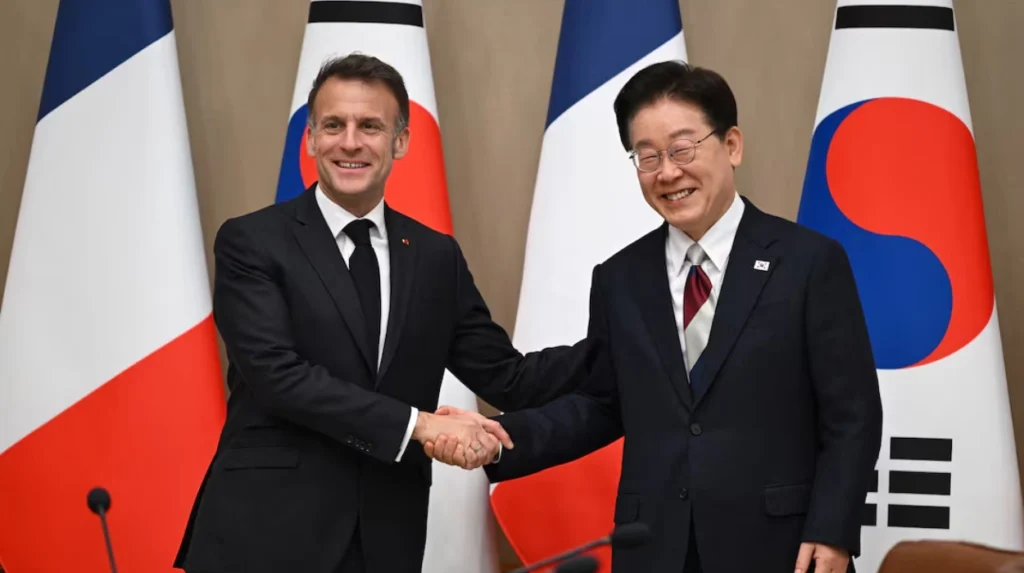
The elevation of Korea-France defence ties into a formal global strategic partnership reflects a deliberate shift in how middle powers position themselves within an increasingly contested Indo-Pacific. The 2026 Seoul summit between President Emmanuel Macron and President Lee Jae-myung marked a transition from symbolic diplomacy to structured cooperation in defence, intelligence, and advanced technology domains. This upgrade signals a recognition that security in the Indo-Pacific is now shaped as much by distributed partnerships as by traditional alliance blocs.
This development emerges amid intensifying geopolitical pressure across multiple fronts, including North Korea’s missile advancements, continued US–China rivalry, and disruptions in global energy and supply chains. France’s decision to deepen institutional engagement with South Korea reflects its long-term strategy of maintaining strategic relevance in Asia, while Seoul uses the partnership to diversify its security relationships without destabilising its core alliance structure.
Institutionalising defence information exchange
A central pillar of Korea-France defence ties is the revision of their classified information-sharing framework. This adjustment allows for deeper intelligence coordination and more structured operational communication between defence establishments. The shift is not merely procedural but reflects an elevated level of trust that enables more sensitive security dialogue.
For South Korea, this reduces overdependence on a single intelligence ecosystem, while France gains enhanced visibility into Northeast Asian security dynamics. The result is a more balanced intelligence architecture that supports mutual strategic awareness in an increasingly unpredictable regional environment.
Macron’s Indo-Pacific military signalling
France’s PEGASE air mission stopover in South Korea in 2026 adds an operational layer to the partnership. While not framed as a combat deployment, it functions as strategic signalling that demonstrates France’s capacity to project power across Indo-Pacific air routes.
This presence reinforces France’s doctrine of strategic autonomy, which prioritises flexible deployment over permanent basing. It also allows Paris to demonstrate that European actors can contribute meaningfully to Indo-Pacific stability without being absorbed into US-centric command structures.
Strategic logic behind expanding Korea-France defence ties
The expansion of Korea-France defence ties is driven by overlapping strategic recalibrations in both capitals. France seeks to remain an active Indo-Pacific actor despite geographic constraints, while South Korea pursues greater strategic autonomy in a region increasingly defined by great-power competition.
Rather than forming a traditional alliance, the partnership operates as a flexible coordination mechanism that integrates defence, technology, and industrial cooperation.
France’s global balancing strategy
France’s Indo-Pacific strategy is rooted in its desire to avoid marginalisation in a bipolar US–China framework. Its overseas territories and naval deployments give it a physical presence in the region, but partnerships like the one with South Korea provide strategic depth.
By aligning with Seoul, France strengthens its position as an independent security actor capable of shaping regional dynamics without relying entirely on NATO structures. This enhances its diplomatic leverage while expanding its operational reach.
South Korea’s gradual strategic autonomy shift
South Korea’s foreign policy is increasingly characterised by diversification rather than realignment. While the US alliance remains central, Seoul is expanding secondary partnerships to reduce strategic vulnerability.
The Korea-France defence ties fit into this broader shift by offering access to European defence technologies and strategic perspectives that differ from US-centred frameworks. This allows South Korea to expand its policy flexibility in an environment of rising regional uncertainty.
Defence industrial integration and technological convergence
A defining feature of Korea-France defence ties is the growing integration of defence industrial ecosystems. Both countries possess advanced capabilities in aerospace, naval systems, artillery, and next-generation communications technologies.
This convergence reflects a broader global trend in which security partnerships are increasingly shaped by industrial and technological interdependence rather than purely military alignment.
Joint interoperability and operational coordination
Both governments have committed to expanding joint exercises and improving interoperability across multiple domains. This includes land, air, maritime, and cyber coordination, designed to enhance combined responsiveness in crisis scenarios.
France brings expeditionary operational experience, while South Korea contributes high-intensity conventional warfare readiness. Together, these capabilities create complementary strengths that enhance the credibility of their joint operational planning.
Defence technology and future systems cooperation
Discussions on submarine technology, missile systems, and aerospace cooperation indicate the depth of industrial ambition within Korea-France defence ties. These areas are strategically sensitive but represent long-term convergence in defence innovation.
The potential exploration of nuclear propulsion technologies and advanced maritime platforms underscores the seriousness of the partnership, even as such cooperation remains subject to political and regulatory constraints involving third-party allies.
Indo-Pacific security recalibration and regional implications
The expansion of Korea-France defence ties contributes to a broader redistribution of security influence in the Indo-Pacific. Rather than replacing existing alliances, it introduces additional layers of coordination that reshape how regional stability is managed.
This evolving structure reflects a shift toward networked security arrangements rather than rigid alliance hierarchies.
Maritime security and chokepoint awareness
Both countries share concerns over maritime chokepoints and global shipping vulnerabilities, including routes linked to the Strait of Hormuz and broader Indo-Pacific sea lanes. France’s naval reach and South Korea’s energy dependence create overlapping strategic interests in maintaining open maritime corridors.
Cooperation in surveillance and information sharing strengthens their ability to respond to disruptions in global trade flows, particularly in times of heightened geopolitical tension.
Strategic signalling to regional actors
The partnership also serves as a signal that Indo-Pacific security is increasingly shaped by a wider set of actors beyond traditional regional powers. European involvement through France adds another layer of complexity to strategic calculations in the region.
For China and other regional stakeholders, this diversification increases the number of actors whose positions must be considered in crisis scenarios, thereby complicating unilateral strategic planning.
External commentary on expanding middle-power security networks
A perspective circulating on X highlights broader debate around the strategic meaning of expanding middle-power defence alignments in the Indo-Pacific. In a post shared by https://x.com/diyarkurda/status/2044023328432697795, the author has spoken on the topic, reflecting concerns and observations about how partnerships such as Korea-France defence ties fit into a wider pattern of emerging security networks outside traditional alliance blocs. The discussion underscores how analysts are increasingly interpreting these arrangements as part of a gradual diffusion of strategic influence across multiple centres rather than a single dominant framework.
Structural constraints and long-term trajectory
Despite its growing depth, Korea-France defence ties remain constrained by geography, alliance obligations, and differing strategic priorities. France operates as an external Indo-Pacific power, while South Korea remains embedded in a heavily militarised regional security environment.
These structural differences limit the possibility of formal alliance formation but enhance the value of flexible cooperation.
Alliance balancing and external constraints
South Korea must carefully manage its expanding partnerships to ensure consistency with its US alliance commitments. Sensitive technologies and defence cooperation must remain aligned with broader alliance frameworks.
France, similarly, must balance its Indo-Pacific ambitions with NATO responsibilities and its relationship with Washington, ensuring that its regional engagement does not create strategic friction within Western alliances.
Evolving architecture of middle-power cooperation
The Korea-France defence ties reflect a broader transformation in global security architecture, where middle powers increasingly build overlapping partnerships to expand strategic autonomy. These arrangements do not replace major alliances but complement them through issue-specific cooperation.
This model is becoming more prominent in the Indo-Pacific, where flexibility and technological integration are increasingly as important as formal alliance commitments.
Emerging equilibrium in a multipolar Indo-Pacific
The deepening Korea-France defence ties illustrate the gradual emergence of a more distributed Indo-Pacific security environment. Influence is no longer concentrated solely within traditional alliance structures but is increasingly shared among technologically advanced middle powers.
This shift does not fundamentally alter existing security frameworks, but it adds complexity to how power is projected and managed across the region. As cooperation between Seoul and Paris expands, it raises broader questions about how middle-power partnerships will shape deterrence, stability, and technological competition in an increasingly multipolar Indo-Pacific landscape.