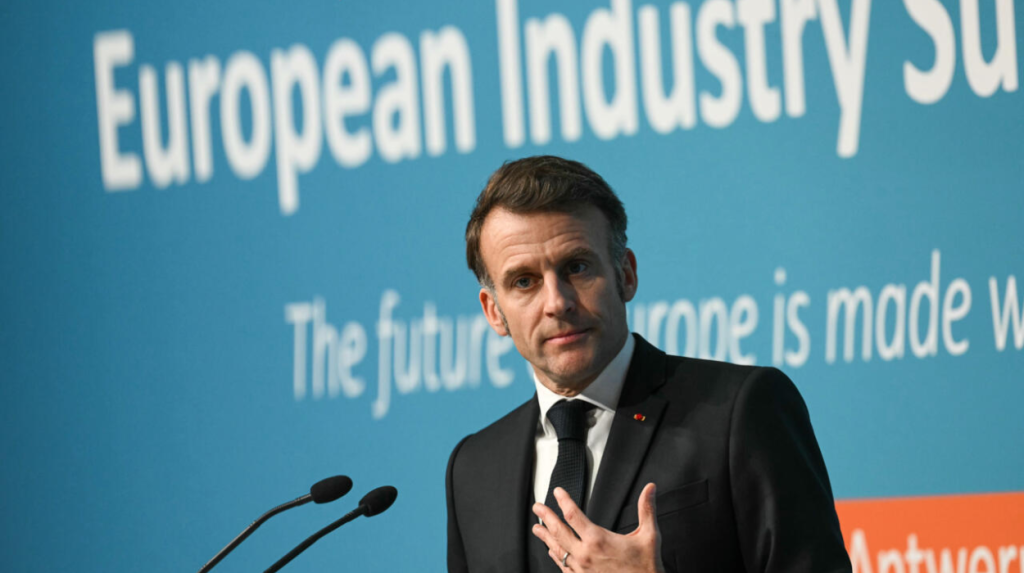
French President Macron created controversy yesterday following remarks he made criticizing Elon Musk’s Starlink company, saying it was “over-subsidized” as he called on Europe to build on public funding support for industry. Macron made these remarks during an industry summit in Antwerp, Belgium, where he used Elon Musk’s success with Starlink as evidence of how public funding can boost innovation, saying that if Europe does not follow suit, it will be left behind by the United States and China.
Macron highlighted that while Starlink is often celebrated as a private-sector innovation triumph, the company benefited from billions of dollars in U.S. government support.
According to the French president, Musk “is probably one of the people in the world who has had in his pockets the most… billions of dollars of the American taxpayers in order to be subsidised.” Macron called the approach “super-innovative,” but also suggested that Europe must develop its own industrial strategy, arguing for a “Buy European” competitiveness plan supported by massive joint EU borrowing to fund key sectors.
Musk responded swiftly on X, the social media platform he owns, contesting Macron’s characterization. He noted that Tesla and SpaceX together have received roughly one percent of the combined value of the companies in government funding.
If you add up all the government funding Tesla and SpaceX have ever received, it is only about 1% of the combined value of the companies.
— Elon Musk (@elonmusk) February 11, 2026
In contrast, if you do that with US and European major aerospace companies, the government money they have received *exceeds* 100% of their…
In contrast, some of the biggest Aerospace companies in the US and in Europe, such as Boeing, Airbus, and Lockheed Martin, have traditionally received public support amounting to more than the total market value of these corporations. Musk’s rebuttal points to the extent of state involvement in traditional industries, whereas it is considered to be privately funded enterprises and companies of the Silicon Valley.
All this being said, the context shows that there is a stark contrast in terms of investment in industries globally. To say this another way, to cite some figures from data provided by the OECD and the European Commission, in the United States, for example, over $150 billion has been directly spent in subsidies and in Research and Development in Aerospace, Defense, and Space Technology between 2010 and 2022, whereas China has invested an estimated $100 to $120 billion on strategic industries such as Artificial Intelligence, Quantum Computers, and Semiconductors. This is in contrast to the €25-30 billion spent annually by EU institutions on high-tech and industrial sectors of the economy, with no strategy in place.
Macron’s Vision of Europe’s Competitiveness has been laid on various pillars such as public investment in various sectors such as the aeronautical sector, the renewable sector, and the digital sector, along with a Buy-European initiative that promotes local suppliers.
Moreover, these investments can be made through joint debt and creating a eurobond that can generate hundreds of billions of euros on a yearly basis, particularly for strategic programs. Macron is of the view that innovation investments need to be made to ensure competition with other global sectoral leaders such as Starlink, Tesla, and SpaceX.
The debate has reportedly attracted substantial controversy due to the underlying policy implications. On one side of the debate, opponents of the policy warn of the risks of inefficiencies, protectionism, and capital suppression, while proponents argue that the European Union cannot hope to compete with the likes of the USA and China in the high-tech industry without government support.
For example, the USA has formulated a $369 billion plan to subsidize clean energy production, more than double what the EU has planned for public investment, with the Chinese government’s investment plans dominating the semiconductor and AI industries.
Macron’s plan, if implemented, will reshape the industrial map of Europe. The use of eurobonds will allow Europe to set up one of the largest public investment funds in European history, with domestic firms benefiting from privilege funding in terms of research and procurement. Macron’s plan will also allow Europe to develop its independence from America and Asia regarding satellite, AI, and green energy.
The main challenge, however, is that achieving unanimity among Europe’s states is difficult. Germany, Holland, and the Nordic countries have always rejected joint debt financing and subsidies. Therefore, it remains to be seen how Macron will navigate a complex political landscape in pursuit of his vision.