Until recently, Greenland did not have many diplomatic voices speaking on behalf of it, but times are fast changing with the aggressive expansion of major Western powers’ presence on the Arctic island. France has officially opened a consulate in Nuuk, the Greenland capital, in fact becoming the first European Union member state to establish a Consulate General in the territory.
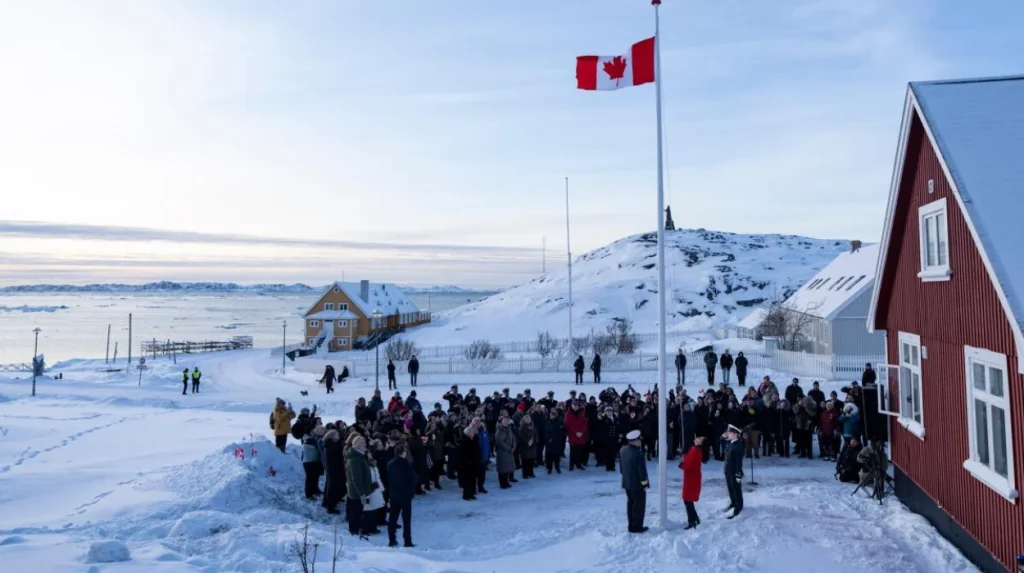
Canada has concurrently established its own diplomatic post, which signifies a dramatic change in foreign relations with Greenland in reaction to controversial comments made by US President Donald Trump on taking control of the island.
For decades, it was a unique situation between nations: the United States was the only important country with a permanent consulate on Greenland, exemplified by a small red-covered edifice flying a U.S. flag. That reign is now over.
France’s Consulate: Symbolism or Strategic Move?
This new consulate is part of a pledge given by French President Emmanuel Macron during his trip to Greenland last June. Indeed, the appointment of Jean-Noël Poirier as Consul General of France in Nuuk sends a message of the strengthening of political, economic, and cultural cooperation between Greenland and Denmark.
Poirier framed the move as one of solidarity, not a challenge, to Washington.
“It’s not against, it’s with,”
he said, underlining France’s commitment to the friendship with Greenland and Denmark. French Ambassador to Denmark Christophe Parisot said the consulate represents tangible cooperation among European allies, not just a symbol of presence.
Why Is Canada Expanding Its Presence in Greenland?
Canada’s interest in Greenland is more straightforward. The two regions possess deep historical, cultural, and geographic affinities, with an Inuit community that spans both sides of the Arctic. Canada lies a mere few miles from the Greenland coast, where cooperation on security, climate change, and Indigenous affairs could be considered strategically compelling.
Canadian Foreign Minister Anita Anand described the new consulate as a long-term commitment to defense, security, and climate collaboration, while Inuit leaders emphasized solidarity across Arctic communities.
“Anything that weakens Inuit self-determination anywhere in the Arctic affects all of us,”
said Natan Obed, president of Inuit Tapiriit Kanatami.
How Do Greenlanders View US Ambitions?
There remain concerns among the people of Greenland following past utterances of President Trump indicating that he plans to acquire Greenland as a U.S. possession. Even though there has been a retraction of such assertions to a certain extent, the people of Greenland are
The new diplomatic missions were welcomed by lawmakers in Greenland, as they were seen as an assurance of support from other nations. This was stated by Pipaluk Lynge, who chairs the Parliament’s foreign and security policy committee.
A January poll conducted for the Copenhagen Post revealed:
- 76% of Greenlanders oppose joining the United States
- More than 50% fear a potential US military invasion
Europe Pushes Back Against US Territorial Ambitions
French officials have explicitly rejected any notion of a US takeover.
“Greenland is neither for the taking nor for sale,”
said French Foreign Minister Jean-Noël Barrot, emphasizing that Greenland is an Arctic and European territory. France’s move is widely seen as part of a broader European effort to counter US unilateralism and assert the EU’s strategic presence in the Arctic.
Why Does Greenland Matter Strategically?
Greenland has become a focal point in global geopolitics due to its strategic location and military importance. The United States views the island as critical for:
- Missile defense systems
- Monitoring Russian and Chinese military activity in the Arctic
- Control over Arctic shipping lanes and resources
As climate change melts Arctic ice, Greenland’s strategic and economic value is increasing, intensifying competition among global powers.
Only Eight French Nationals—but Broader Ambitions
Despite the small French population in Nuuk—just eight registered nationals, with an estimated 30 across Greenland—Paris has ambitious plans for its consulate.
According to the French Foreign Ministry, the consulate will:
- Support French citizens administratively
- Expand cultural, scientific, and economic cooperation
- Strengthen political ties with Greenlandic authorities
- Enhance EU engagement in the Arctic region
This indicates that the consulate is less about citizens and more about geostrategic positioning.
Canada’s Arctic Strategy and Middle Power Diplomacy
Additionally, Canada’s move equally indicates a broader geo-political shift. Mark Carney, the country’s Prime Minister, has championed a heightened alliance among middle power countries, given frosty relations with America. Carney, in a speech at Davos, mentioned that there was a possibility for a “permanent rupture in the world order” and thus, countries ought not to blindly follow America.
Historical Context: Arctic Disputes and Cooperation
Canada and Denmark have an island called Hans Island, which was previously used as a sign of the competition called the ‘Whisky War,’ in which troops from the two countries erected flags and placed liquor on the island. However, in 2022, the two countries divided the island in peace.
Greenland at the Center of a New Arctic Power Struggle
France and Canada’s diplomatic expansion in Greenland underscores a broader shift: the Arctic is becoming a frontline of geopolitical competition among Western allies, Russia, and China.
While framed as solidarity and cooperation, these moves reflect:
- Growing mistrust of US unilateralism
- European efforts to assert strategic autonomy
- Canada’s ambition to strengthen Arctic leadership
- Rising global competition over Arctic resources and military positioning
The presence of multiple consulates in Nuuk signals that Greenland is no longer a peripheral territory—it is a geopolitical battleground of the 21st century.