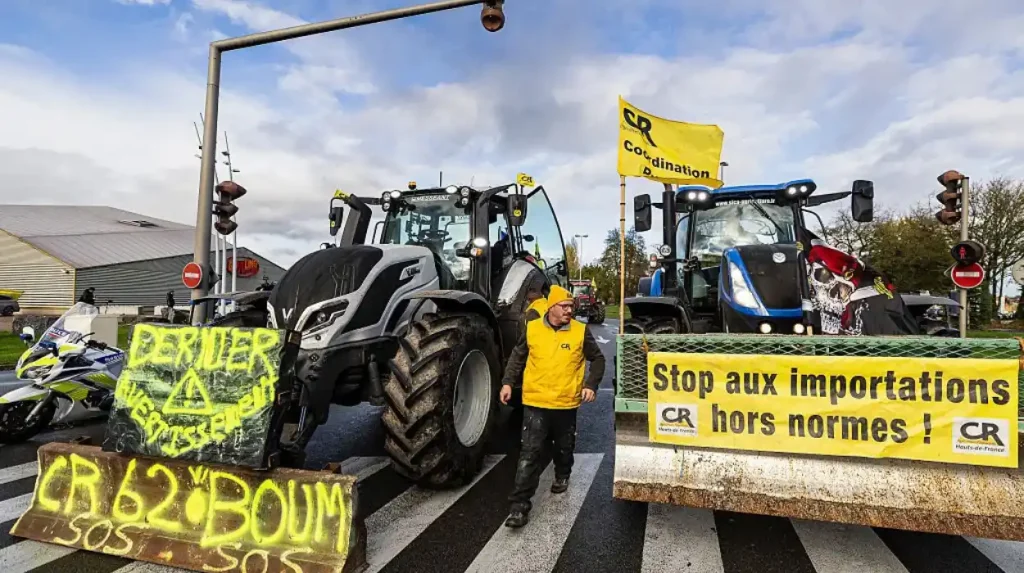
The Mercosur blockade of France has now turned out to be one of the most controversial trade conflicts within the European Union with the ratification deadline ending in December 2025. Paris takes an active position in search of a blocking minority to drug the development of the EU-Mercosur agreement, placing its position as a defense of the agricultural stability that is needed. The conflict has increased divisions among the member states whose interests lie in domestic protection and those who are advocating expansion of global markets.
The European Commission perceives the agreement as urgently strategic especially with slackening growth and re-emerged tariff pressure by the United States in 2025. France, though, claims that speed threatens to weaken the main production standards in Europe and social solidarity.
Political Timing And Strategic Pressure
The closeness of the vote has increased the diplomacy manoeuvring in Brussels. The efforts by France to expand to Italy, Poland, and Austria are indicative of a wider effort to remodel consensus politics in the council of the EU. As the agricultural protests continue to escalate back home, there is little space that the French government can compromise.
Meanwhile, Commission officials threaten to blow the years of negotiations. A number of EU diplomats privately admit that the political window of the deal can soon shut down in case of a new stalling momentum.
Agricultural Protests And Public Sentiment
The pressure has been maintained on French farmers throughout the years 2025 due to the outbreak of diseases, increasing costs of inputs, and regulation. The protests in rural areas have positioned Mercosur imports as a reality threat instead of a peripheral trade adaptation.
Surveys of the public opinion in the middle of 2025 demonstrate that most of the French participants of the survey would prefer to wait until the deal is postponed until better guarantees of the protection are created. This internal support has strengthened the Parisian readiness to take the criticism by Brussels.
Historical Context Of The Mercosur Agreement
The EU-Mercosur agreement is a 20-year-old and probably one of the longest-running trade negotiations in the history of modern Europe. A political consensus was found in late 2024 when Brazil was re-engaged with President Luiz Inacio Lula da Silva rekindling frozen negotiations.
Although this breakthrough came, France never developed a less cynical attitude towards agricultural liberalization in terms of large-scale exporters.
Two Decades Of Negotiation
The promise of tariff cuts on the manufacturers in Europe and an opportunity of entering the fast-growing South American markets was the starting point of the negotiations. With time, environmental and labor issues were at the center of the obstacles, especially in relation to deforestation and the use of pesticides.
By 2025, the contract had been transformed into a hybrid system with trade liberalisation provisions, and sustainability provisions. France claims that such clauses are not well enforceable.
Previous French Resistance
Paris had earlier stood in its way in 2019, claiming environmental damage to the Amazon basin. The episode that followed was a precedent of unilateral opposition based on global responsibility and not limited national interest.
The blockade at hand is a repetition of the previous objections, but it is further enhanced by economic anxieties caused by geopolitical instability and political polarization in the home country.
French Agricultural Concerns
The Mercosur blockade of France is founded mostly on the agricultural risk valuation than the industrial trade effects. The authorities underline that European producers have to work under higher environmental and welfare standards, which form structural cost disadvantages.
The threat is not an immediate collapse but rather a slow decline in the competitiveness of economies in the rural regions that are already struggling.
Import Volumes And Market Disruption
The contract permits almost 100,000 tons of tariff free beef into the country, and quotas of poultry, sugar, and ethanol per year. According to the French agricultural unions, such volumes would push down prices and put supply chains on their knees.
French ministries commissioned economic modelling in 2025 that even such small increases or decreases in prices would increase the pace of farm closures in vulnerable areas.
Regulatory Asymmetry And Standards
The French officials insist on the differences in the use of pesticide, standards of animal feed, and traceability regulations. Paris demands that the presence of mirror clauses will be necessary to create fair competition.
France is worried that regulatory arbitrage may destroy the commitments to the Green Deal promises by the EU without authoritative enforcement mechanisms.
European Commission Counterarguments
The European Commission asserts that the deal has net economic advantages and geopolitical bargaining. According to the officials, giving up on Mercosur would undermine the credibility of Europe as a trade partner.
Brussels has made the deal appear as a strategic hedge against supply chain disruption and overreliance on Asia.
Economic Growth And Export Opportunities
Commission tests value exportation of European machinery, chemicals, pharmaceuticals and wine. These are considered essential given poor growth projections of 2026.
There is also the argument by the supporters that agricultural safeguards being negotiated in 2025 give adequate buffers, such as emergency suspension clauses in case of market disruptions.
Strategic Trade Diversification
In a wider context, the deal promotes the diversification agenda in Europe beyond the economic sector. The Mercosur markets provide alternatives to highly-politicized trade relations with China and the United States.
To Brussels, Mercosur blockade by France would be a bad omen of disintegration amidst a period of unification, which is the strength of bargaining.
Blocking Minority Dynamics
The strategy of France is based on the formation of a coalition that will represent a minimum 35 percent of the population in the EU. The role of Italy is still central, and the demographic pressure of Poland makes its opposition even heavier.
This strategy puts the increased application of procedural power in EU trade governance in the spotlight.
Potential Coalition Partners
Austria and Hungary have shown reservations of outlying agricultural and environmental protection. Their alliances with France are because of common domestic pressures and not ideological opposition trade.
Nevertheless, the final unification of these states is still questionable because of the clash of economic concerns.
Negotiation Leverage Ahead Of Summits
France is leveraging on the upcoming EU summits to drive some concessions such as tighter inspection regimes and legally binding standards. The Commission is not that keen on re-examining aspects of the deal.
South America Von der Leyen (2025) has received a diplomatic overture towards South America, indicating how important the ratification is.
Broader Geopolitical Stakes
The Mercosur blockade of France goes beyond the mechanics of trade and into the issue of world influence. The international system is in a state of disintegration and thus trade agreements are being used to serve geopolitical purposes.
According to Paris, social model protection and home stability are credibility reasons as well.
Transatlantic And Global Trade Shifts
The negative US trade policies reemerged in 2025, which has led to a drift to strategic autonomy by the EU. Paradoxically, it is now ironic that internal resistance makes that purpose difficult.
Other parties are taking notes with fears that the disunity within the EU would make it less forceful in its negotiating stance on the world stage.
Environmental And Sustainability Debates
The environmental organizations are split. Others are of the opinion that the transaction encourages deforestation although others view involvement as a bargaining point of reform.
The post vote scrutiny by the European Parliament in 2026 still has the potential to restructure enforcement mechanisms and allow future refocusing.
Implications For EU Unity
The Mercosur blockade of France reveals permanent rural-urban inequalities in Europe. Farmers feel that globalization is one sided whereas urban industries are enjoying the open markets unequally.
The way in which Brussels can cope with this tension will determine the legitimacy of trade policy in the future.
There are also the domestic political implications. A sense of inability to secure agriculture might become the basis of populist movements before the next round of electoral events in many of the member states.
France’s Mercosur blockade ultimately reflects a deeper question confronting the European Union in 2025: whether competitiveness and cohesion can advance together without one eroding the other. As negotiations narrow toward decisive moments, the balance between protection and openness remains unresolved, inviting scrutiny over whether adaptive safeguards can reconcile national resilience with collective ambition.