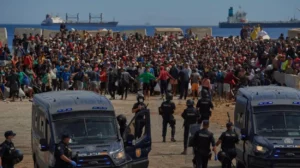
This was followed by a new bilateral migration agreement signed by the United Kingdom and France, which postulated any new arrival should be matched by one departure under a one-in, one- out pilot scheme. The policy is that any migrant arriving in the UK illegally across the Channel as an adult may be detained and removed to France, when asylum decision is inadmissible. The UK in exchange has agreed to take the same number of asylum seekers in France who have good family ties and undergo extensive eligibility forms in the UK.
The accord is a culmination of two years of bilateral diplomacy between the UK Prime Minister Sir Keir Starmer and the French President Emmanuel Macron worked out during a summit in July 2025 and subsequently accepted by the European Commission. Both governments describe the agreement as a mutual way of responding to humanitarian issues being faced and the increased transnational smuggling networks that have made the Channel one of the deadliest migration channels across Europe.
Implementation was then undertaken at operational levels with new Home Office resources, an expanded capacity in the Immigration Removal Centres, and a new legislative framework to allow quick adjudication of inadmissible asylum claims. The scheme will operate up to June 2026, by the end of which both governments will examine the scalability and the legal sustainability of the scheme.
Effectiveness: detentions, deterrence, and returns
During the first week of operation, about 155 migrants were intercepted by the UK authorities as they arrived in boats and the UK was considering raising the number of removals to France on a weekly basis. These early attempts show the potential logistics were viable for the program, but too small in comparison to the wider migration pressure on the UK.
There were more than 108,000 asylum applications to the UK in 2024 (a 20% increase on 2023), and Channel crossings in the first half of 2025 were increased by nearly 49% on the first half of 2024. These patterns point out to the extent of irregular migration and the possible endpoints of deterrence approaches, which are confined to returns.
Although the one-in, one-out approach introduces numerical balance, it is open to interpretation as to whether the policy can interfere with the impetus of cross-border irregular migrants. Migration theorists note that the attitude towards the UK remains viable because of the language, relations with diasporas, and even possibilities to earn money in the informal economy. In the absence of an expansion of legal migration channels, some asylum seekers will take the risk of crossing despite the removal threat.
Migrant rights and humanitarian concerns
The new move has come in with a heated criticism by rights and migration watchdogs who cite that there are all major risks to the laws protecting asylum seekers. Amnesty International UK has criticized the agreement as a short term politically convenient action that can ignore duties under international refugee law. Concerns of particular interest relate to the threat of repatriating vulnerable people with inadequate procedural protection and the possibility of isolating family units in detention in inquiry or transfer.
The UNHCR was more reserved in its assessment saying it believed that the scheme could be used to bring order and fairness should it be implemented responsibly; however, information on legal access and procedural transparency has not been disclosed. The agency insisted on the need of personalized evaluations and protection so that non-refoulement is not contravened.
The rights groups have also cast a doubt on how migrants will be held within the UK due to the fear of being crowded in cells and the fact that indefinite administrative detention tends to have psychological effects. Although the Home Office has indicated its commitment to prioritize welfare and legal access, oversight will be also important in ensuring any adherence to the rights framework given that the policy is bound to be implemented within a short period of implementation.
Political dynamics shaping the agreements
Political catalyzation of the agreement can be seen in the pressure to alleviate the visibility of Channel crossings domestically in the two countries. In the UK, calls of the Reform UK party, including Nigel Farage, have urged a withdrawal of the European Convention on Human Rights and wide scale deportation authority in order to overcome what they refer to as a flawed implementation of border control.
Ealing that it is the middle way, Prime Minister Starmer has insisted on the greater importance of international cooperation along with the delineation of legal procedure of migration between lawful methods of immigration and unlawful settlement. Claiming that the agreement with France is a realistic step that can and will be enforced, his administration hopes to avoid opprobrium that will be posed by the opposition parties as well as a part of the population that is growing in concern about immigration.
President Macron has had to make a similarly framed position of the agreement in that it is necessary to restore order and break up trafficking paths however his government is facing censure by domestic civic rights groups and left wing political activists. While the logistical load of France accepting migrants returned under the deal puts additional pressure on its existing system to absorb all forms of migration across the Mediterranean.
Broader implications for Franco-British cooperation and European migration policy
The bilateral accord happens to be one of the most prominent UK-France bilateral agreements on migration post-Brexit. It is a transition to more practical association beyond the EU establishment yet remains the support of the European Commission. Observers are viewing it as a possible model to future agreements between the EU member states and other third countries struggling with similar migratory flows in the future.
However, the political durability of such a scheme remains uncertain. Implementation challenges, particularly concerning human rights compliance and operational transparency, may prompt legal challenges in both jurisdictions. A failure to adhere to standards of fairness, dignity, and legal process could undermine the agreement’s legitimacy and provoke domestic and international backlash.
Policy coordination at the European level remains fragmented. While some member states are experimenting with bilateral arrangements, others argue that only a pan-European mechanism—such as a reformed Dublin system or shared asylum responsibility model—can sustainably manage migration while protecting rights. The Franco-British scheme may catalyze debate within the EU about whether such localized approaches offer effective models or dangerous precedents.
Migration policy expert Rupert Lowe commented on this issue, noting via social media that
“These agreements represent a pragmatic step towards controlling irregular migration, but success will require thorough safeguards for migrants’ rights and multi-level cooperation between all stakeholders.”
Just before the local elections, on April 24th, Farage stated Reform would announce their illegal migrant mass deportation policy in 'three to four weeks' time.
— Rupert Lowe MP (@RupertLowe10) June 27, 2025
I have one simple question, @Nigel_Farage.
It's almost July – where is it?
Unserious, unprofessional, untrustworthy. pic.twitter.com/tD5OYSTrgJ
His analysis reflects a broader concern among practitioners that technical feasibility alone is insufficient without sustained political and legal accountability.
How this bilateral scheme evolves in the coming months will be pivotal not just for Franco-British relations but for the broader question of how liberal democracies respond to irregular migration while maintaining legal commitments and moral clarity. As Europe continues to grapple with the complexities of cross-border displacement, this agreement stands at the intersection of sovereignty, security, and human rights.