Since 2023, the country of France has seen a sharp rise in the share of racially and religiously-motivated hate crime. There has been an increase of over 60 percent of documented incidences within a year. Among the most affected communities are those of the blacks, Arab, Muslim and Jewish. The epicenter of this break is in Antisemitism and Islamophobic violence.
The Israel-Gaza outbreak in October 2023 caused a new uprising of hatred, as the number of committed antisemitic crimes increased considerably. This also consisted of physical attacks, threats, and the assault of synagogues. Islamophobic attacks also increased to unprecedented levels, with Muslims, as well as Mosques under attack across urban and non-urban settings.
This increase is more than isolated instances of prejudice. It is a marker of greater-degrees of structural tension in the social fabric of France, in which long-standing problems of exclusion, inequality, and political rhetoric are all at play to stoke division.
Institutional responses and policy inconsistencies
The Ministry of the Interior in France has openly reproached the upsurge of hate crimes. In early 2025, the Interior Minister, Bruno Retailleau, promised to increase enforcement efforts and to more than triple anti-discrimination teams. His rhetoric employed in the past, like referring to France as a country which is flooded with migrants, or banning headscarves on universities drew a lot of negative response among civil society.
Such a contradiction between fighting violence and inciting policies of division leaves concerns on whether the state is committed to resolving racism. Opponents report that these rhetorical devices normalize xenophobia, creating the atmosphere wherein xenophobia-motivated hate crimes can be disregarded or acceptably legitimized.
Judicial rulings expose systemic flaws
In June 2025, the European Court of Human Rights dismissed France on charged issues of racial profiling. The case pertained to a black French citizen who was stopped several times by the police without any substantial reason. The ruling by the court is indicative of the inherent issues within the law enforcement practice and institutional responsibility.
In spite of the repeated dialogue on the matter of police reform, little has been done to address the issue of independent oversight and diversity training. Structural reforms are largely a mere show unless there is an underlying structure that is backed by enforcement measures and there is political will.
The lived experience of marginalized communities
To those who are directly targeted, hate crimes are not occurrences in the category of fortnightly, or even daily, but occurrences on the hourly level. Members of targeted communities are verbally abused, violently assaulted, and having their property destroyed. Religious buildings–mosques, synagogues and other cultural premises have also been subjected to bombing, again and again.
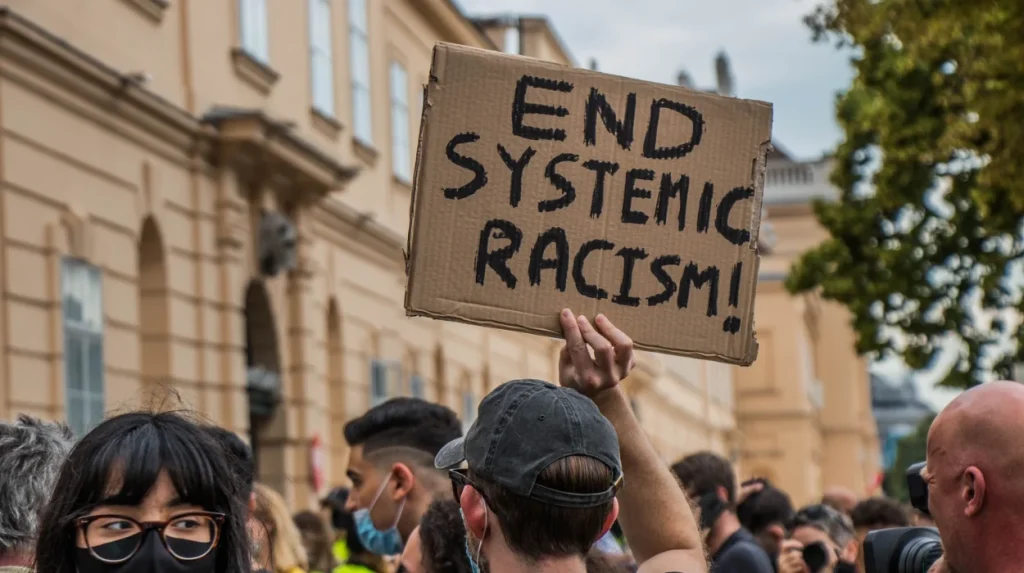
Families and societal activist groups have continually made requests of justice and social transformation. At a protest in Marseille, the sister of a young man who died in a racist attack typified the anger:
“We expect justice to prevail. Let this conviction serve as a warning to ensure that these acts do not become normalized.”
These testimonies highlight feelings and psychological impact of the threat in which people live and how changes must be implemented beyond pure images.
Political stagnation and the role of civil society
France has yet to develop a national approach to its struggle with systemic racism even though SOS Racisme and other organization-based activism has lasted decades. Most programs require local leadership or NGOs, which tend to work on low resources and without powerful institutional support.
The most worrying aspect is rising laws that curtail the role of non-governmental organizations and curtail their right to protest. The activist groups that experienced more surveillance and pressure report antiracist or pro-migrant interests.
Such prohibitions not only lead to a contraction of democratic space but can also undermine the confidence of majority populations in democratic systems of control, specifically many of the most at-need populations, indeed the most at-risk of hate crimes.
International scrutiny and a divided society
France’s handling of racism is increasingly subject to international critique. The European establishments and other international human rights watchdogs have urged more commitments and deeper reforms. France has been one of the founding states of the European Union and in line with this, it ought to take steps in promoting democratic values as well as being an example in the safeguarding of human rights.
Domestically though the country is still very divided. Among secularism, the discourse on national identities and the multicultural reality of contemporary France, contradictory narratives on belonging and equality are still coming into collision. The republican ethos of undivided nationhood is being stretched by these pressures that are increasingly getting more public and violent.
The above discussion of the Government rhetoric that vacillates between recognition and denial helps complicate the course of action even more. The resultant confusion sends different messages to perpetrators and the victims.
Pathways to systemic change
There are still avenues of progress despite such challenges. Inclusion programming and forums have been initiated by local governments and community institutions, as well as the schools. Where interfaith work and youth programming are bringing communities together, they are building knowledge and resilience.
The success of such projects in the long term requires the political will to maintain such practices, adequate funds and national coordination. France finds itself in a vital decision: whether or not to approach the problem of racism in other ways than as a matter to be acted upon.
The ruling will not only matter about the social cohesion in the country, but also about the fact the nation is a democracy that subscribes to liberty, equality, and fraternity. An inadequate response to systemic racism threatens to further divide the society and develop a crisis of legitimacy in the state.
To a wider European puzzle of how to maintain human rights under the influence of an increasing polarization and changing geopolitical tides, the case of France in 2025 represents a manifestation. It is increasingly important to act.