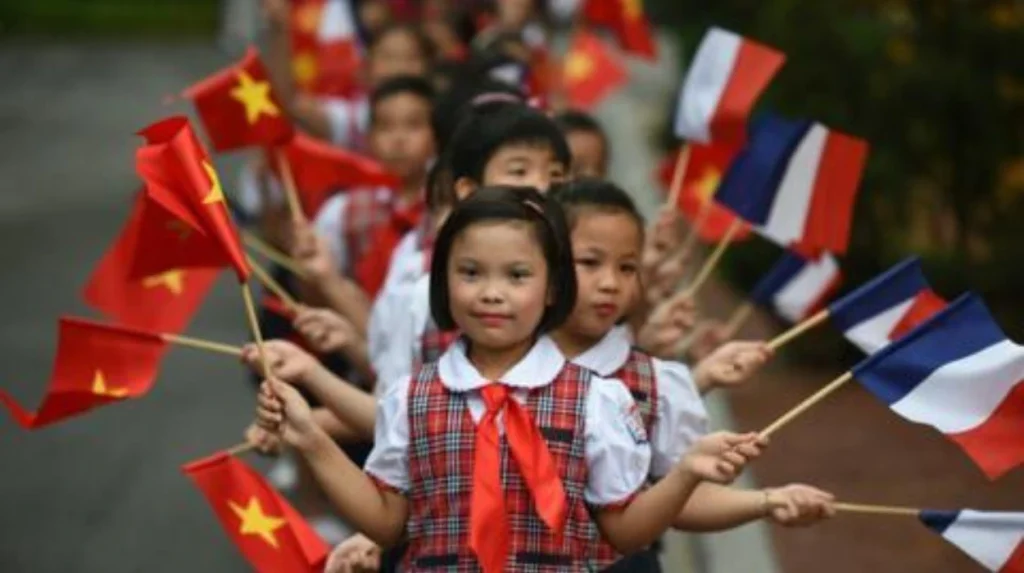
On Sunday, French President Emmanuel Macron embarks on his first trip to Southeast Asia as a French leader in ten years, beginning in Vietnam. The trip is a part of France’s efforts to manage the legacy of its colonial history while navigating human rights conflicts, countering China’s influence, and strengthening economic relations in the area.
What economic deals are expected during the visit?
France is concentrating on energy, infrastructure, and technology in an effort to grow its €5.3 billion trading partnership with Vietnam. During the visit, more than 30 agreements are anticipated to be inked, including partnerships in satellite development and nuclear energy..
Vietnam is France’s 17th-largest trading partner outside the EU, according to the most recent EU statistics. French exports to Vietnam are worth €1.6 billion, while Vietnamese imports are worth €3.7 billion currently, and over 2,000 French businesses export to Vietnam.
Vietnam’s attempts to diversify foreign investment, especially in the fields of renewable energy and transportation, are in line with France’s goals to offset China‘s expanding regional influence.
Macron’s team wants to establish French companies as reliable substitutes for Chinese infrastructure finance despite the fact that France is only ranked 16th among foreign investors in Vietnam.
How does ‘bamboo diplomacy’ guide Vietnam’s foreign policy?
Vietnam is aggressively bolstering its own international alliances in the meanwhile to protect itself from economic pressure and Beijing’s South China Sea claims. By building facilities on shoals and atolls that are occasionally claimed by other nations, including the Philippines, and often intruding into Vietnamese-claimed seas, China militarizes the region and asserts authority over broad swaths of territory beyond internationally recognized maritime borders.
Vietnam is seen as essential to safeguarding marine routes and guaranteeing supply chain resilience in France’s Indo-Pacific strategy. After more than 50 years of diplomatic relations, France became the first EU nation to elevate ties with Vietnam to a “Comprehensive Strategic Partnership” in October 2024.
This strategy is in line with Hanoi’s so-called “bamboo diplomacy,” which has seen Vietnam improve ties with the US, Japan, and now France in recent years. In light of the current tensions between the US and China, Macron’s future trips to Indonesia and Singapore highlight larger European attempts to re-engage with ASEAN.
What historical scars still linger from French colonization?
The Vietnam tour is marred by the effects of France’s colonial past. In a series of military wars between 1858 and 1885, France established Indochina as a colony and subjugated Vietnam.
Although colonial control ended with the Battle of Dien Bien Phu in 1954, where Viet Minh forces overcame French troops following a 56-day siege, lasting cultural linkages were left behind. Following the French evacuation, the United States’ role grew until it culminated in the Vietnam War, which killed around two million people.
By hosting the peace talks that resulted in the Paris Peace Accords, which were signed at the Majestic Hotel on Paris’ Champs-Elysées, France played a crucial diplomatic role in bringing an end to the Vietnam War in 1973. Although Macron is unlikely to publicly confront France’s colonial past and aftermath, the country’s complicated postcolonial connection is reflected in the country’s continuing French architectural influences and about 30,000 francophone people.