Claims being spread by Kremlin officials that Emmanuel Macron used cocaine on a train to Kyiv with German chancellor Friedrich Merz and Keir Starmer have been dismissed by the Élysée Palace as “disinformation.”
The fabricated statements, which first surfaced on pro-Russian social media platforms before being adopted by a Kremlin official and a spokeswoman, coincide with a recent uptick in Kremlin attempts to discredit European initiatives to aid Ukraine.
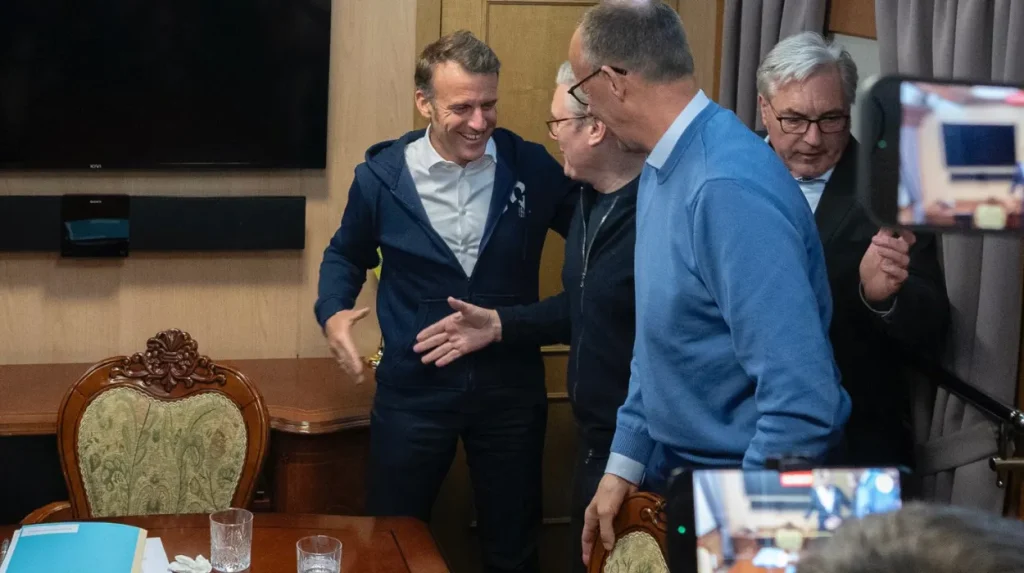
“This fake news is being spread by France’s enemies, both abroad and at home. We must remain vigilant against manipulation,” Élysée shared a post on X following the online circulation of images showing Macron taking a handkerchief or tissue from the table during his meeting with the British prime minister and Merz.
When European unity becomes inconvenient, disinformation goes so far as to make a simple tissue look like drugs.
— Élysée (@Elysee) May 11, 2025
This fake news is being spread by France’s enemies, both abroad and at home. We must remain vigilant against manipulation. pic.twitter.com/xyXhGm9Dsr
Online conspiracy theorists claimed Merz was carrying a white cocaine spoon and the French president was hiding a bag of cocaine, despite the fact that the handkerchief was easily recognized in high-resolution photos of the encounter as the item Macron picked up.
“This is a tissue. For blowing your nose,” the Élysée posted next to an image from the meeting. “This is European unity. To build peace.
“When European unity becomes inconvenient, disinformation goes so far as to make a simple tissue look like drugs.”
The cocaine claim had been rapidly amplified by senior Russian figures, including the Kremlin’s foreign ministry spokesperson, Maria Zakharova, on her Telegram channel.
“After pushing Zelensky into yet another hellish scheme to derail a settlement and prolong the bloodshed in Europe, it’s like a joke: a Frenchman, an Englishman, and a German got on a train – and did a line,” Zakharova wrote on Sunday.
“Apparently, they were so out of it they forgot to hide the paraphernalia – a small bag and a spoon – before the journalists arrived. Europe’s fate is in the hands of placeholders who are dependent, in every sense of the word.”
Kirill Dmitriev, an envoy of Vladimir Putin and head of the Russian Direct Investment Fund (RDIF), also commented on the video. “Is this footage AI or real? If it’s real – are we looking at sugar or something entirely different? If it’s something else, it explains a lot of recent ideas and proposals,” he said on X.
The misinformation about drug use, which is not the first time Russian officials have made such false statements, coincides with broader Kremlin attempts to stoke tensions over ceasefire pressure between the US, Europe, and Ukraine.
The non-profit Institute for the Study of War declared this week that Putin is trying to influence current talks over a ceasefire and future peace in Ukraine, most likely in an attempt to weaken Ukrainian-US-European unity around a complete 30-day ceasefire in Ukraine.
In an attempt to communicate directly with the Trump administration and the American people and present Russia’s demands for Ukraine’s capitulation as fair, Kremlin officials have recently increased their interaction with Western media.
Simultaneously, Russia has increased its clandestine attempts to damage Western politicians, including Macron, using “pro-Russian” social media profiles that try to erode political confidence.
Zakharova and other Russian officials have previously implied that Volodymyr Zelenskyy, the president of Ukraine, was an “unstable cocaine addict.” Zakharova has also asserted that drug usage is widespread among European politicians.