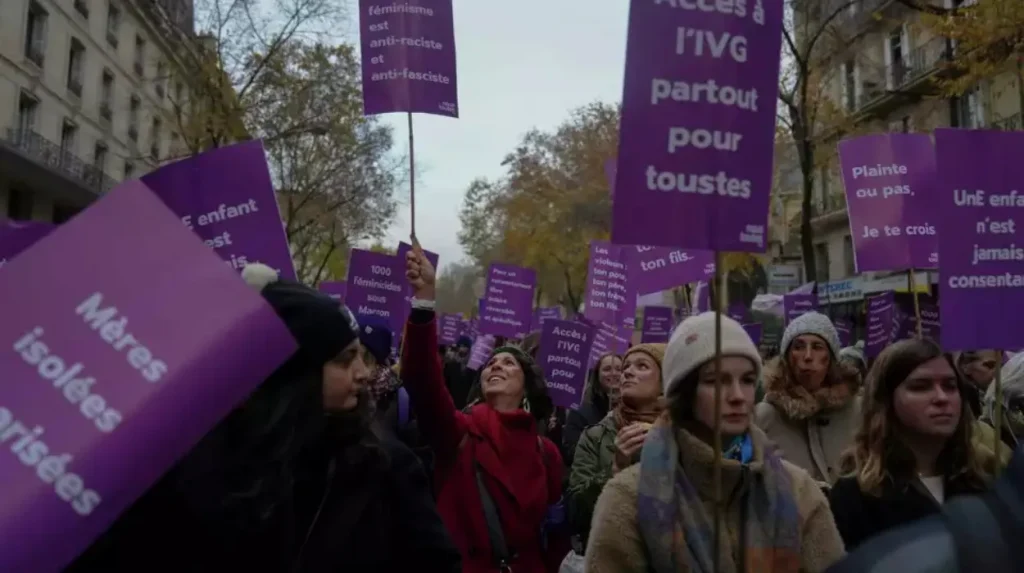
On Saturday, thousands of people protested against sexist and sexual assaults as well as femicides in Paris and other French cities. Large groups of men and women marched in Paris while holding purple signs that supported women’s reproductive rights and condemned gender-based violence. Following the election of Donald Trump as the next president of the United States, protesters voiced concerns about a potential reversal of women’s rights. Additionally, they showed support for Gisèle Pélicot. Anger over sexual abuse in France has been heightened by the horrific trial of her ex-husband and dozens of other men who were charged with rape while she was unconscious and under the influence of drugs.
French demand action on femicide and sexual violence
“Unfortunately, violence can be committed by anyone. Our brothers might be the culprit. It might be our dad’s. It might be our coworkers. Our employers might be involved. Speaking on behalf of the feminist collective “Nous Toutes,” which translates to “All of us,” Maelle Noir stated,
“I think that’s the big shock for people.”
“Neither the victim nor the rapist have a typical profile that can be used to identify them,”
she stated. Organizers of the protest called for more government funding to combat sexism and sexual assault and advance gender equality. Men were urged by Ms. Otitoju to act to prevent sexual assault.
“We want to see men taking responsibility, never keeping silent when they see violence against women and girls, and supporting women who are on the receiving end of this kind of behavior.”
The ongoing Gisele Pelicot trial, in which 50 men are charged with raping the 71-year-old while she was unconscious for ten years, served as the impetus for the protests. Dominique Pelicot, her 72-year-old husband, has already acknowledged drugging her, raping her, and letting other men harm her.
Thousands take to the streets in France for women’s safety
As part of the roleplay, the majority of the other males deny rape, saying they believed she was asleep.
“There is no other way to describe this trial than cowardice,”
Ms. Pelicot told the court on Tuesday. She continued,
“It is time for society to look at this macho, patriarchal society and change the way it looks at rape.”
Five years after the #MeToo movement, French culture “remains very sexist in all aspects,” according to the High Council for Equality between Men and Women (HCE), with women still receiving inferior treatment to men. 93% of women believe that they receive different treatment in at least one sphere of society, such as the workplace, public places, educational institutions, etc. Since just 20% of French people believe that men and women are equal in this regard, inequality is especially noticeable in the workplace, according to the survey.
France unites against rising femicide and sexist violence
The HCE research suggests requiring employers to provide anti-sexism training or toughening penalties for businesses that fail to implement an efficient anti-sexism system. Indeed, the protections provided to victims of moral harassment in the workplace have long eclipsed the specific problem of sexual harassment. Especially considering that allegations from victims of sexual harassment were rarely taken seriously by French courts. However, things have altered significantly, with sexist and sexually harassing conduct now becoming big concerns for businesses, whose responsibilities to their employees in this area have grown significantly over time. French businesses today understand how important it is to avoid and deal with these circumstances. The social roles that society still assigns to men and women, such as complaining that too many women in meetings are a waste of time because “they are too talkative” or that men are unable to take notes while participating in discussions because “men can’t do two things at the same time,” are the foundation of sexism, which is different from sexual harassment. Telling a pregnant woman that she was viewed as ambitious or that she shouldn’t think about accepting a position that requires a lot of pressure, or asking a woman to make coffee at a meeting because she does it so well, are other instances of sexist conduct.
French protests highlight the urgency of tackling gender inequality
In 1992, the crime of sexual harassment was first included in French penal law. The main goal of the law at the time was to punish sexual harassers in the context of a hierarchical relationship at work, and it only addressed specific scenarios. The offense is now specified in articles 222–33 of the Penal Code using language that is substantially similar to that of the Labor Code following a series of amendments intended to broaden its application to more circumstances. The punishment for the offender is two years in prison and a fine of 30,000 euros, which in some cases can be raised to three years in prison and a fine of 45,000 euros.