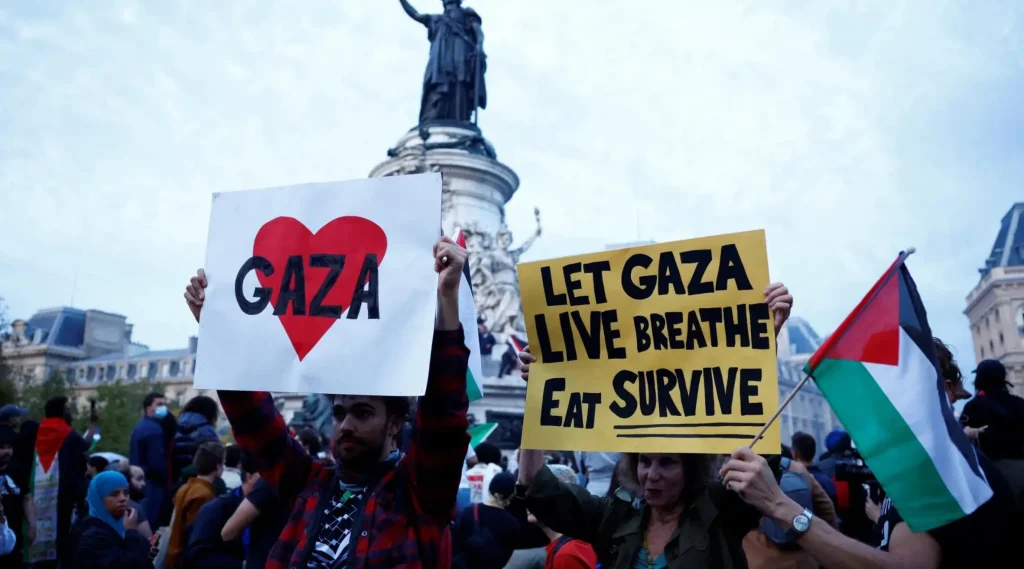
In France there are serious types of violation of human rights by political leaders. They adopted different strategies to silence and scare people who show criticism of Israel and support palestine. Nowadays, France is the nation that seriously violated the rights to free speech. People are not allowed to openly express their thoughts.
The Euro-Med Rights highlights many cases that are against humanity. One of the examples is, France has been cracking down on university students who are peacefully protesting against Israel’s actions in Gaza. The French government uses different tactics to stop these protestors and also targets pro-Palestine political leaders.
Many students protest at the Sorbonne University in Paris and demand to stop the Gaza war. French police broke up this peaceful protest on April 29. The students were sitting in the square and protesting against the Gaza war that started on October 7, 2023. The police compelled the students to leave the area. This happened just days after a similar protest at Sciences Po, another university in Paris. Because of that protest, the head of the greater Paris region stopped funding Sciences Po.
Students of this university highlight that they protest peacefully and just show support for Palestine. Their aim is to only educate the people about the current situation in Gaza. They also stated that police break up their protest, and also treat people with harsh behavior.
About 50 protesters were removed from the campus by police with the help of security guards, and they were taken away in groups. The conflict between Israel and Palestine had a detrimental effect on human rights in France, as seen by a rise in antisemitic events, limitations on pro-Palestinian demonstrations, and threats to restrict the rights of refugees and asylum seekers.
The right to a sufficient standard of life was not sufficiently protected by government efforts to counteract the impacts of inflation, especially for those living in economically disadvantaged neighborhoods. Children within the migrant and asylum-seeking population continued to endure cruel living circumstances, incarceration, and mistreatment by police. Identity checks that discriminated were still common.
Furthermore, concerns about restrictions on civil society have grown after the government disbanded Les Soulèvements de la Terre, an umbrella organization of environmental campaigners opposing the construction of a massive water reservoir in Sainte-Soline, western France, in June. The dissolution was reversed in November by the Council of State, the highest administrative court in France, which found that the closure of the organization violated the right to freedom of association.
The Ligue des droits de l’Homme, a well-known rights organization, faced funding withdrawal threats from the French government in April after the group condemned police brutality during the Sainte-Soline riots. In its Rule of Law report, the European Commission observed that the interior minister’s repeated pronouncements regarding the termination of proceedings and the assessment of funding to particular parties “could be perceived as a means to exert pressure.”
A law passed in March that permits the use of contentious surveillance technology at the 2024 Olympic and Paralympic Games has raised concerns from thirty-eight civil society organizations, including Human Rights Watch and the National Consultative Commission on Human Rights (CNCDH), regarding potential risks to fundamental rights.
Following hostilities in Israel and Palestine, the interior minister’s blanket prohibition on pro-Palestinian rallies was overturned by the Council of State in October, with a focus on evaluating the dangers of disruption to public order on a case-by-case basis. Press freedom and source confidentiality were threatened when police arrested journalist Ariane Lavrilleux and searched her house. Using secret data that had been leaked, Lavrilleux co-authored an investigative piece in 2021 about France’s suspected involvement in illegal airstrikes carried out by the Egyptian military.
The administration explored its long-overdue national anti-racism, anti-Semitism, and discrimination strategy in January. Although a start in the right direction, the plan has certain drawbacks, such as a lack of policies to combat systemic racism and racial profiling.
Following the death of Nahel M., a 17-year-old French citizen of Algerian heritage, during a traffic check in July, the UN Committee on the Elimination of Racial Discrimination called on France to address the structural and systemic causes of racial discrimination, particularly by the police. Addressing “deep issues” of racism in police is what the UN Office of the High Commissioner for Human Rights (OHCHR) urged on France to do.