The French government asserts that it is working to ensure that it and other European member states give a collective reaction to what it calls the “ signs of intimidation” exuded by the United States regarding the future of Greenland. These statements were made by the Foreign Affairs Minister of the French government, Jean-Noël Barrot. President Donald Trump of the United States continues to indicate that Greenland is a priority of the United States.
In Nuuk, I reaffirmed France’s unwavering support for the sovereignty and territorial integrity of Denmark and Greenland.
— Emmanuel Macron (@EmmanuelMacron) December 23, 2025
Greenland belongs to its people.
Denmark stands as its guarantor.
I join my voice to that of Europeans in expressing our full solidarity. pic.twitter.com/W3EUn3dAME
The controversy was reignited after the US military’s dramatic capture of Venezuelan President Nicolás Maduro, which has emboldened Trump’s geopolitical ambitions and injected fresh urgency into debates over Arctic security. Trump has repeatedly suggested that the United States “needs” Greenland for national security reasons, even as European leaders insist the territory belongs to its people and to Denmark.
Why is Greenland suddenly at the centre of strategic tensions?
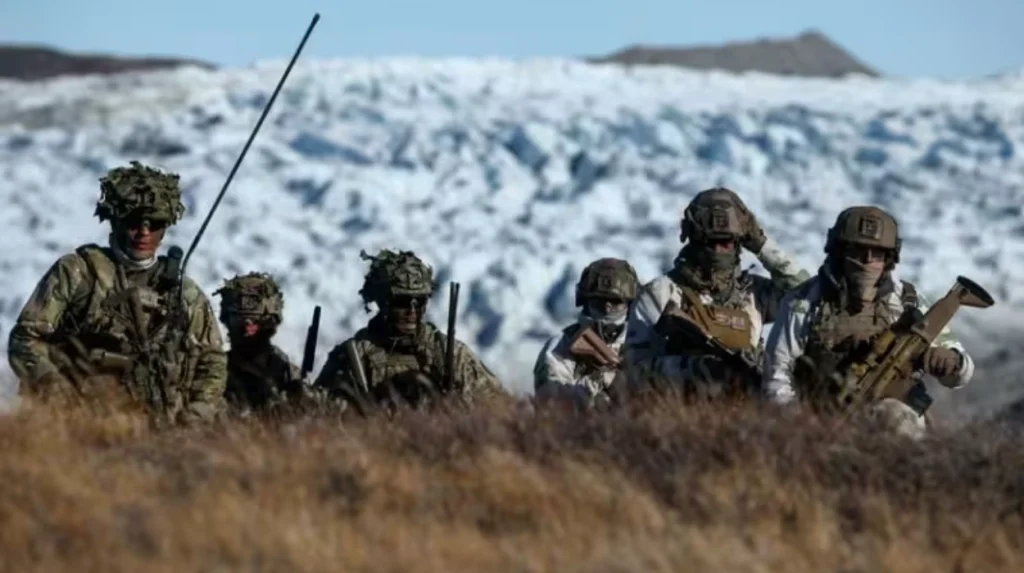
Greenland, a self-governing state within the Kingdom of Denmark, is strategically placed across the essential Arctic sea routes and is home to the Pituffik Space Base, operational on behalf of the United States. It is also the key to the other essential sea gap: the Greenland, Iceland, and United Kingdom Gap. This is critical for monitoring the passage of Russian naval activities in the North Atlantic.
Trump and his associates claim that the value of Greenland has increased due to Russia and China’s rise in the Arctic region, even though experts dispute the extent of the perceived threat. Russian and Chinese naval presence in the region is real but limited in proximity to Greenland itself, and not the “all over the place” scenario sometimes portrayed by US officials.
Mineral wealth is another factor. Greenland’s permafrost is believed to conceal rare earth elements and other critical resources for modern technology and defence. Control over these assets could help Washington reduce its dependence on Chinese supply chains — but Greenlandic and Danish leaders have stressed that partnerships, not annexation, are the only acceptable path.
How far is the US government willing to go?
The White House has explicitly stated that military force is “always an option” to pursue the goal of gaining control over Greenland, a remark that has drawn sharp rebukes from European leaders. While some senior US officials — including Secretary of State Marco Rubio — later downplayed the likelihood of a Venezuela‑style intervention, the very suggestion has shaken long‑standing diplomatic norms and raised questions about NATO solidarity.
Barrot himself dismissed such ideas as “nonsense,” saying it would make “absolutely no sense for a NATO country to attack another NATO country,” and that using force against a close ally would violate the very principles of the alliance.
What is France’s plan for a European response?
According to Barrot, France has options it is considering at the French Foreign Affairs Ministry, the Quai d’Orsay, and these it intends to discuss through the Weimar Triangle, composed of France, Germany, and Poland. The implication of the message could well be that Europe intends to do more than simply register disapproval in the face of the threat from the north.
However, European planning faces structural constraints. NATO’s collective defence guarantee under Article 5 theoretically binds members to defend one another, yet the very idea that a leading NATO member (the US) might undermine another’s territorial integrity exposes deeper fractures within the alliance.
How unified is Europe in defending Greenland?
Many leaders among the European Nations, such as the president of France, President Emmanuel Macron, the chancellor of Germany, Olaf Scholz, and the prime ministers of the UK, Keir Starmer, Italy, Poland, Spain, and other leaders, have shown support for the sovereignty of Denmark and Greenland as the statement asserts,
“Greenland belongs to its people and should be determined solely by Denmark and Greenland itself.”
Canada’s Prime Minister Mark Carney also signalled support, planning a high‑level diplomatic visit to Greenland in the near future. Nordic states — Sweden, Norway, Finland, Iceland — have likewise pledged to defend the principle of territorial integrity.
But unity masks complexity: while the principled defence of sovereignty is strong, Europe lacks the hard power — especially naval and air assets in the Arctic — to deter unilateral actions by a superpower. Some argue that Europe must significantly up its Arctic security commitments, including joint exercises, intelligence‑sharing, and physical presence, to make coercion truly unthinkable.
What are the risks to NATO and international order?
Denmark’s Prime Minister Mette Frederiksen warned that any attempt by the United States to seize Greenland would be “the end of NATO” and “post‑Second World War security” as we know it. Her assertion reflects deep concern that a superpower’s attempt to override the sovereignty of a smaller ally would undermine the entire alliance framework.
European leaders contend that the fate of Greenland is to be determined by international law and by democratic processes, not by threat of military force. A takeover would set a dangerous precedent, weakening norms against the acquisition of territory and probably encouraging similar challenges elsewhere.
What does this mean for Europe’s strategic independence?
France’s push for a European answer to US pressure on Greenland underscores a broader question: can Europe defend its strategic interests independently of Washington? The Greenland dispute highlights the vulnerability of European security to shifts in US policy — even among NATO allies.
Critics of the US approach argue that Washington already enjoys extensive military access in Greenland under longstanding agreements but does not need sovereignty to pursue security cooperation. Denmark has repeatedly granted the US rights to expand bases and deploy forces, yet Trump continues to frame full control as a geopolitical necessity.
As a response to this new reality in the Arctic region, and despite a lack of specific threats in this region so far, Europe has mainly relied on diplomacy rather than on a military response. However, with a further rise in Arctic rivalry with Russian and Chinese interests, European countries may also be challenged to invest in Arctic capacities on their own part.
Is Greenland at the heart of a new geopolitical contest?
What was once considered a remote Arctic outpost with few people, it has now become the bright focus of great-power rivalry. With a result of climate change in opening new sea routes and melting ice that exposes riches in minerals, the Arctic possesses a strategic importance far greater than its modest size would suggest. Greenland, rich in resources, strategically placed, and politically autonomous, sits at the intersection of these dynamics.
The assertiveness of Europeans vis-à-vis Greenland-from diplomatic pushback to the preparation of coordinated responses-suggests that geopolitical competition in the Arctic is no longer something over the horizon but is instead a present strategic predicament. If Europe is unable to convert its moral and legal postures into tangible security measures, so much of this protestation will fall on deaf ears in a world in which power politics increasingly trumps international norms.