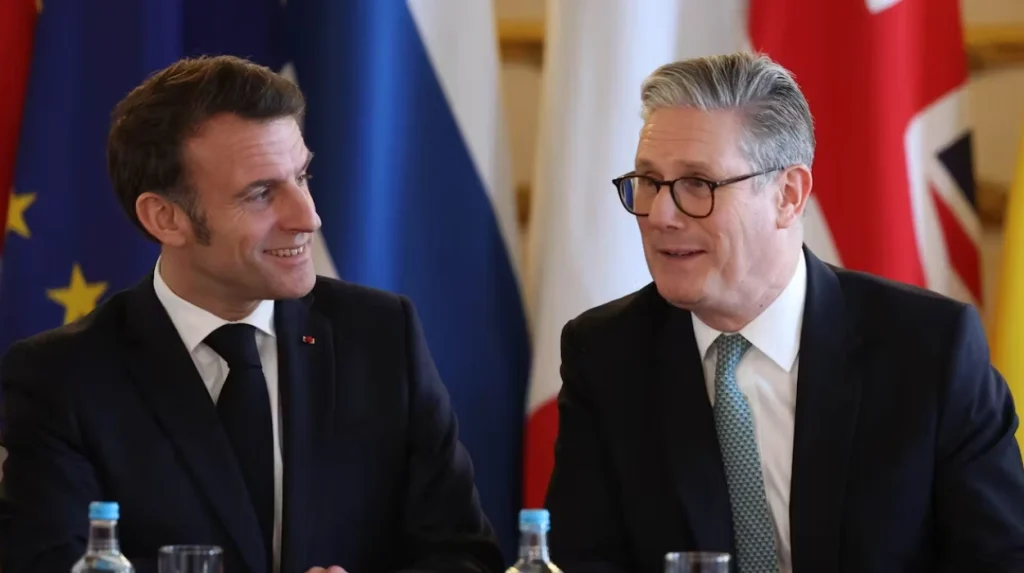
The Northwood declaration of 2025 between the United Kingdom and France is a turning point in European defence cooperation. This is the first time when both sovereign nuclear countries of Europe have agreed to coordinate their own nuclear deterrence and it is another sign of a united position to meet increasing threats, especially that of Russia. The agreement, which was revealed by the British Prime Minister Keir Starmer and the French President Emmanuel Macron, follows an increasingly unwillingness of the US to ensure European safety and increased Russian aggressiveness in Ukraine and other areas. It is an act of political as well as strategic readjustment reflecting the willingness of Europe taking more responsibility in ensuring its own security.
Contextualizing the Pact in Europe’s Security Landscape
Russian Aggression and European Vulnerability
European security dynamics have been jolted, since the full-scale invasion of the Ukrainian by Russia, in the beginning of 2022. The protracted military hearing by Moscow, whose actions are refusing to pledge allegiance to peace has intensified the trend of further warfare. That the origin of the present war is once again in Russia, is not only stressed by the Northwood Declaration, but it was also clear in London and in Paris that Russia has again represented a great danger that the continent has always remained in.
This menace cannot be limited to the traditional warfare but to hybrid strategies, cyberattacks, and strategic coercion. Their move in the UK and France to orchestrate their nuclear deterrents is addressing this complex issue squarely. It ends up sending a highly-convincing message regarding the possibility of any aggression towards one by responding with cohesive and decisive nuclear interdiction.
US Strategic Reorientation and European Autonomy
The agreement shows change in transatlantic relations too. An increasingly Asia-centric approach taken by the United States now poses threats to European allies to the United States, who worry whether the American security guarantees are reliable, and to the level. This readjustment has been given a push by the appeals by US President Donald Trump to European nations to step up their military spending.
Starmer emphasized that the pact is “no greater demonstration” of the importance of UK-France relations and a vital step to “make our people safer and more secure” amid these uncertainties. The UK and France also wish to address possible deterrence gaps by intensifying the collaboration and encouraging the European allies of their commitment to collective defense.
The Mechanics and Significance of the Northwood Declaration
Independent but Coordinated Nuclear Forces
The characteristic feature of the agreement is related to the fact that the UK and the French nuclear forces will be operationally independent, yet they will be coordinated by a new UK-France Nuclear Steering Group. It will be a body steered jointly by the French Presidency and the UK Cabinet Office and will coordinate and manage policy, capability development and operations.
This is a moderate solution between sovereignty and strategic alignment. Each country monitors its arsenals and indicates unity. The declaration states unequivocally that
“there is no extreme threat to Europe that would not prompt a response by both nations,”
illustrating the pact’s deterrent intent.
Enhancing Capabilities and Industrial Cooperation
The agreement, besides being a strategic signal, entails building up the missile power. Both nations plan to procure more Storm Shadow cruise missiles and are currently working on their replacement. Such collaboration sustains thousands of expert opportunities in the UK defense concentration, such as about 1,300 directly relative to missile assembly and 300 at MBDA, the missile-making company.
The agreement is also linked to the UK doubling the size of the Combined Joint Expeditionary Force to 50,000 soldiers that can operate on land, sea, air, cyber, and space environments. Such an expanded cooperation in military matters (in addition to the nuclear deal) appears to be a nuance of a broad-based strategy of deterrence and defense.
Political and Parliamentary Reactions
Support and Reservations in the UK Parliament
There have been some reservations raised by the UK members of parliament over the pact with claims that an effect on the national sovereignty will be compromised especially on Trident nuclear deterrent. The interoperability of the coordination with NATO nuclear planning frameworks and how the practical arrangement of joint decision-making will be made remains questionable.
These issues emphasize the fragile perfection between collective security improvement and retaining autonomous authority in respect to nuclear forces. The UK government has appealed to the MPs that the independence in operations is not threatened but the arrangements on how such coordination would be done are not fully known.
French Political Perspective
French President Emmanuel Macron presented the agreement as a collective duty to keep the EU to European values and security during a period when these are being threatened more and more. He emphasized that the agreement opens a “new chapter” in bilateral and European relations, aimed at championing “fair and lasting peace worldwide.”
The French government considers the pact a way of strengthening strategic autonomy of Europe without weakening NATO. It is also a reaction to the security environment that has not been the same and is no longer adequate to depend on external powers.
Strategic Implications for European and Global Security
Reinforcing Deterrence Credibility
In their harmonised nuclear deterrent capabilities, the UK and France are sending a strong signal to possible warring parties as validated by Russia, especially. The pact alleviates the chances of miscalculation because it clears that an assault on either party would result in a joint nuclear action, which increases the cost of aggression.
This augmented deterrence is paramount regarding the intent of Russia to resort to military force in order to pursue political objectives and its current course of fighting in a hybrid warfare. The agreement is also a morale booster to the European allies who would feel threatened by the US strategic transformation.
Challenges and Risks
Nevertheless, risks could be found in the pact. Increased coordination speed would make command and control preparations more difficult and suggest serious doubts about crisis control of escalation. The absence of the finer information on the operation protocols creates doubts on how the decisions would be taken in case pressure appeared.
Also, the alliance is likely to introduce retaliatory actions on the part of Russia once leading to the beginning of the alternative arms race in Europe. It also casts doubts on the future of NATO nuclear stance and on the possible desire of other European nations to pursue the same arrangements or insist on a higher degree of participation.
Economic and Industrial Dimensions
The focus of the pact on development and missile capability and joint enhancement of capabilities bodes well to both defense industrial bases. The joint effort is keeping thousands of people employed, and keeps the technology level up, strengthening the strategic gap between the UK and France.
It is also an indication of a move towards possible European leadership in defence projects, lessening reliance on US technology and supply-chains. It is an important element of this industry that enhances the long-term sustainability of deterrence, as well as the overall tendencies of European defense policy.
Voices from Experts and Analysts
This individual has commented on the subject putting emphasis on the importance of the pact as a show of European determination amid rising and falling power global balances. The observer observed that though the agreement enhances deterrence, it can be managed carefully to ensure that there was no unwarranted escalation and enhancing cohesion of alliances.
The UK and France will combine their nuclear deterrents for the first time
— Peter Stefanovic (@PeterStefanovi2) July 10, 2025
'From today our adversaries will know that any extreme threat to this continent would prompt a response from our two nations,' Starmer says pic.twitter.com/rFyGfjvcTu
The Future of European Nuclear Deterrence
The UK France pact over nuclear power is a strategic point in the European defense position. It is a practical reaction to an acceleration in a volatile security environment and the changing face of transatlantic relations. Through coordinations of their war forces in terms of nuclear, the UK and France will be able to deter aggression better as well as to assure allies of their sincerity.
However, the agreement also poses some tough questions concerning sovereignty, alliance relations, and crisis management. It will succeed through transparent processes, political enthusiasm, and through ongoing negotiation with NATO and other partners.
As Europe navigates these challenges, the Northwood Declaration may well be the first step toward a more integrated and autonomous European defense identity, balancing national interests with collective security imperatives. The world will watch closely to see how this historic cooperation shapes the continent’s strategic landscape in the years to come.