Recent diplomatic tensions between the United States and Denmark over Greenland represent
“a strategic wake-up call for the whole of Europe,”
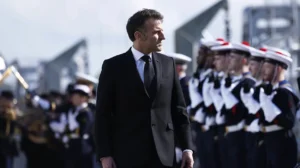
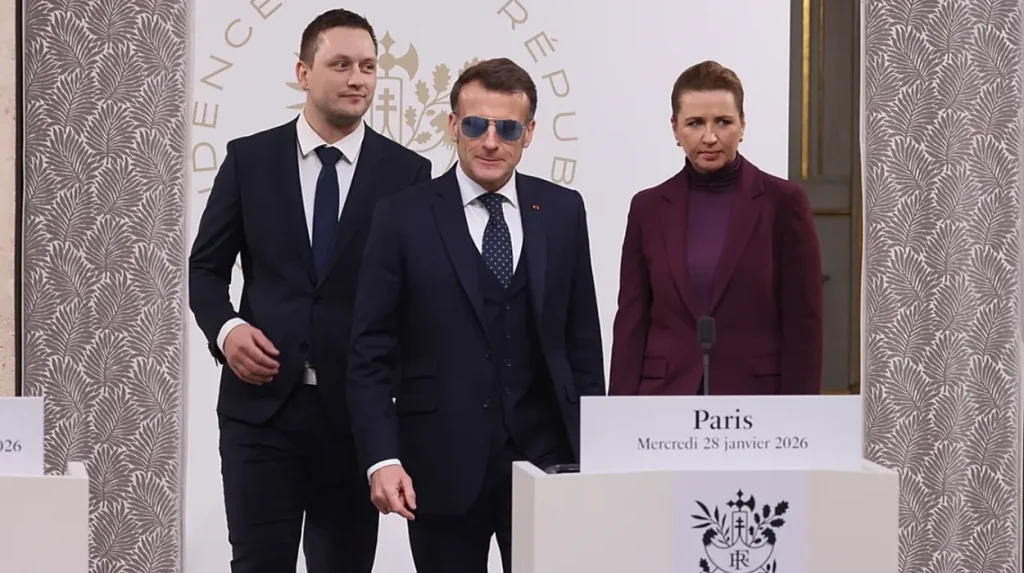
French President Emmanuel Macron said on Wednesday, standing alongside Danish Prime Minister Mette Frederiksen and Greenlandic Prime Minister Jens Frederik Nielsen at the Élysée Palace.
The high-level meeting, held amid renewed controversy surrounding US President Donald Trump’s statements and ambitions regarding Greenland, was intended to send a clear political signal of European unity and resolve in the face of growing pressure on the Arctic’s strategic balance.
Why Is Greenland at the Center of Transatlantic Tensions?
The relevance of Greenland has escalated in recent years with the reduction of Arctic ice, which has made new maritime routes and access to unexplored natural resources possible. Greenland is located on vital North Atlantic routes and has significant US military facilities, including Pituffik Space Base, which is a crucial component of the country’s missile warning, space surveillance, and Arctic defense systems.
The Arctic region is warming at a rate approximately four times faster than the global average, as indicated by climate information, which has accelerated the rivalry between global powers. The region is believed to contain 13 percent of the world’s undiscovered oil and 30 percent of the undiscovered natural gas, apart from deposits of rare earth elements, which are essential for clean energy and defense technologies.
What Message Were European Leaders Sending From Paris?
The Paris summit highlighted Europe’s determination to assert itself more distinctly in Arctic matters.
“The talks covered Arctic security, economic resilience, social development in Greenland, and Europe’s preparedness to contribute to the autonomous Danish territory’s development,”
said a statement from the Élysée Palace.
Macron made it clear that the confrontation with Washington must not be considered a bilateral problem but rather a moment of strategic significance for Europe. He urged Europeans to become more conscious of several aspects:
“European sovereignty, Europe’s role in Arctic security, fighting foreign interference and disinformation, and collectively addressing climate change.”
How Does Europe Plan to Strengthen Its Arctic Role?
France has articulated the Arctic as a rising “pillar of European strategic autonomy.” While not an Arctic state, France has a substantial presence in the region through research stations, satellite monitoring capacity, and its maritime forces, which undertake periodic patrols in the North Atlantic and Arctic-proximate waters.
The European Union has stepped up its financial outlays related to the Arctic in recent years, committing several hundred million euros to climate research, sustainable development, and infrastructure in the High North. France and the EU have both indicated a willingness to deepen economic, scientific, and security cooperation with Greenland, particularly in sectors such as renewable energy, education, and digital connectivity.
What Role Does NATO Play in the Arctic?
Danish Prime Minister Mette Frederiksen echoed Macron’s view, saying that the recent tensions were a learning experience for Europe. She reiterated the importance of Europeans being able to protect themselves while still playing a crucial role in Arctic security through NATO.
With seven out of the eight Arctic nations now being members of NATO, following Sweden’s membership, NATO has significantly increased its presence in the Arctic region. This is especially true as Russia is upgrading its military infrastructure in the Arctic region and China declares itself a “near-Arctic state.”
How Does Greenland View Its Partnership With Europe?
The Greenlandic Prime Minister, Jens Frederik Nielsen, emphasized the ideological aspect of cooperation with France and Europe.
“It is more than just an economic partnership or a security partnership. It is a partnership based on a shared set of values, such as democracy, self-determination, and respect for international law,”
he said.
Greenland has only 57,000 citizens and is facing a number of challenges, such as the cost of infrastructure, climate change, and the fact that fishing accounts for more than 90 percent of exports. European assistance is considered essential for Greenland’s economic diversification.
Why Is France Expanding Its Diplomatic Presence in Greenland?
As a concrete signal of engagement, France is set to open a consulate in Nuuk on February 6, enhancing its diplomatic, economic, and scientific footprint in the Arctic. The move reflects Paris’s broader ambition to remain a relevant actor in polar affairs and to support Greenland’s development while countering external pressures.
Is This Part of a Broader European Diplomatic Push?
The Paris meeting fits into a wider European diplomatic effort. In recent weeks, Mette Frederiksen has engaged in extensive consultations across Europe, including participation in a North Sea energy and security summit in Hamburg and high-level talks in Berlin.
In a statement released on January 27, the Danish government warned of a deteriorating geopolitical environment marked by war in Europe and shifting global power dynamics. Frederiksen reiterated that Denmark’s security depends on strong alliances and deep integration within the European community.
Why Does Greenland Matter to Europe’s Future?
Despite its small population, Greenland’s strategic weight far exceeds its size. As Arctic competition intensifies, control over infrastructure, resources, and governance in the High North is increasingly seen as central to Europe’s long-term security and economic resilience.
For Macron and his counterparts, the Greenland episode has crystallized a broader lesson: Europe can no longer afford to treat Arctic affairs as peripheral. Instead, the region is fast becoming a frontline in the contest over sovereignty, resources, and geopolitical influence.