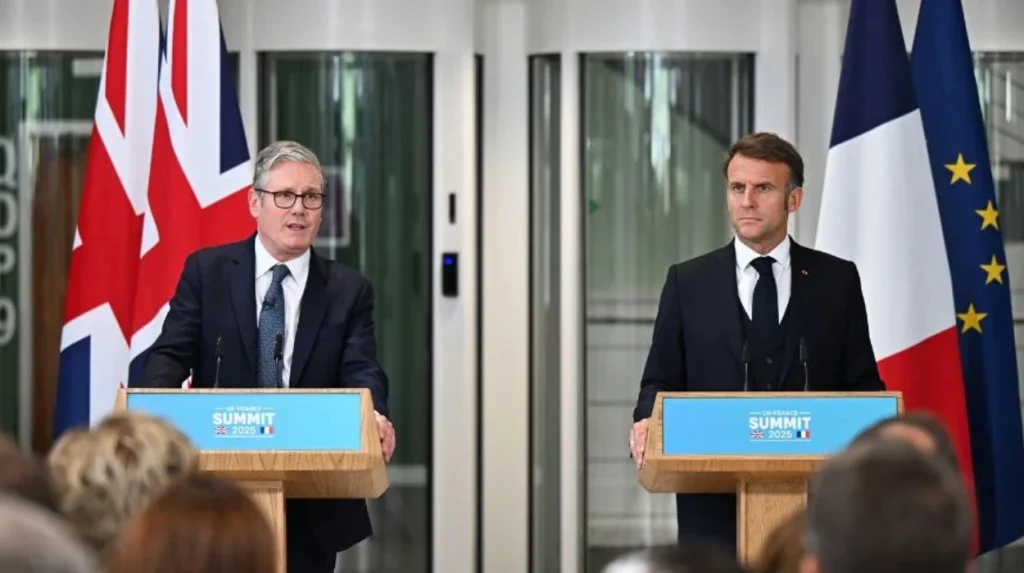
The defense landscape in Europe in 2025 is changing radically. The Lancaster House 2.0 agreement between the United Kingdom and France is not only a continuation of that of 2010 but a rebalanced desire of self-reliance strategically. It reinstates the definition of what European independence might entail in a period when American aid is becoming more conditional.
The new agreement focuses on nuclear coordination, collective development of weapons and cross-border planning of industries. It is also indicative of a practical reaction to the shifting transatlantic dynamics with both countries trying to achieve the defense position of Europe during a time of global instability.
The environment which has led to this new wave of partnership is the unpredictability of security structures. The conflict in Eastern Europe, internet invasion, and energy insecurity have increased the fear of overdependence on Washington in the region. The new Lancaster system proposes the use of a coordinated nuclear steering group, joint modernization projects in order to strengthen European credibility.
The military and technological capabilities behind Lancaster House 2.0
Under the symbolism of diplomacy, the success of Lancaster House 2.0 relies on physical defense production. Neither country has changed its stance to declarations of intent to practical capability building; an approach that incorporates nuclear deterrence, industrial cooperation and next generation technology integration.
Joint nuclear deterrence and weapon modernization
The UK and France are the sole nuclear power in Europe and they contribute more than an equivalent of 40% of the European defense spending in NATO. The establishment of the UK-France Nuclear steering group in 2025 is a significant strategic move- synchronizing of doctrines, planning and building credibility in deterrence.
This project is a complement to such technological projects as the STRATUS missile project, which aims at replacing and extending the reach of the Storm Shadow/Scalp missile. Such developments, which have been tested in the battlefields such as Ukraine, demonstrate how the alliance is not only modernising its arsenals, but also its signalling. These integrations in nuclear and missile research create a better division of labor that makes the Europeans more prepared.
Defence industry integration and strategic readiness
It is also important with industrial and logistical integration. Lancaster House 2.0 strengthens collective industrial policies, which seeks to defend defense supply chains and to increase technological resilience. The common interest in artificial intelligence, robotics, and surveillance system research means that the two countries are both capable of adapting fast in case of crisis.
This development is evidenced by the enhanced Combined Joint Force. It is planned as a fast reaction, corps-level military unit, but extends into cyber, space and maritime mediums. The joint capabilities establish a system of collective defense, which turns bilateral cooperation into a model of collective defense on a scale in relation to Europe.
This ambition is aided by long-term investment. The 2.3% of GDP in the UK defense budget in 2024 was high in comparison to France although both still topped Europe in the acquisition of advanced weapons and cyber preparedness that are also indicators of operational maturity.
Strategic autonomy and European security without Washington
The demand for European strategic autonomy has been growing with the changing U.S. global priorities. Lancaster House 2.0 represents a deliberate effort of London and Paris to give more responsibility in the defense of Europe, and the attempt reveals the structure limitations or the reality of political matters.
Policy, perception, and limits of independence
President Emmanuel Macron’s July 2025 address to the UK Parliament set the tone: “The UK and France have a special responsibility to the security of Europe. His utterance reflected the desire to put in place an independent European deterrence framework that can even work without the U.S. leadership.
Nevertheless, there is low operational independence. The U.S continues to supply strategic airlift, critical intelligence, satellite, and munitions infrastructure. European deterrence and credible regionally- does not have the international depth, speed and reach of the American support. Lancaster House 2.0 is thus a dream and a trial to whether Europe was really ready to be independent or not.
Analysts believe that the issue is not a political desire but scalability. The challenge of achieving the same level of logistical reach and technological advances of the U.S. military is a generation task to the European military.
European consensus and NATO cohesion
Autonomy will have no meaning unless it is founded on European consensus. Although the UK-France partnership is powerful, it cannot act alone. Increased involvement of Germany, Italy and Central European states are needed to bring about sustainability of balance and deterrence coherence.
The interoperability and the ability to synchronize command across the board has improved in recent exercises by the combined joint force, but the integration is still haphazard. The difference in threat perception particularly between western and Eastern European states makes joint planning difficult.
Still, optimism persists. Recently, a senior EU defense official said that the UK-France alliance is a test ground of Europe, in case it succeeds, it gives the template to everyone. That is the feeling which bilateral leadership might develop to align the continental defense.
Innovation, deterrence, and the future of European defense
European deterrence strategy is now characterized by technological innovation to a greater extent than traditional power. Lancaster House 2.0 encompasses the integration of artificial intelligence, cyber defense, and systems of next-generation intelligence in the operational doctrines and synchronizes them with the nuclear and conventional deterrence strategies.
Integrating technology and deterrence
London and Paris both know that contemporary war is swift and accurate. Their common investment in AI-based targeting, quantum-based early warning, and secure data-sharing solutions are indicative of a transition to predictive defense models. These technologies are meant to minimize the response time, streamline the resources, and predict the strategy of a hybrid warfare.
These areas of industrial collaboration guarantee technological independence in Europe. It enables both countries to manage sensitive information, to deal with patents of defence on the national level, and to decrease the reliance on non-European suppliers, which are the primary goals of the concept of autonomy in security.
A shifting center of gravity in global defense
Lancaster House 2.0 embodies the changing identity of Europe in terms of defence- it is the mixture of aspiration, need and structural adjustment. It means that London and Paris believed that the security of the continent had to be based on European capacity and not transatlantic reliance.
The future effectiveness of this agreement will be based on its sustainability even in the political cycles and incorporation in the broader European defense planning. Long term investment, interoperability and industrial synchronization will be the key to the success of Lancaster House 2.0 as a foundation of European defense or an experience in the quest of autonomy.
With the world balance of power shifting and the U.S. swinging towards the Asian direction, the biggest question is still open, can the UK and France really protect Europe without the assurance of Washington? It remains to be seen in the next decade whether this union will be the beginning of an independent European defense or whether ancient dependencies will covertly re-establish themselves in the event of crisis again.