In 2025, the Nigeria banditry wave intensifies and spreads to the northern and central states that increases humanitarian burdens and complicates the counter-crime and counter-insurgency structure of the government. Although the total attacks are said to have decreased by 17 per cent in the first quarter, the officials report that attacks have become deadlier, more organized, as well as more interconnected with the extremist networks. Mass kidnappings have become a hallmark such as 25 schoolgirls kidnapped in Kebbi on November 17 and over 315 students killed in Niger state, leading to temporary school shutdowns in the susceptible districts.
In Kaduna, Zamfara, Sokoto and Niger, communities are still experiencing an escalated rate of raids that combine the traditional banditry with the methods traditionally linked to ISWAP and Boko Haram. National Human Rights Commission datasets show that 2,266 individuals were murdered by bandits and insurgent-related organizations during the first six months of 2025 as of itself which already exceeds the total of 2024. Food insecurity will impact over 33 million Nigerians in the mid-year lean season as humanitarian agencies estimate as displacement becomes more serious, escalating the security crisis into a national level socio-economic crisis.
France commitment renewal and shifting bilateral dynamics
The re-invigoration of France in its relationship with Abuja is now a key external factor that determines the security environment in Nigeria in 2025. On the 7th of December, after a phone call with President Bola Tinubu, President Emmanuel Macron once again echoed his message of solidarity to the people of the country in dealing with its security issues spreading to the terrorist threat in the North. The declaration on X is based on previous discussions in July whereby both governments repeated their intention to coordinate the escalating violence.
French policy is an adjustment of its larger Africa policy following a series of military withdrawals in Mali, Burkina Faso, and Niger. Paris is becoming more focused on indirect support, technical expertise and training as opposed to direct deployment. This is in line with the long-term ambition by France to maintain influence in West Africa by forming alliances as opposed to massive military deployment.
France’s targeted support mechanisms
France has been supporting special training programs, intelligence sharing platforms, and stabilization services to rural populations who have been most hit by the surge of banditry in Nigeria. Nigerian authorities have been insisting on the necessity of capacity-building, which includes the need of more effective early-warning systems and counter-kidnapping units. The French approach also includes the protection of the autonomy of Nigeria, where both governments emphasize the importance of respect for sovereignty and responsibility towards each other in designing the programs.
These obligations are the efforts of France to develop a post-Sahel model based on the local forces and providing the specific impact intensive assistance where the institutional vacuum remains significant.
US security partnership expansion under renewed strategic alignment
The United States intensifies participation through extending intelligence sharing arrangements, logistics support and provision of mobility and surveillance-specific defense platforms. Authorities emphasize the centrality of Nigeria to U.S. regional policy, citing the population and economical mass and her emerging status in the stability equation in West Africa.
The re-entry into 2025 is congruent with counter-extremism priorities in the Trump administration, which continues to associate insurgency based in Africa with greater threats globally. The U.S. focuses on enhancing Nigeria on its rapid-response operations especially in the rural regions where banditry networks take advantage of the forested corridors and porous borders. The technical assistance of American support also entails tracking of financial flows used by the kidnapping syndicates.
Strategic alignment shifts within the US-Nigeria cooperation
The American policy has moved to touch upon broader geopolitical factors such as the receding presence of the French in the Sahel or the growing military presence of Russia. This overlaying environment brings a unique convergence of the major powers around the insecurity issues of Abuja. In the case of Nigeria, the convergence provides a new leverage as it will improve the bargaining power and increase the range of available military and intelligence technologies.
Russia’s expanding military cooperation and its regional ambitions
Russia is also strengthening its grip in the Nigerian security environment and is intensifying already existing military-technical relationships. Diplomatic interest continued with Maria Zakharova, the spokesperson of the Russian Foreign Ministry, stating that the country is ready to provide the required support to its partners in Nigeria. The Chief of Defence Staff of Nigeria, General Christopher Musa has commended the ability of Russia to be dependable in the May 2025 consultations stating the significance of the drones donated, surveillance systems and precision weapons.
Russian programs also covered counterterrorism training, collaborative intelligence drills, and equipment support based on the operations against bandit groups that tend to employ drones and encrypted messages. Moscow sees collaboration with Nigeria as an easy way to enter a West African region that is going through a radical geopolitical rearrangement.
Russia’s post-coup regional positioning
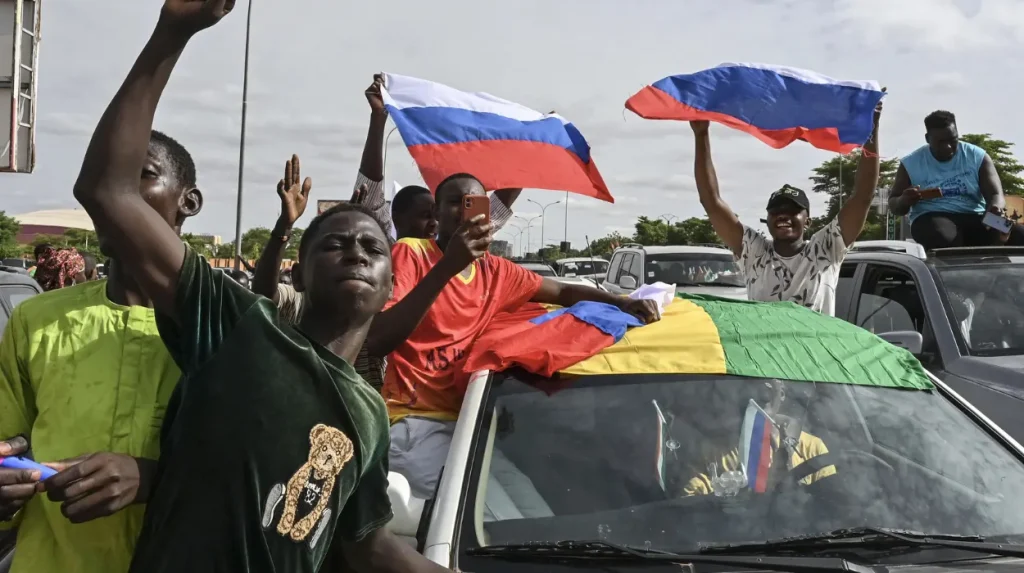
The increasing influence of Russia in the Sahel was following military takeovers where Russia was able to offer defense agreements and nuclear cooperation programs with its neighbors such as Niger. Cooperation of Nigeria with Moscow gives it diversification on partners in security as well as strengthening it to fight the borderless threats. The association is also a pointer of a larger change in African security trends that are not based on the single partner relationship.
Rare trilateral convergence and its operational implications
A notable trend in 2025 is that France, the U.S., and Russia will be united around the growing banditry problem in Nigeria. Despite all three powers having different international interests in almost all geopolitical fronts, they are simultaneously providing security aid. This convergence is motivated by a similar understanding that Nigeria is unstable which poses regional and international risks, both in terms of migration and extremists propagation.
Operational synergies and coordination gaps
Potential synergies are the built-in intelligence that will reveal the cross-border supply flows, common training principles of the multi-service units of Nigeria, and the augmented support of the technology in the early warning systems. Nevertheless, the lack of coordination is still held back due to the political motives, systems incompatible, and the current fiscal constraints faced by Nigeria.
Nigeria retains complete control of what is going on, managing its operations with a multi-partner system that does not surrender power to gain advantages. However, there are still loopholes in logistics, communication guidelines, and sustainability planning in the long term.
Broader geopolitical implications of the Nigeria banditry surge
The Nigerian banditry wave is redefining the trend of influence in West Africa. The multipolar competition also enables Nigeria to widen the scope of partners and eliminate the reliance on any external actor. Crisis also demonstrates the process of how banditry has transformed into a mixed threat of combinations of economic grievance, political influence and ideological influence as compared to a mere criminal activity.
The African stability in Nigeria indirectly gives European security structures (especially through the EU and NATO) an edge on the basis of migration corridors and containment of extremists.
Sustainability pressures and national constraints
Nigeria is still under a critical institutional pressure as over 589 schools countrywide have been shut because of the risk of abduction. The government finds it difficult to match operations on the large affected ground. Success in the long term depends on how we solve the underlying drivers such as farmer- herder conflicts, which increased by 64 percent in the first quarter of the year 2025.
The evolving geopolitical realignment surrounding Nigeria’s security crisis marks an exceptional moment in modern foreign relations, where conflicting global powers find overlapping urgency in responding to the Nigeria banditry surge. As bandit networks adopt new technologies and expand cross-border influence, the trajectory of these partnerships will shape whether Abuja can regain control over contested regions. Emerging questions now revolve around whether deeper international coordination can reduce abductions and restore village life, or whether competing agendas will generate unforeseen vulnerabilities in a region where stability remains precarious.