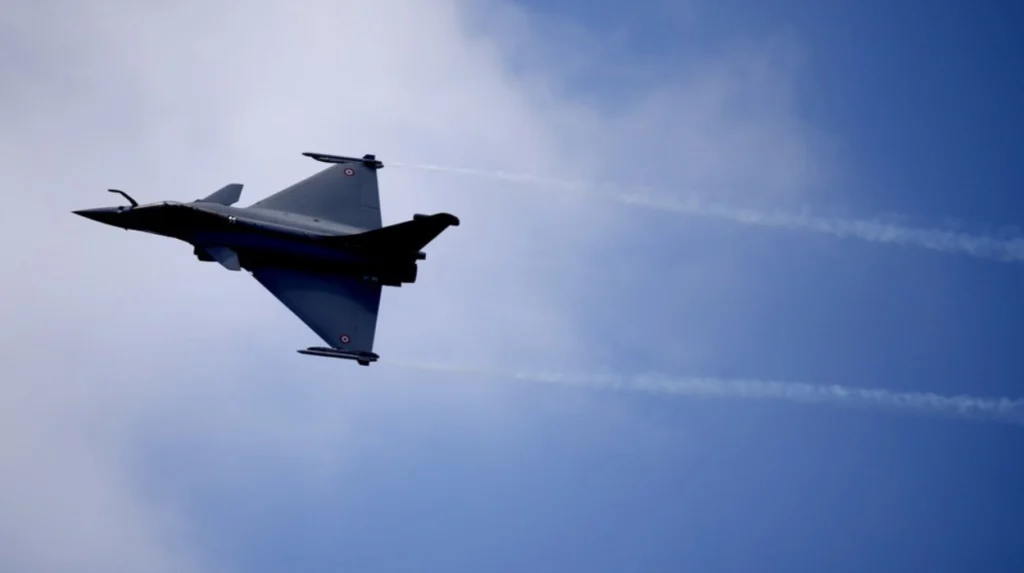
As the European Union seeks to build its strategic autonomy, the French defence industry is gearing up more than three years after the outbreak of the war in Ukraine.
Recently, French Minister of the Armed Forces Sébastien Lecornu and Economy Minister Éric Lombard will make a high-profile visit to the Eurenco group’s new plant. In Bergerac, 1,800 tonnes of powder will be moved annually from Germany, Italy and Sweden, primarily for artillery, to France. In the past two years, the company has doubled its sales, and it has filled its order book until 2029.
By 2030, France’s defence budget is projected to rise to €67.5 billion, increasing from €50.5 billion this year. President Emmanuel Macron has consistently stated that the sector should anticipate a “substantial” boost in public orders, which is encouraging for French defence manufacturers, though the funding situation is still not fully settled.
Engaging Defence Stakeholders
“I was contacted by the Ministry of Defence in November 2021 to manufacture bullets for the special forces,”
Plubeau & Cie, President Olivier Lacreuse told Euractiv. Originally, the company specialized in precision metalwork for the railway industry and sports shooting bullets.
“Two models of our bullets have been approved, and we opened our new factory last Monday, but I am still struggling to secure my supply of raw materials,”
Lacreuse said.
“I import my cartridge cases from the United States, but given the current geopolitical instability, I am looking for suppliers in France.”
Increasing defence spending is also expected to speed up the conversion of struggling sectors, such as the automotive industry. The Fonderie de Bretagne – a foundry that produced spare parts for Renault in the Lorient region -is set to be taken over by the French group Europlasma, which will produce 24,000 metal casings for artillery shells per day.
France’s Robust Export Achievement
In 2024, France’s defence industry’s exports reached €18 billion, the best result since 2022. In light of the increasing number of conflicts around the world and the tensions with the United States, new buyers may be encouraged to invest in French military equipment.
Dassault Aviation, Safran, and Thales all posted strong profits in 2024 as a result of the sale of Rafale fighter jets, submarines, drones, missiles, and Caesar howitzers. There are also many small and medium-sized enterprises securing contracts abroad.
Underwater acoustics and robotics company RTSYS generates nearly 90% of its revenue from exports to Europe and Asia. “We anticipate strong growth in our business over the coming years,” François-Xavier de Cointet, the company’s director, said.
“With rising tensions in the South China Sea and the recent attacks on Baltic Sea cables, everyone is realising the need to monitor underwater infrastructure.”
Following the European Commission’s announcement yesterday to generate €800 billion in defense funding via loans and debt, Jacques, the French MP, emphasized the necessity for French defense companies to collaborate on a continental scale.
“Coordinating the production of new weapons at the continental level will, contrary to what some may think, help to grow the French industry,”
he stated.
“We can easily imagine French groups setting up factories in other European countries, just as foreign companies could establish themselves in France.”
Currently, the European defense industry represents 33% of worldwide arms exports, which includes American firms operating in Europe. Nonetheless, Samuel B. H. Faure, a political science lecturer at Sciences Po Saint-Germain-en-Laye, cautioned in Le Grand Continent that “the prospect of national rearmament among European nations could lead to heightened industrial rivalry and a potential decline in the EU’s collective capabilities should not be dismissed.”