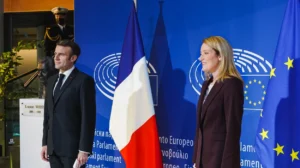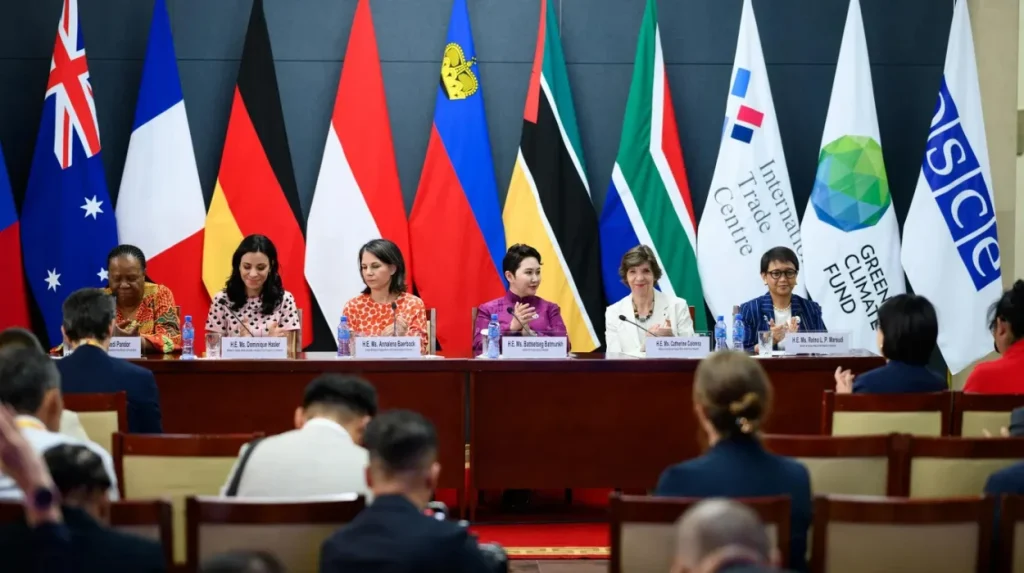
The Feminist Foreign Policy Summit, organized in Paris on October 22-23, 2025, highlights a shift of the intersection between gender equality and global diplomacy in France. The conference, organized by the French Ministry for Europe and Foreign Affairs, gathered more than 40 countries in the form of foreign ministers, multilateral organizations, researchers and even the leaders of civil societies. The summit is based on the French promise of feminist foreign policy in 2019 and the growing global trend to entrench gender equality in the very foundation of international affairs.
By 2025, over 15 countries have officially rejected feminist foreign policy. This is a strategic shift in perspective of moving away from the old diplomatic approach of military and economic politics to the focus on human security, inclusiveness and equality. The initiative by France is aimed at showing that the advancement of women rights enhances democracy as well as global stability, particularly in states where there is conflict, climatic stress and social disorders.
The summit was labeled by the Foreign Minister Stephane Sejourne as reaffirmation of the role of gender equality not being an accessory to diplomacy but its prerequisite. The policies of France have associated gender equality with sustainable peace, climate recovery, and technological access, which advances an ideology of diplomacy that merges a moral administration with realistic governance.
Central themes driving France’s 2025 summit agenda
The protection of sexual and reproductive health and rights is one of the key principles of the feminist foreign policy in France. In a world that seems to be returning to the era of restrictive legislations, France has been diplomatically strong to protect the right of access to abortion and reproductive services as human rights. France still funds health infrastructure programs, family planning programs, and education in Africa, Latin America, and Asia through partnerships with initiatives, including She Decides and the Generation Equality Forum.
The summit, in 2025, once again confirmed that the independence of women over their bodies is a part of sustainable development and peacebuilding. Reproductive rights, as pointed out by delegates, are not just a question of personal freedom but also a factor of social and economic equity. The case of France serves as an inspiration to countries on the need to address these issues as international concerns and not domestic arguments.
Empowering feminist civil society and economic inclusion
The feminist diplomacy in France places a lot of investment in leadership in the civil society. Since 2020 its Support Fund to Feminist Organizations has borne financial and institutional support to over 1,400 organizations in 75 countries. Such organizations feature prominently in supporting gender justice at community level in rural education projects to legal reforms advocacy.
One of the major points on the agenda in 2025 was aimed at economic participation. Nevertheless, less than 40% of the labor income in the world is still represented by women. This summit stated that economic independence is a key factor in achieving equality in the long run, and reforms to achieve greater access to credit, opportunities to become an entrepreneur, and safeguards against informal workers were encouraged. There were also discussions on how women are being integrated into the digital economy, an area that is also becoming associated with global competitiveness and social change.
Strengthening women’s role in peace and security
France renewed its commitment to the resolutions of the UN Security Council 1325 and in fact, women negotiating peace and rebuilding peace in post-conflict countries must be included. French officials referenced statistics that indicated that when peace deals female leaders are 35 percent more probable to remain beyond 15 years.
The experiences of women peacebuilders in Afghanistan, Sudan, and Ukraine were examined in panels, and the idea was that lasting stability relies upon having gender-balanced decision-making. The current experiences and work of France in the Sahel and Middle East demonstrate that feminist diplomacy can be translated into the working strategy, which promotes dialogue, education, and reconstruction programs.
Expanding the scope of feminist diplomacy
The summit of France expanded feminist foreign policy beyond social and political equality to climate governance. The deliberations placed women as frontiers in environmental stewardship especially in the developing world which has been characterized by desertification, floods and agricultural disturbances. The representatives of the Pacific Islands and Sub-Saharan Africa emphasized that the policies should support women-led climate adaptation programs with finances.
In 2023, France initiated the Climate and Gender Facility and was further committed in 2025 to finance projects allowing gender-responsive budgeting and entrepreneurship in renewable energy. This strategy is based on the increased awareness of the fact that sustainability and gender equality are mutually supportive objectives.
Addressing digital transformation and gendered online threats
Digital governance was also brought to the limelight of the 2025 summit as it looked at the intersection of gender, technology, and security. The Laboratory of Women Rights Online, opened in France in 2024, displayed statistics indicating that there was a 60 percent increase in digital harassment based on gender in the world. The laboratorium favors innovation in artificial intelligence ethics and policy on cybersecurity using gender-sensitive approaches.
Feminist diplomacy, experts argued, has to adjust to the problem of surveillance technologies, algorithmic bias, and online abuse. The focus of France on digital rights is a futuristic aspect of feminist foreign policy – an aspect that combines equality with technological responsibility.
Institutional accountability and international cooperation
France encouraged other countries involved to implement quantifiable indicators to monitor gender equality in foreign policy. The Paris Summit launched a voluntary Feminist Diplomacy Scorecard, a data-based model of evaluating transparency, funding distribution, and representation in foreign ministries. This is an initiative that will formalize responsibility and co-ordinate the national efforts on a common international framework.
Joint initiatives with the European Union, African Union and OECD will come up with agreed metrics to measure the impact of policy. Such an impulse towards measurability aims at turning feminist diplomacy into aspiration rhetoric into an evidence-based practice.
The geopolitical relevance of feminist foreign policy in 2025
The summit in France is organized in a shifting power structure and an uncertain-norm environment that is global. The foreign policy of the previous century is reconsidered due to the events in Eastern Europe and Africa, the active development of digital warfare, and environmental disasters. France offers a prototype of applying gender equality to diplomacy and considers peace and progress as inseparable elements by the social justice factor.
Although critics have pointed to the danger of feminist foreign policy overextending due to lack of funding, proponents maintain that this model is one of the few to consider the fundamental causes of instability, inequality, exclusion, and disenfranchisement. The focus on cooperation, creativity, and quantifiable outcomes in the summit is indicative of the attempts of France to make equality a component of modern diplomacy and not a marginal agenda.
Toward a new era of global cooperation
France should be at the center of a revolutionary approach to diplomacy through the Feminist Foreign Policy Summit of 2025. The connection between gender equality and climate resilience, digital rights, and economic reform in the French approach is more than a mere matter of morality advocacy but it exemplifies statecraft at its strategic level.
As global crises grow increasingly intertwined, the feminist framework provides a lens through which cooperation, peace, and sustainability can be pursued collectively. Whether this model achieves lasting influence will depend on sustained political will, international partnerships, and the integration of equality into every dimension of governance. Yet, the Paris summit demonstrates that feminist diplomacy is no longer a theoretical concept, it is a practical strategy shaping the future of global relations and redefining how nations pursue justice in a complex world.