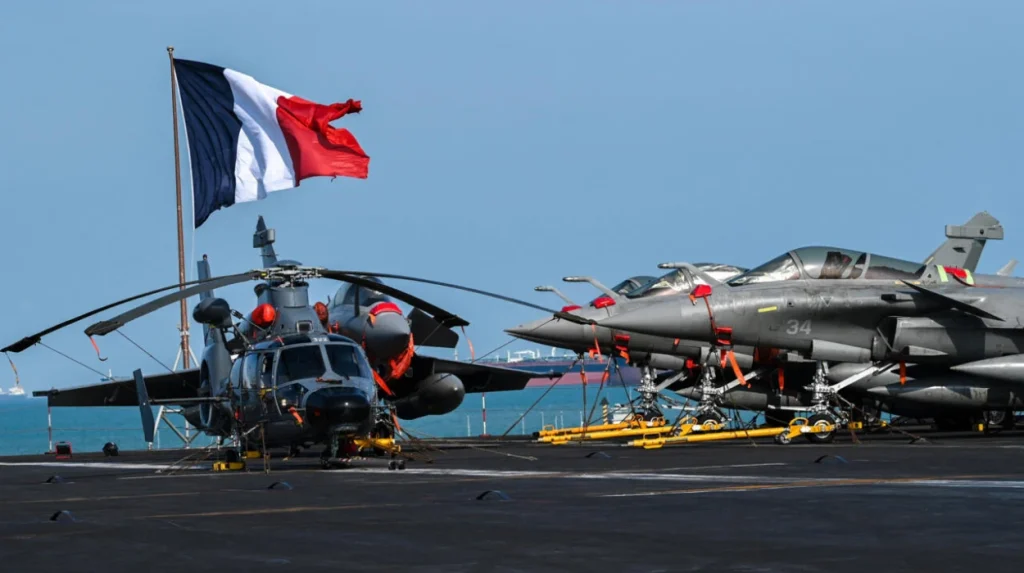
The Rafale fighter jet manufactured by Dassault Aviation in France has come out as more than a military machine. It is the emblem of national industry, strategic independence, and the French desires in the international defense sector. However, mid-2025 it became the unwitting centerpiece of a geo-political game of tug-of-war. After its operational debut in the India-Pakistan war, the Rafale has been targeted by a focused mobilization of disinformation, led mainly by politically sponsored organizations in China.
This tactical fabrication initiative drives home the increased role of electronic propaganda and more importantly the fact that in arms trading today technical excellence is no longer the only determining factor but now power to create the narrative also counts. In the case of France, it was not a mere war of the reputation case, but it turned out to be a challenge of credibility to defend the world.
From Kashmir to coordinated campaigns
A flashpoint in Pahalgam
The war started on April 22, 2025, a terrorist attack that was bloody and took place in a tourist-friendly town of Pahalgam, Kashmir. India in retaliation carried out an operation named the “Operation Sindoor,” where airstrikes were carried into the Pakistani administered region. One of the jets used was the French-manufactured Rafale, which was used in combat duty for the first time.
Counter OSINT imagery and geolocation sources indicated that at least one Rafale had gone down though this was not confirmed publicly in India. The loss of a Rafale, a Sukhoi Su-30 and a Mirage 2000 was later confirmed by General Jlrome Bellanger, a commander of the Air and Space Force of France.
Export leverage and regional stakes
This combat incident occurred at a critical time. France bases their arms exports on the Rafale that has already sold more than 500 units all over the world. Current and future deals with countries such as Indonesia, Philippines and Iraq also meant that any bad publicity would cause losses in possible future sales. Opportunity to discredit a major Western competitor was also seen by China, which was already expanding its JF-17 and J-10 exports.
Behind the disinformation curtain
China’s diplomatic maneuvers
French intelligence, supported by multiple NATO-aligned states, identified coordinated activity by Chinese embassies, especially in Jakarta, Abuja, and Dhaka. These attachés met with high-level defense officials in countries weighing Rafale purchases. The message was consistent: the Rafale had failed in combat, was too expensive, and was technologically obsolete.
Indonesia, in particular, was targeted heavily. Having already ordered 42 Rafales in 2022, Jakarta had been in discussions to expand the fleet. Chinese officials actively lobbied against this, urging consideration of Chinese alternatives like the FC-31 and J-10C. French diplomats were informed through backchannels that these meetings were framed as “defensive briefings” meant to protect “regional stability.”
Social media saturation with engineered content
In parallel with diplomatic efforts, a surge of social media accounts—many newly created and linked to Pakistan and Chinese networks—spread disinformation. French digital forensics labs traced more than 1,000 accounts on platforms such as X, Instagram, and YouTube that disseminated content ranging from doctored crash images to deepfake “pilots” criticizing the Rafale’s airframe stability.
Much of this content falsely attributed failures to “internal oxygen system collapses” and “radar blindness under jamming,” none of which were validated by independent aviation watchdogs. Several viral clips claiming to show Rafale crashes were actually re-skinned video game footage from simulators like DCS World.
Pakistan’s Ministry of Defense added fuel to the fire by retweeting one such video, which was later debunked. By the time it was taken down, it had amassed over 2 million views and had been cited in local media across Southeast Asia.
Synchronization of digital and real-world pressure
The real danger of the campaign lay in its hybrid nature. Diplomats echoed social media narratives in private meetings, while bots and influencers gave their words online traction. This feedback loop blurred the line between rumor and fact. Countries like Bangladesh and Morocco, previously seen as leaning toward French fighters, began to request additional technical evaluations.
France’s response to hybrid aggression
Paris hits back with data and diplomacy
France moved swiftly. The Ministry of Armed Forces released a technical breakdown of Operation Sindoor, highlighting that Rafales executed 29 sorties with only one confirmed loss. The ministry labeled China’s efforts as
“An orchestrated attack on the credibility of France’s defense sector.”
General Bellanger directly addressed the digital footage, stating, “What is circulating online has no relation to the operation in Kashmir. France does not respond to fiction; it responds with facts.” The French Embassy in Jakarta established a secret briefing to Indonesian authority against Chinese claims and re confirmed the schedule of delivery.
Strategic partnerships and local endorsements
The military of India has come out in praise of the Rafale. An in-depth article in the Indian Defence Research Wing singled out the ease of the jet to escape radar and the capability of high speed action at more than 45,000 + ft. India’s endorsement—especially after actual combat usage—provided a powerful counterweight.
The UAE and Greece, both active Rafale users, issued statements reaffirming their confidence in the platform. This multilateral pushback helped dampen the immediate impact of China’s campaign but did not eliminate its long-term effects.
Broader implications for global arms diplomacy
Expert insights and patterns of escalation
AJP Helo, a leading defense analyst, gave an interview to France24 where he emphasized that “the sophistication of this campaign—especially the integration of AI and game footage—is something entirely new.” He warned that disinformation is becoming as potent as kinetic warfare in influencing state-level procurement decisions.
This person has spoken on the topic in an interview with France24, highlighting how this digital disinformation strategy marks an evolution in China’s approach to arms competition:
Beijing disinformation targeted French Rafale jets to boost sales of China-made planes, intel says https://t.co/MivbqNJRMI via @FRANCE24
— Andrew J Phelan (@ajphelo) July 7, 2025
Systemic strategy, not a one-off incident
This is not China’s first involvement in such tactics. In 2023, similar disinformation tactics were observed during Egypt’s consideration of Western naval equipment. Beijing’s playbook now combines economic leverage, strategic diplomacy, and information manipulation to challenge Western arms dominance in the Global South.
In this context, the Rafale campaign fits into a broader geopolitical strategy. By weakening France’s hold over its most visible defense export, China chips away at European influence, not just militarily, but diplomatically.
Navigating future battles of perception
The Rafale’s brief combat setback in Kashmir became the nucleus for an aggressive campaign that demonstrated how the tools of warfare have evolved. Truth now competes with plausibility, and digital forgeries travel faster than government rebuttals.
For France, this episode reaffirmed the necessity of embedding information operations into its defense export strategy. Traditional military domination might not suffice anymore, as the potential of other parties weaponizing narratives becomes refined, as is the case of China.
The final big rearmament transaction be it in North Africa, Southeast Asia, or Latin America, may depend not only on the specifications, but on who will be victorious in the war of perceptions. The ability of France to adjust to this new environment will decide whether it will continue playing in the global arms market or not. A single political gaffe, of either genuine or imagined, would remap the partnerships, shake up acquisitions and rearrange the key players in the future of military aviation.